Ghost Fitness/Collagen/Do vitamins help with ligaments and joints?
Do vitamins help with ligaments and joints?
The short answer
Search the register for ligament: zero hits. Vitamin C holds collagen formation for cartilage and bones, vitamin D muscle and bones, vitamin K bones; connective tissue belongs to manganese and copper. All maintenance, met from food; load does the strengthening.
- The sentence huntthe word ligament appears in no authorised claim for any vitamin or mineral
- The joint-adjacent vitamin sentencesvitamin C: collagen formation for cartilage and bones; vitamin D: muscle function and bones; vitamin K: bones
- The connective tissue sentencesmanganese: normal formation of connective tissue; copper: maintenance of normal connective tissues; both minerals
- The verbmaintenance throughout; strengthens and heals belong to load and the healing phases
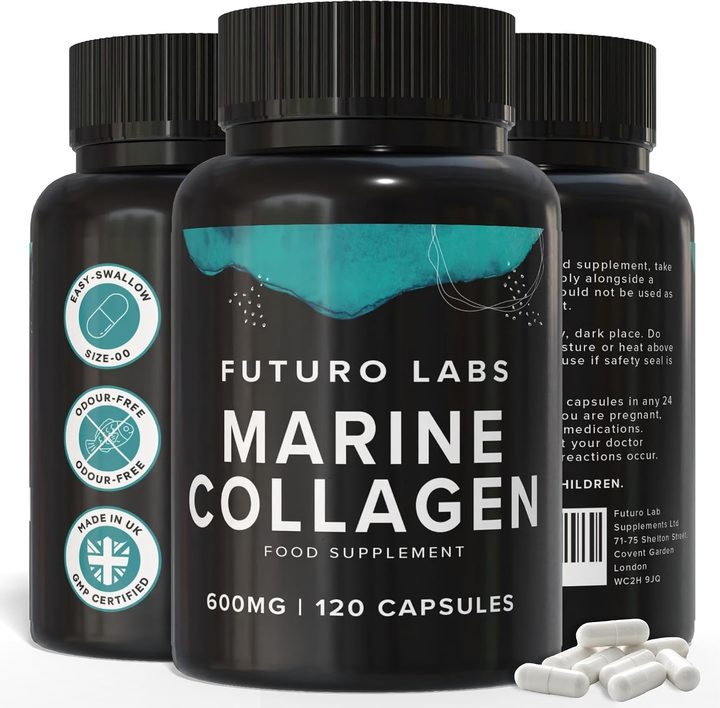
Our brand: the worked example on this page
Futuro Labs Marine Collagen
- 28p a day
- 120 capsules, 2 capsules daily
- Lab tested
- Made in the UK
The one sentence that applies, carried honestly: Futuro Labs Marine Collagen on Amazon UK, 2 capsules, 1200mg hydrolysed type 1 marine collagen with 12mg vitamin C at 15% NRV plus zinc, 120 for £16.99, 28p a day, lab tested and UK made, the vitamin C contributing to normal collagen formation for cartilage and bones and the collagen holding no sentence of its own. Full label breakdown. The verb audit is on the vitamins for strong bones and joints page; the collagen enzymes and their cofactors on the vitamin for tendon repair page; the best vitamin for ligament repair on the vitamin for ligament repair page.
The sentence hunt: what the register says about ligaments, which is nothing, and what it says nearby
Do vitamins help with ligaments and joints is a question the honest page answers by doing the one thing a shelf never does, which is to search the UK nutrition and health claims register for the word ligament and report the result, because the register is the list of every sentence a vitamin or mineral is permitted to say about the body and a search of it is the fastest way to find out what the evidence has actually earned. The result is zero hits. No vitamin and no mineral holds an authorised sentence that names a ligament, in any tense or construction, so a tub that promises ligament support, ligament health or ligament repair has no sentence in the register to print and is either borrowing a nearby sentence from a different tissue or saying something the law does not permit. The nearby sentences are the useful part of the hunt, and there are three for vitamins. Vitamin C contributes to normal collagen formation for the normal function of cartilage and of bones, the register's only cartilage sentence and the one that comes closest to a ligament, since a ligament is mostly type 1 collagen and vitamin C is the cofactor for the prolyl and lysyl hydroxylases that shape every collagen chain the body makes, in ligaments as in cartilage, so the sentence describes a ligament's biochemistry without being allowed to name the tissue. Vitamin D contributes to the maintenance of normal muscle function and of normal bones, and the muscle around a joint is what stabilises it and shares the load its ligaments would otherwise take, so vitamin D's sentence reaches the joint through the muscle and not through the ligament. Vitamin K contributes to the maintenance of normal bones, the two ends a ligament is attached to. The connective tissue sentences, which are the ones a ligament tub most wants, belong to minerals and not to vitamins at all: manganese contributes to the normal formation of connective tissue, and copper contributes to the maintenance of normal connective tissues, copper being the cofactor for lysyl oxidase, the enzyme that cross-links collagen fibres outside the cell and gives a ligament or tendon its rope-like strength. That is the whole of the register's answer, and the hunt has found no verb stronger than contributes to or maintenance of anywhere in it.
What the sentences mean for a ligament, the verb that is missing, and the honest capsule
What the sentences mean for a ligament and a joint is maintenance, and the honest page says why the word is accurate rather than timid. Every one of the sentences above rests on deficiency evidence, what goes wrong in a body short of the nutrient: without vitamin C, collagen cannot be hydroxylated and connective tissue fails, the historical disease scurvy, with joint pain and bleeding among its signs; without vitamin D, muscle weakens and bone softens; without copper, cross-linking fails and connective tissue is weak, a rare deficiency seen in specific conditions. So a reader short of any of them has ligaments and joints that are maintained worse than they should be, and correcting the shortfall restores the maintenance, which is exactly what the sentences say and all they say. What the sentences do not say, and no trial has shown, is that more of any vitamin than the body needs makes a normal ligament stronger or a healing one heal faster, because a ligament is strengthened by progressive load over months, its fibres aligning and thickening to the tension placed on them, and is healed through inflammatory, proliferative and remodelling phases under controlled loading, with the vitamins permitting that work by being present and never performing it. The verb the shelf wants, strengthens or heals, is therefore missing from the register for a reason the biology supplies, and a reader who buys it has bought the barbell's verb in a bottle. The practical reading is short: the cofactors a ligament needs, vitamin C, copper, zinc and iron for the collagen enzymes, vitamin D for the stabilising muscle, are met from an ordinary varied diet, with vitamin D the one to supplement through a UK winter at ten micrograms by guidance, and a reader eating well has pulled every vitamin lever a ligament has before opening a tub. Collagen for completeness: it holds no sentence in the register either, its ligament evidence being one small ankle instability trial and a synthesis marker study, so the honest capsule pairs collagen with vitamin C in order to carry the one sentence that applies, vitamin C's, and says so. The worked example does exactly that: two capsules, 1200mg hydrolysed type 1 marine collagen with 12mg vitamin C plus zinc, 120 for £16.99 at 28p a day, lab tested and UK made, the vitamin C contributing to normal collagen formation for the normal function of cartilage and bones at 15% of its reference value, the zinc to normal protein synthesis, and the collagen stated as holding no sentence of its own. Do vitamins help with ligaments and joints: as cofactors with maintenance sentences, none of which names a ligament, met from food, while the strengthening belongs to load and the healing to the phases.
| The nutrient | The register's sentence | How it reaches a ligament or joint | The verb |
|---|---|---|---|
| Any vitamin or mineral | No sentence names a ligament | Zero hits | None |
| Vitamin C | Contributes to normal collagen formation for the normal function of cartilage and bones | Cofactor for the hydroxylases shaping every collagen chain, ligaments included | Contributes to |
| Vitamin D | Maintenance of normal muscle function and normal bones | Through the muscle that stabilises the joint | Maintenance of |
| Vitamin K | Maintenance of normal bones | The two ends a ligament attaches to | Maintenance of |
| Manganese | Normal formation of connective tissue | A mineral, not a vitamin | Contributes to |
| Copper | Maintenance of normal connective tissues | Cofactor for lysyl oxidase, the cross-linking enzyme | Maintenance of |
| Collagen | No sentence | One small ankle instability trial; a synthesis marker study | None |
| Load and the healing phases | Not in the register | Progressive load strengthens; controlled loading heals through phases | Strengthens; heals |
| The worked exampleOurs | Vitamin C's sentence at 15% NRV | Two capsules, 1200mg marine collagen with 12mg vitamin C plus zinc, 28p a day | The one line that applies |
What to check on the label
- Search for the word ligament: no vitamin holds it.
- Read vitamin C's cartilage sentence as the nearest: the collagen cofactor.
- Credit manganese and copper for connective tissue: minerals, not vitamins.
- Keep every verb at maintenance: strengthens is the barbell's.
- Eat the cofactors; supplement vitamin D in winter: then lift.
Our brand
The worked example: Futuro Labs Marine Collagen
Futuro Labs Marine Collagen: 2 capsules daily, 1200mg hydrolysed type 1 marine collagen with 12mg vitamin C and 1.5mg zinc (15% NRV each), 120 capsules for £16.99, 60 days at 28p a day, lab-tested, UK GMP made. Slim veggie-shell capsules, odour free. Fish derived: pescatarian, not vegetarian or vegan.
- Collagen per serving
- 1200mg hydrolysed type 1 marine (fish)
- Co-factors
- vitamin C 12mg (15% NRV), zinc 1.5mg (15% NRV)
- Serving
- 2 capsules a day
- Bottle
- 120 capsules, 60 days
- Price
- £16.99 (28p a day)
- Capsule
- slim size 00, veggie shell, odour free
Questions people also ask
Which vitamin is best for ligaments?
None holds a ligament sentence in the UK register; the nearest is vitamin C, which contributes to normal collagen formation for the normal function of cartilage and bones and is the cofactor for the enzymes that shape every collagen chain, ligaments included, a maintenance role met from fruit and vegetables rather than a strengthening one.
Do any supplements hold a connective tissue claim?
Two minerals do: manganese contributes to the normal formation of connective tissue and copper to the maintenance of normal connective tissues, copper being the cofactor for the enzyme that cross-links collagen fibres in ligaments and tendons, both met from nuts, seeds, whole grains and shellfish in an ordinary diet, and neither a treatment.
Does vitamin D help joints?
Through the muscle and the bone: vitamin D contributes to the maintenance of normal muscle function and normal bones, the muscle around a joint stabilising it and sharing the load its ligaments would take, with deficiency common through a UK winter and corrected at ten micrograms a day by guidance, and no joint or ligament sentence of its own.
Can vitamins strengthen ligaments?
No vitamin holds a strengthening sentence and no trial shows one: ligaments are strengthened by progressive load over months as their fibres align and thicken to the tension placed on them, and vitamins permit that adaptation by being present, which is what the register's maintenance sentences describe and all they describe.
Why does a collagen capsule mention cartilage if collagen has no claim?
Because the sentence is vitamin C's: vitamin C contributes to normal collagen formation for the normal function of cartilage and bones is an authorised claim, so a collagen capsule containing vitamin C may print it about the vitamin C, while collagen itself holds no sentence for cartilage, ligaments, joints or anything else.
Sources
- Retained Regulation (EC) No 1924/2006 on nutrition and health claims made on foods, and the Great Britain nutrition and health claims register. https://www.gov.uk/government/publications/great-britain-nutrition-and-health-claims-nhc-register
- The vitamin C deficiency literature: severe deficiency impairs collagen synthesis and produces connective tissue failure, the historical disease scurvy, essentially absent on ordinary modern diets. PubMed record
- The collagen biosynthesis literature: procollagen chains are hydroxylated by prolyl and lysyl hydroxylases that require vitamin C and iron as cofactors, glycosylated, assembled and secreted, then cross-linked outside the cell by lysyl oxidase, a copper-dependent enzyme, with zinc-dependent enzymes remodelling the matrix, so the cofactors of collagen synthesis are vitamin C, iron, copper and zinc, each with a register sentence for connective tissue or collagen formation. PubMed record
- The GB claims register, vitamin D entries: vitamin D contributes to normal bones, teeth, muscle function, immune function and calcium absorption, with UK guidance suggesting 10 micrograms daily in autumn and winter. https://www.gov.uk/government/publications/great-britain-nutrition-and-health-claims-nhc-register