Ghost Fitness/Collagen/What should you check on a collagen label?
What should you check on a collagen label?
The short answer
Walk the label in reading order: source and count on the front, then flip for the ingredients order, the dose per serving, vitamin C and zinc at 15% NRV, the fish allergen line, the warning and the batch date.
- The front, ten secondssource named, capsule or serving count, no borrowed promises
- The ingredients lineorder tracks quantity: collagen first or walk away
- The paneldose per serving at true scale; cofactors with NRV percentages
- The small printallergen emphasis, the warning, batch and best-before, an address
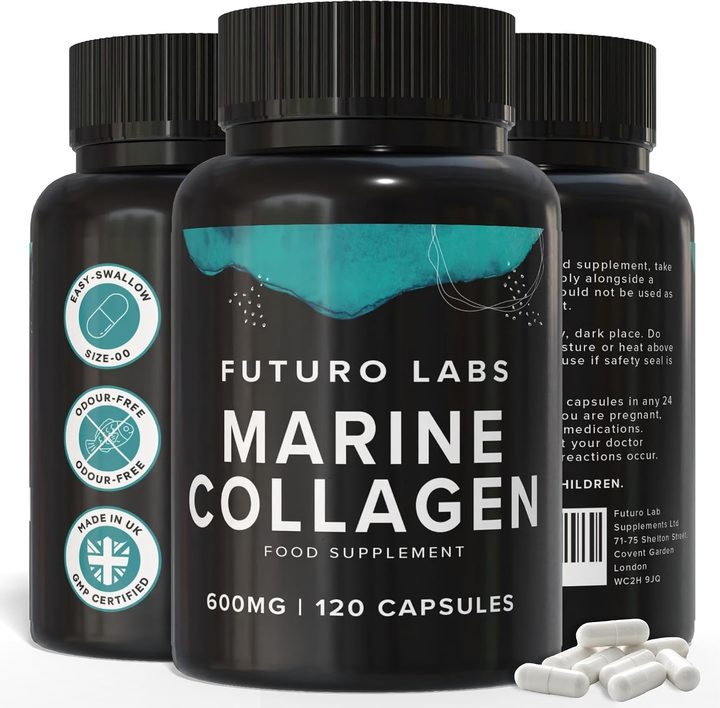
Our brand: the worked example on this page
Futuro Labs Marine Collagen
- 28p a day
- 120 capsules, 2 capsules daily
- Lab tested
- Made in the UK
A label built to pass its own tour: Futuro Labs Marine Collagen on Amazon UK, 1200mg hydrolysed type 1 marine stated per two-capsule serving, vitamin C and zinc at 15% NRV, fish declared, warning printed, £16.99 for 60 days at 28p. Full label breakdown. The consolidated buying card is on the ten-point card page; the testing hierarchy on the third-party page.
The front and the flip: stops one to three of the sixty-second walk
Do this as a physical tour, because a label is geography and the checks live at fixed addresses, so walk it in reading order and the whole audit takes a minute. Stop one, the front panel, ten seconds: the source should be named in the product's own title, marine or bovine, the naming rule's free quality signal, the capsule or serving count should be legible for the pence division later, and the front should be scanned once for trespass, repair, rebuild, anti-ageing and clinical-results vocabulary all being register violations that end the tour early. Stop two, the flip, and the single most informative line on any tub, the ingredients list: UK labels order contents broadly by descending quantity, so collagen sitting first tells you the tub is what it claims, collagen lurking mid-list behind bulking agents, sweeteners or maltodextrin tells you it is a garnish product, the ingredient-order forensics that expose token dosing in five seconds, with the line's length itself a reading, one-item powders and shell-plus-fill capsules at one end, tablet excipient casts and gummy confectionery lists at the other. Stop three, still on the ingredients line, the shell check: capsule products name their shell material here, gelatine meaning an animal wrapper with its own species and certification questions, vegetal cellulose or HPMC meaning the plant-derived alternative, two words that matter to more diets than ever read them.
The panel, the small print, and the off-label stop that completes the tour
Stop four, the nutrition or supplement panel, the tour's arithmetic centre: the collagen dose stated per serving at its true scale, gram-honest capsules like the worked example's 1200mg or gram-scale powders, with any product implying protocol research at a two-capsule dose failing the scale-honesty test on the spot; and beneath it the cofactor lines, vitamin C and zinc listed with their NRV percentages, 15% being the threshold at which the label's only lawful sentences activate, their absence meaning a tub that may claim nothing at all per the purity paradox. Stop five, the allergen line: fish emphasised in bold or capitals on every marine product by law, its absence on a collagen tub reading as bovine or porcine by elimination, and the line doubling as the species disclosure most fronts decline to make. Stop six, the small print band: the standing warning, not for pregnant or nursing women or those on medication without advice, present and legible; the batch number and best-before date, the two-clocks page's anchors; and a UK business name and address, the accountability line a faceless pouch cannot fake. Stop seven, the only stop off the label itself: the certificate question, whether per-batch heavy-metals and microbiology documents exist on request, ranked by the paper-trail page's hierarchy, sixty seconds of walking having now covered everything the consolidated buying card checks, at the addresses where each item actually lives, which is the entire trick of reading labels quickly: not knowing more, just knowing where.
| The stop | What lives there | Pass and fail |
|---|---|---|
| The front | Source named, count legible, no trespass vocabulary | Repair and anti-ageing wording ends the tour |
| The ingredients order | Quantity ranking: collagen first | Mid-list collagen is a garnish product |
| The shell line | Gelatine, or vegetal cellulose | Two words that settle diet and certification questions |
| The panel | Dose per serving; C and zinc with NRV percentages | 15% NRV activates the only lawful sentences |
| The small print | Fish emphasis, the warning, batch, date, address | Absences here are accountability failures |
| Off the label | Per-batch certificates on request | The paper-trail hierarchy ranks the answers |
The verdict, completed in one lap
What should you check on a collagen label: walk it, front for the named source and clean vocabulary, ingredients line for the order that exposes garnish products and the shell material that settles diets, panel for the true-scale dose and the cofactors at 15% NRV, small print for the fish emphasis, the warning, the batch, the date and an address, and one step off the label for the certificates, sixty seconds covering every check because each lives at a fixed stop. The worked example is built to be walked: Futuro Labs Marine Collagen, source in the title, collagen first on the line, vegetal shells named, 1200mg per two-capsule serving with 12mg vitamin C and 1.5mg zinc at 15% NRV, fish emphasised, warning printed, batch-dated, UK made and addressed, £16.99 for 60 days at 28p a day, a tub that finishes its own tour with time to spare.
What to check on the label
- Walk it in reading order: every check has a fixed address.
- The ingredients order is the tell: collagen first, or garnish.
- The panel does the arithmetic: true-scale dose, cofactors at 15% NRV.
- The small print carries the law: allergen, warning, batch, address.
- One stop sits off the label: certificates on request, ranked by paper.
Our brand
The worked example: Futuro Labs Marine Collagen
Futuro Labs Marine Collagen: 2 capsules daily, 1200mg hydrolysed type 1 marine collagen with 12mg vitamin C and 1.5mg zinc (15% NRV each), 120 capsules for £16.99, 60 days at 28p a day, lab-tested, UK GMP made. Slim veggie-shell capsules, odour free. Fish derived: pescatarian, not vegetarian or vegan.
- Collagen per serving
- 1200mg hydrolysed type 1 marine (fish)
- Co-factors
- vitamin C 12mg (15% NRV), zinc 1.5mg (15% NRV)
- Serving
- 2 capsules a day
- Bottle
- 120 capsules, 60 days
- Price
- £16.99 (28p a day)
- Capsule
- slim size 00, veggie shell, odour free
Questions people also ask
What is the single most important thing on a collagen label?
The ingredients order: UK labels rank contents by quantity, so collagen first means a genuine product and collagen mid-list behind bulkers means a garnish, exposed in five seconds.
What dose should the panel show?
A true-scale statement: gram-honest capsules around 1-to-2g per serving or gram-scale powders, with protocol imagery on a two-capsule dose failing the scale-honesty test instantly.
Why do the vitamin C and zinc lines matter so much?
They carry the label's only lawful sentences, activating at 15% NRV: a collagen-only product may claim nothing at all, so the cofactor lines are where legality lives.
What does the allergen line tell me beyond allergy?
The species: fish must be emphasised on marine products, so its absence reads as bovine or porcine by elimination, the disclosure most front labels decline to make.
What can't the label itself show?
The certificates: per-batch heavy-metals and microbiology documents exist off-label, on request, and the paper-trail hierarchy ranks a batch-matched certificate from a named lab above every printed slogan.
Sources
- Futuro Labs Marine Collagen listing and label: 1200mg hydrolysed type 1 marine collagen per 2-capsule serving with 12mg vitamin C and 1.5mg zinc at 15% NRV each, 120 capsules, independently lab tested, UK made. https://www.amazon.co.uk/dp/B0C2J7N364
- EFSA Panel on Dietetic Products, Nutrition and Allergies. Scientific Opinion on the substantiation of health claims related to magnesium. EFSA Journal 2010;8(10):1807. https://efsa.onlinelibrary.wiley.com/doi/10.2903/j.efsa.2010.1807
- EFSA Panel on Dietetic Products. Scientific opinion on Dietary Reference Values for fats: Adequate Intake of 250mg combined EPA and DHA per day for adults. EFSA Journal 2010;8(3):1461. https://www.efsa.europa.eu/en/efsajournal/pub/1461
- The collagen peptide trial literature: randomised controlled studies of hydrolysed collagen supplementation across skin, joint and connective-tissue outcomes, typically at 2.5g to 15g daily, with small effects and frequent industry funding. PubMed record