Ghost Fitness/Collagen/Does collagen help with joints weightlifting?
Does collagen help with joints weightlifting?
The short answer
A lifter's joint has three complaints; collagen answers two, as research. Tendon pain: the pre-loading protocol, ~15g with vitamin C, beside rehab. Ache after volume: ~10g over months, small trials. Locking, swelling or giving way: assessment, not a supplement.
- Complaint one, tendon pain~15g gelatin or hydrolysed collagen with ~50mg vitamin C an hour before loading: a synthesis marker doubled, one small trial
- Complaint two, the ache after volume~10g a day for 12 to 24 weeks: modest joint comfort gains in small, mostly industry-funded trials
- Complaint three, the mechanical jointlocking, swelling, giving way: no supplement; an assessment
- The registerno collagen claim; vitamin C's collagen formation sentence for cartilage and skin
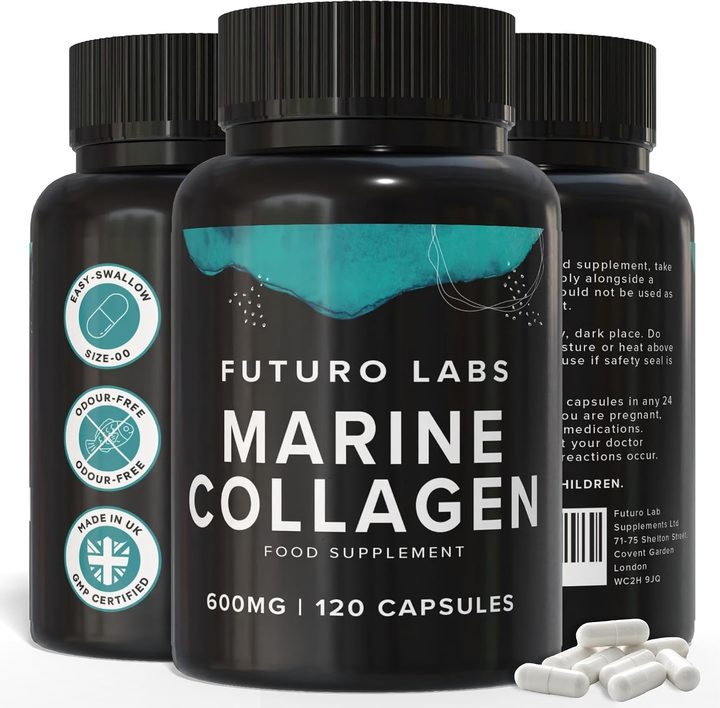
Our brand: the worked example on this page
Futuro Labs Marine Collagen
- 28p a day
- 120 capsules, 2 capsules daily
- Lab tested
- Made in the UK
On its true terms: Futuro Labs Marine Collagen on Amazon UK, 2 capsules, 1200mg hydrolysed type 1 marine collagen with 12mg vitamin C at 15% NRV plus zinc, 120 for £16.99, 28p a day, lab tested and UK made, below both research doses and taken for vitamin C's collagen formation sentence, which names cartilage. Full label breakdown. The doses by tissue are on the how much for tendons and joints page; the full ranking of joint supplements for lifters on the supplements for lifters' joints page.
Sort the complaint first: tendon pain and the ache after volume, and what the trials gave each
Does collagen help with joints when weightlifting cannot be answered until the joint complaint is sorted, because a lifter who says my knees hurt is describing one of three different things and collagen's evidence belongs to two of them, so this page sorts first and answers second. Complaint one is tendon pain, and most lifters' joint pain is this: pain just below the kneecap at the patellar tendon on squats and jumps, above the heel at the Achilles on running and calf work, at the outer elbow on curls and pulls, at the front of the shoulder on presses, with the warm-up pattern, pain at the start that eases as the tissue warms and returns afterwards, and a spot that a fingertip finds. For this complaint collagen has its one timed protocol: a small crossover trial gave around fifteen grams of gelatin with roughly 50mg of vitamin C an hour before six minutes of skipping and roughly doubled a blood marker of collagen synthesis against placebo, with engineered ligaments grown in the participants' serum coming out stiffer and richer in collagen, and that trial became the pre-loading protocol some physiotherapists use beside a tendon loading programme, the collagen with vitamin C an hour before the rehabilitation session. It is a marker result in a handful of people with no injury outcome trial and no claim, and it sits beside the loading programme that does the actual work, never instead of the assessment that should precede it. Complaint two is the dull ache after volume: knees that complain the evening after a heavy leg day, shoulders that ache after a pressing block, hips after high-rep squats, a diffuse discomfort in the joint rather than a fingertip spot on a tendon, worse with volume and better with a lighter week. For this complaint collagen has the joint comfort trials: around ten grams of hydrolysed collagen a day for twelve to twenty-four weeks reduced activity-related joint discomfort in a small number of trials, one of them in athletes with exercise-related knee pain, effects that were real on the trial scales, modest in size and produced by trials mostly funded by the peptide's manufacturer, so the entry is research at ten grams over months with load management and a lighter week as the interventions that carry more weight. Two complaints, two research entries at two different doses and two different clocks, an hour before for the tendon and months for the ache.
The third complaint, the register, and the worked example on its true terms
Complaint three is the mechanical complaint, and the honest page separates it because a supplement has no business near it: a knee that locks or catches, a joint that swells after sessions or stays swollen, a shoulder that gives way or feels unstable overhead, a knee that will not fully straighten, a hip that clicks with pain, a joint that is hot. These are structures, cartilage, meniscus, labrum, ligament, or an inflamed joint, and the answer is an assessment, physiotherapist or doctor, since a supplement taken for a locking knee is time lost while the structure worsens, and the collagen aisle should say so on every joint page. A related note for the reader with an osteoarthritis diagnosis rather than a lifter's ache: the undenatured type II collagen studied for joints, UC-II at around forty milligrams a day, is a different molecule from hydrolysed type 1 collagen working by a different proposed mechanism, so a lifter buying hydrolysed collagen for complaint two is not buying the type II research and vice versa. Then the register, which governs what the tub may say about any of this: collagen holds no authorised claim for joints, cartilage or anything else, so a tub promising joint support is either borrowing a line from an ingredient beside it or saying something the register does not permit, and the one relevant borrowed line is vitamin C's, that vitamin C contributes to normal collagen formation for the normal function of cartilage, which is why the honest capsule pairs collagen with vitamin C and lets vitamin C carry the word cartilage. The worked example is stated on its true terms, which for this page means below both research doses: two capsules, 1200mg hydrolysed type 1 marine collagen with 12mg vitamin C plus zinc, 120 for £16.99 at 28p a day, lab tested and UK made, a dose below the ten grams of the joint comfort trials and well below the fifteen of the tendon protocol, so a lifter with complaint one buys the fifteen grams as gelatin or powder for the hour before rehabilitation, a lifter with complaint two who wants to test the trials buys ten grams of powder for months and measures, and the capsule is the habit and the vitamin C line, bought by the lifter who wants those and not the grams. Does collagen help with joints when weightlifting: for tendon pain, as a timed adjunct to the loading programme, as research; for the ache after volume, at ten grams over months, as research; for locking, swelling or giving way, not at all, and an assessment does.
| The complaint | How it presents | Collagen's evidence | What carries the weight |
|---|---|---|---|
| Tendon pain | Warm-up pattern; a fingertip spot below the kneecap, above the heel, outer elbow, front of shoulder | ~15g with ~50mg vitamin C an hour before loading; a synthesis marker doubled in one small trial; no claim | The loading programme, physiotherapist-led, after an assessment |
| The ache after volume | Diffuse joint discomfort the evening after heavy volume | ~10g a day for 12 to 24 weeks; modest gains in small, mostly industry-funded trials; no claim | Load management, a lighter week |
| The mechanical joint | Locking, catching, swelling, giving way, will not straighten, hot | None | An assessment; not a supplement |
| The type II note | An osteoarthritis diagnosis rather than a lifter's ache | UC-II ~40mg a day, a different molecule and mechanism | The clinician managing it |
| The register | What the tub may say | No collagen claim | Vitamin C's collagen formation sentence, naming cartilage |
| The worked exampleOurs | Two capsules, 1200mg type 1 marine collagen with 12mg vitamin C plus zinc, 28p a day | Below both research doses | The habit and the vitamin C line |
What to check on the label
- Sort the complaint: tendon, ache or mechanical.
- Tendon: the protocol beside rehab: ~15g with vitamin C an hour before.
- Ache: ten grams over months, as research: and a lighter week.
- Mechanical: an assessment: no supplement applies.
- Buy the capsule for what it is: the vitamin C line, below both doses.
Our brand
The worked example: Futuro Labs Marine Collagen
Futuro Labs Marine Collagen: 2 capsules daily, 1200mg hydrolysed type 1 marine collagen with 12mg vitamin C and 1.5mg zinc (15% NRV each), 120 capsules for £16.99, 60 days at 28p a day, lab-tested, UK GMP made. Slim veggie-shell capsules, odour free. Fish derived: pescatarian, not vegetarian or vegan.
- Collagen per serving
- 1200mg hydrolysed type 1 marine (fish)
- Co-factors
- vitamin C 12mg (15% NRV), zinc 1.5mg (15% NRV)
- Serving
- 2 capsules a day
- Bottle
- 120 capsules, 60 days
- Price
- £16.99 (28p a day)
- Capsule
- slim size 00, veggie shell, odour free
Questions people also ask
Does collagen help knee pain from squatting?
Depends which knee pain: pain at the patellar tendon just below the kneecap with the warm-up pattern is tendon pain, where around fifteen grams of collagen with vitamin C an hour before a loading session is research beside the rehabilitation, while a diffuse ache after volume is the ten-grams-over-months joint comfort research, and a knee that locks, swells or will not straighten is an assessment.
How much collagen should a weightlifter take for joints?
By complaint: around fifteen grams of gelatin or hydrolysed collagen with roughly 50mg of vitamin C an hour before a tendon loading session for tendon pain, around ten grams a day for twelve to twenty-four weeks to test the joint comfort trials for the ache after volume, and a two-capsule 1200mg dose is below both and bought for the habit and the vitamin C line.
Is collagen or glucosamine better for lifters' joints?
Neither holds a claim and both are research tier: hydrolysed collagen has the tendon marker protocol and the ten-gram joint comfort trials, glucosamine has decades of mixed osteoarthritis trials with small or null effects, and for a lifter the interventions with the most evidence are load management, a lighter week and an assessment for anything mechanical.
Can collagen fix a clicking or locking knee?
No: locking, catching, swelling or giving way point to a structure, cartilage, meniscus or ligament, or to an inflamed joint, and the answer is an assessment by a physiotherapist or doctor, since a supplement taken for a mechanical complaint is time lost while the structure worsens.
Why does a collagen label mention cartilage if collagen has no claim?
Because the sentence belongs to vitamin C: vitamin C contributes to normal collagen formation for the normal function of cartilage is an authorised claim for vitamin C, so a collagen capsule that includes vitamin C may print it about the vitamin C, and collagen itself holds no authorised claim for joints or anything else.
Sources
- The gelatin and vitamin C pre-exercise research (Shaw, Baar and colleagues): 15g gelatin with vitamin C taken about an hour before loading, studied for markers of collagen synthesis, the protocol behind the tendon-training conversation. PubMed record
- The collagen peptide trial literature: randomised controlled studies of hydrolysed collagen supplementation across skin, joint and connective-tissue outcomes, typically at 2.5g to 15g daily, with small effects and frequent industry funding. PubMed record
- The undenatured type II collagen (UC-II) trial literature: small randomised studies at 40mg daily against joint outcomes, a different mechanism and dose to hydrolysed collagen, with no authorised claim resulting. PubMed record
- Retained Regulation (EC) No 1924/2006 on nutrition and health claims made on foods, and the Great Britain nutrition and health claims register. https://www.gov.uk/government/publications/great-britain-nutrition-and-health-claims-nhc-register