Ghost Fitness/Collagen/Does collagen help with weight loss?
Does collagen help with weight loss?
The short answer
The marketing chain, link by link: collagen is protein, true by nitrogen; protein is satiating, true for complete protein; so collagen is satiating, weaker, since it is less satiating per gram than whey; so collagen helps weight loss, untested, no trial existing; so it shrinks belly fat, unsupported. The chain breaks at link three, and no weight claim exists. Weight loss is the deficit's, complete protein's and training's.
- Link one and twocollagen is protein by nitrogen: true; complete protein aids satiety and a deficit: true
- Link threeso collagen is satiating: weaker; less satiating per gram than whey; no muscle-sparing for want of leucine
- Link fourso collagen helps weight loss: untested; no randomised trial on weight or fat; no claim
- Link fiveso it shrinks belly fat: unsupported; a deficit, cardio, sleep and less alcohol move belly fat
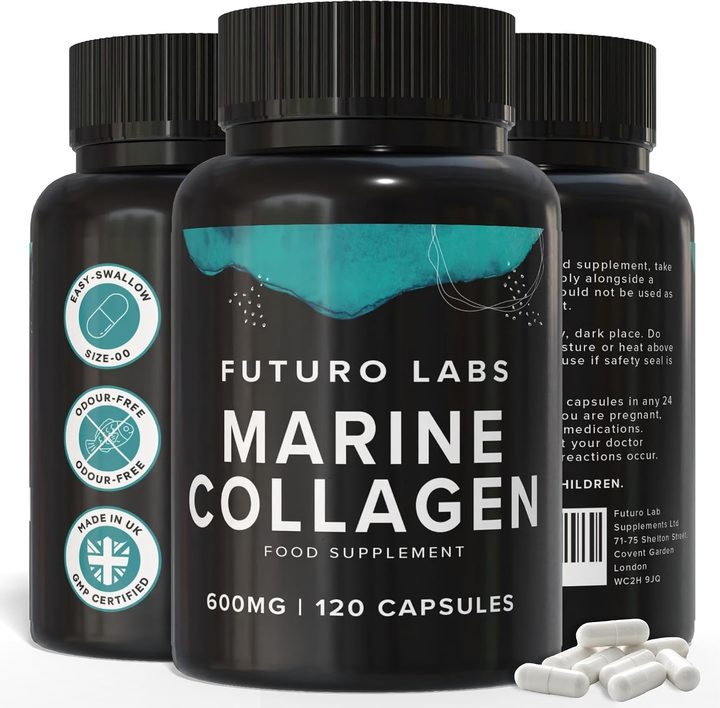
Our brand: the worked example on this page
Futuro Labs Marine Collagen
- 28p a day
- 120 capsules, 2 capsules daily
- Lab tested
- Made in the UK
A capsule dose under five calories, for a reason that is not the scale: Futuro Labs Marine Collagen on Amazon UK, 2 capsules, 1200mg hydrolysed type 1 marine collagen with 12mg vitamin C at 15% NRV plus zinc, 120 for £16.99, 28p a day. Full label breakdown. The swap test for a cut is on the swap test page; collagen against whey for weight loss on the whey comparison.
The first three links of the chain, and where it weakens
Does collagen help with weight loss, and do collagen peptides or marine collagen help, are questions sold as a chain of five links, each sounding like the last, and the honest page checks the chain link by link, because it holds for two links and breaks at the third. Link one: collagen is protein. True, by nitrogen. A nutrition label measures protein by nitrogen, hydrolysed collagen is protein and contains nitrogen, and a ten-gram scoop is ten grams of protein on the label and in an app, the counting pages' first fact, so the tub that says twenty grams of protein a serving is not lying. Link two: protein is satiating and helps a deficit. True, for complete protein. The satiety and energy-restriction research supports a higher protein intake on a deficit for two reasons, fullness per calorie and the preservation of lean mass, and the research was done on whey, casein, meat, eggs and dairy, the protein and energy-restriction literature's guard rails, so a lifter on a cut eats protein at the higher end of the range from those sources and loses fat rather than muscle. Link three: so collagen is satiating and helps a deficit. Weaker, and this is where the chain gives. Collagen is not the protein the satiety research used, it is an incomplete protein with almost no leucine and no tryptophan scoring near zero on quality scales, the protein quality literature's verdict, and in the comparisons that exist it is less satiating per gram than whey and does not spare muscle on a deficit for want of the leucine that switches synthesis on, the whey-versus-collagen trials' finding, so link three inherits link two's truth only partly, a scoop of collagen giving a small fullness that a complete protein would give more of for the same forty calories.
The last two links, untested and unsupported, what does the losing, the reason to take collagen anyway, and the chain filed
Link four: so collagen helps weight loss. Untested, which is a different thing from false and an important one. There is no randomised trial of collagen peptides, marine or bovine, on body weight, fat mass or waist circumference, the collagen trial literature covering skin, joints and connective tissue and not the scale, so the fourth link rests on nothing, and the register agrees, no authorised weight, fat or body composition claim existing for collagen or for any supplement outside the meal-replacement rules, the claims register's position, which is why a tub that says weight management on the front has said something the register does not allow. Link five: so collagen shrinks belly fat. Unsupported, and the variant that asks it deserves the plain answer: belly fat is subcutaneous fat under the skin, moved by a sustained calorie deficit, and visceral fat around the organs, moved by a deficit, aerobic exercise, sleep and less alcohol, with the day-to-day bloat of gut contents moved by fibre, lactose, sweeteners and salt, the flat stomach literature's four layers, and no supplement, collagen included, moves any of the four, so the fifth link is the fourth link wearing a smaller target. What does the losing is the three things the trials do find: a sustained deficit at around half a kilo a week, complete protein at the higher end of the range to keep the muscle, and the training that tells the body which tissue to keep, with sleep making the other three tolerable, and a reader who wants the scale to move has those levers and no others. The reason to take collagen anyway, if a reader has one, is its own and not the scale's: the tendon protocol at around 15g with vitamin C an hour before loading, or the skin trials' 2.5 to 10 grams for the loose-skin question a large cut raises, with modest expectation, taken on top of a complete diet and counted on the label at forty calories a scoop, the swap test's rule that it never replaces the whey or the meal's protein and may replace a worse snack. The chain filed: protein by nitrogen true, complete protein and satiety true, collagen's satiety weaker, collagen and weight loss untested with no claim, collagen and belly fat unsupported, and weight loss belonging to the deficit, complete protein and training, with the worked example being a capsule dose under five calories for a reason that is not the scale, £16.99 for 120 at 28p a day.
| The link | The claim | The verdict |
|---|---|---|
| One | Collagen is protein | True by nitrogen: a label and an app count it |
| Two | Protein is satiating and helps a deficit | True for complete protein: whey, meat, eggs, dairy |
| Three | So collagen is satiating | Weaker: less satiating per gram than whey; no muscle-sparing for want of leucine |
| Four | So collagen helps weight loss | Untested: no trial on weight or fat; no authorised claim |
| Five | So collagen shrinks belly fat | Unsupported: a deficit, cardio, sleep and less alcohol move belly fat; no supplement does |
| What does the losing | A sustained deficit, complete protein at the higher end, training, sleep | Collagen for its own reason, counted at forty calories a scoop |
The verdict, a chain that holds for two links and breaks at the third, with nothing tested and nothing claimed at the end of it
Does collagen help with weight loss: the marketing chain holds for two links and breaks at the third, collagen being protein by nitrogen and complete protein aiding satiety and a deficit in the research, but collagen being less satiating per gram than whey and unable to spare muscle for want of leucine, so that the fourth link, that collagen helps weight loss, is untested by any trial of collagen peptides or marine collagen on weight or fat and unsupported by any authorised claim, and the fifth, that collagen shrinks belly fat, is unsupported since belly fat is moved by a sustained deficit, aerobic exercise, sleep and less alcohol and by no supplement, leaving weight loss to the deficit, complete protein at the higher end and training, and collagen to its own reason at forty calories a scoop. A capsule dose under five calories for a reason that is not the scale: Futuro Labs Marine Collagen, 1200mg type 1 with 12mg vitamin C, 120 for £16.99 at 28p a day.
What to check on the label
- Grant links one and two: protein by nitrogen; complete protein and satiety.
- Weaken link three: collagen is less satiating and spares no muscle.
- Read link four as untested: no trial, no claim.
- Read link five as unsupported: belly fat has four levers and none is a capsule.
- Lose the weight with the deficit, complete protein and training: collagen for its own reason.
Our brand
The worked example: Futuro Labs Marine Collagen
Futuro Labs Marine Collagen: 2 capsules daily, 1200mg hydrolysed type 1 marine collagen with 12mg vitamin C and 1.5mg zinc (15% NRV each), 120 capsules for £16.99, 60 days at 28p a day, lab-tested, UK GMP made. Slim veggie-shell capsules, odour free. Fish derived: pescatarian, not vegetarian or vegan.
- Collagen per serving
- 1200mg hydrolysed type 1 marine (fish)
- Co-factors
- vitamin C 12mg (15% NRV), zinc 1.5mg (15% NRV)
- Serving
- 2 capsules a day
- Bottle
- 120 capsules, 60 days
- Price
- £16.99 (28p a day)
- Capsule
- slim size 00, veggie shell, odour free
Questions people also ask
Do collagen peptides help with weight loss?
No trial says so: there is no randomised trial of collagen peptides, marine or bovine, on body weight, fat mass or waist circumference, no authorised weight or fat claim exists for collagen, and the satiety research behind the idea was done on complete protein, which collagen is less satiating than per gram and unlike in sparing muscle on a deficit.
Does marine collagen help you lose weight?
No more than bovine, and neither has a weight trial: marine collagen is type 1 from fish skin and bovine is types 1 and 3 from hide, the source changing dietary status and not efficacy, and no collagen of any source has been tested on weight or fat or holds a weight claim, so the marine label adds a price and not a mechanism.
Does taking collagen help with belly fat?
No: belly fat is subcutaneous fat moved by a sustained calorie deficit and visceral fat moved by a deficit, aerobic exercise, sleep and less alcohol, with the day-to-day bloat moved by fibre, lactose, sweeteners and salt, and no supplement, collagen included, moves any of the four layers.
Is collagen more filling than whey?
Less, per gram, in the comparisons that exist: the satiety research supporting a higher protein intake on a deficit was done on complete proteins such as whey, and collagen, an incomplete protein with almost no leucine, gives a smaller fullness for the same forty calories a scoop and does not spare muscle on a cut.
Should I take collagen while losing weight?
For its own reason only: a physiotherapist's tendon protocol at around 15g with vitamin C an hour before loading, or the skin trials' 2.5 to 10 grams for the loose-skin question a large cut raises, counted at forty calories a scoop, never in place of the whey or a meal's protein, and with the weight loss done by the deficit, complete protein and training.
Sources
- The protein and energy-restriction literature: higher protein intakes during a calorie deficit are studied for satiety and for preserving lean mass, the guard rails of sensible weight management. PubMed record
- The protein quality literature: scoring systems such as PDCAAS and DIAAS rate proteins by essential amino acid completeness and digestibility, with collagen scoring at or near zero for lacking tryptophan. PubMed record
- The direct comparison trials: randomised studies pitting whey against collagen peptides on muscle protein synthesis and lean mass, in which whey consistently produced the greater anabolic response. PubMed record
- The body composition and abdominal appearance literature: a flat abdomen depends on subcutaneous fat, which a sustained calorie deficit reduces, visceral fat, which a deficit, aerobic exercise, sleep and less alcohol reduce, abdominal distension from gut contents, gas and fluid, which diet and timing govern, and the tone and posture of the abdominal wall, which training governs, with no supplement shown to reduce any of the four. PubMed record