Ghost Fitness/Collagen/Does collagen help with loose skin during weight loss?
Does collagen help with loose skin during weight loss?
The short answer
Loose skin is decided by amount lost, speed, age, sun, smoking, genetics and time; collagen is not among them, its trials being in weight-stable people. Lose 0.5 to 1% a week, lift, eat 1.6g protein per kilo, wait a year.
- The variablesamount lost, speed of loss, age, sun history, smoking, genetics, time: collagen not among them
- What the trials wereweight-stable people, mostly women 35 to 65, instrument changes at 2.5 to 10g over 8 to 12 weeks; nothing during a loss
- The levers during a cuthalf to one percent of body weight a week; resistance training; protein 1.6 to 2.2g per kilo; daily sunscreen
- After the lossretraction continues a year or more; significant excess is a doctor's, managed surgically
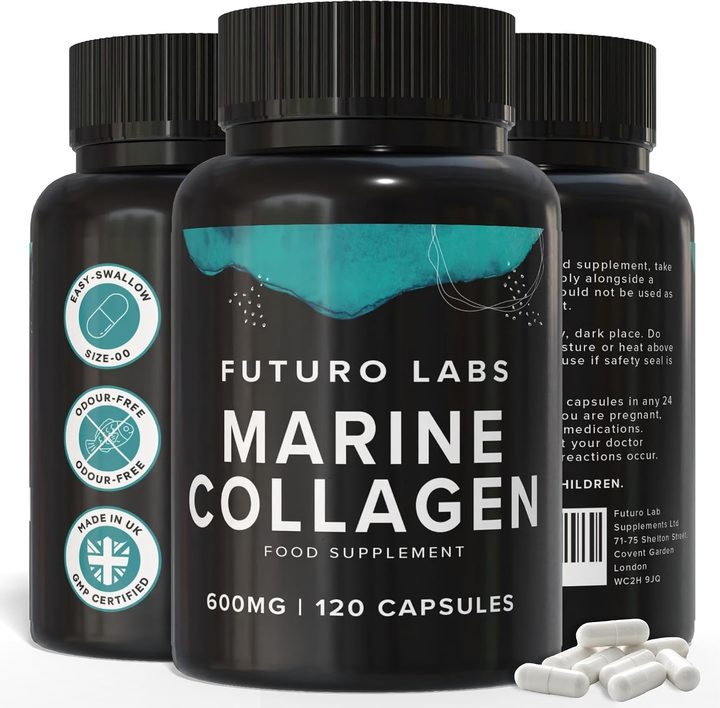
Our brand: the worked example on this page
Futuro Labs Marine Collagen
- 28p a day
- 120 capsules, 2 capsules daily
- Lab tested
- Made in the UK
On its true terms, off the list of variables: Futuro Labs Marine Collagen on Amazon UK, 2 capsules, 1200mg hydrolysed type 1 marine collagen with 12mg vitamin C at 15% NRV plus zinc, 120 for £16.99, 28p a day, lab tested and UK made, around five calories inside a cut, below the skin trial doses and taken for vitamin C's collagen formation sentence for skin. Full label breakdown. The tightening timetable is on the tighten skin page; the skin tightening and weight loss pairing on the skin tightening weight loss page; belly fat on the belly fat page.
The variables that decide loose skin, ranked, and the one that is not on the list
Does collagen help with loose skin during weight loss is a question with a word in the middle that changes everything, during, because the skin's response to weight loss is decided by a known list of variables while the loss is happening and in the year after, and the honest page ranks that list before looking for collagen on it. Variable one is the amount lost: skin stretched over fifty kilograms of fat for a decade has been remodelled to that size, its elastic fibres lengthened and in part broken, and it does not retract the way skin stretched over ten kilograms for a year does, so the amount is the largest single predictor of whether loose skin remains and the one a reader cannot change except by having lost less. Variable two is the speed: the rate of weight loss literature finds that slower loss, around half to one percent of body weight a week, with adequate protein and resistance training, preserves more lean mass than rapid loss, so that the volume under the skin falls as fat and not as muscle, and gives the skin's slow remodelling a chance to follow the shrinking volume rather than being left behind by it, the reason bariatric patients who lose fastest carry the most excess skin. Variable three is age, since dermal collagen and elastin decline across the decades and sharply after menopause, and a thirty-year-old's skin recoils from a loss that a sixty-year-old's cannot. Variables four and five are sun history and smoking, both of which degrade the elastic fibres skin needs to recoil, ultraviolet light by photoageing and smoking by impairing the whole of connective tissue repair, so a reader who has done both has skin with less spring before the loss begins. Variable six is genetics, the unchangeable difference between two people of the same age losing the same weight at the same speed and ending with different skin. Variable seven is time, since skin retraction continues for a year or more after weight stabilises, and a judgement made at three months is made too early. Collagen is not on the list, and the reason is not prejudice but the trials: the oral collagen skin trials were run in weight-stable people, mostly women aged thirty-five to sixty-five, and measured elasticity and hydration by instrument at 2.5 to 10 grams a day over eight to twelve weeks, a few percent in small, mostly industry-funded trials, and no trial has given collagen to people during a weight loss and measured skin laxity, retraction or excess, so collagen's evidence does not touch the question and the variables above are the whole of the answer.
The levers a lifter controls during a cut, what comes after, and the worked example inside a deficit
Of the seven variables, a lifter in the middle of a cut controls three and can influence a fourth, and those are the honest levers. The speed: set the deficit so that the loss runs at around half to one percent of body weight a week, half a kilo to a kilo for most lifters, which is slower than most cuts are run and is the rate at which lean mass is best preserved and the skin has the most time to follow. The volume beneath: keep resistance training through the cut, heavy enough to hold or build muscle, because skin follows what it covers and muscle filling the space the fat leaves is the only tightening a lifter can do from the inside, over the months of the cut and the year after. The protein: eat 1.6 to 2.2 grams per kilo from complete sources, the higher end in a deficit, since that is what preserves the muscle doing the filling and what the skin's own remodelling is built from, and a collagen scoop does not count toward it, lacking tryptophan and most of whey's leucine, so a reader who booked collagen as protein during a cut has under-eaten the protein that matters. The sun: daily sunscreen protects the elastic fibres the skin will need to recoil, a lever with a slow clock and the largest long-term effect on how skin looks. Then the variables a lifter cannot move: the amount is already decided, age and genetics are given, and smoking is a decision that has, in this case, one right answer. After the loss comes time, and the honest page is plain about how much: skin retraction continues for a year or more after weight stabilises, so the judgement of what is loose skin and what is skin still retracting is made at twelve to eighteen months and not at three, and where significant excess remains after that, an apron of skin at the abdomen, folds at the arms or thighs, it is a medical matter managed surgically, a conversation with a doctor about referral, and not a nutritional one, since no nutrient, collagen included, removes skin that has lost its elastic fibres. Collagen inside all this is stated on its true terms: a supplement whose skin trials do not touch the question, whose few percent by instrument in weight-stable people is not evidence about retraction, and which holds no skin or weight claim, so a reader who takes it during a cut takes it for the vitamin C line and the habit and books its calories, around five in a capsule dose and thirty-six in a dessertspoon, inside the deficit. The worked example is that supplement: two capsules, 1200mg hydrolysed type 1 marine collagen with 12mg vitamin C plus zinc, 120 for £16.99 at 28p a day, lab tested and UK made, around five calories, below the skin trial doses, taken for vitamin C's collagen formation sentence for skin and off the list of variables that decide the outcome. Does collagen help with loose skin during weight loss: the list that decides it is the amount, the speed, age, sun, smoking, genetics and time, collagen is not on it, and the levers a lifter holds are the rate, the barbell, the protein and the sunscreen.
| The variable | What it does | Can a lifter move it | The lever |
|---|---|---|---|
| The amount lost | The largest predictor; skin remodelled to a size does not fully return | No, once lost | Not applicable |
| The speed of loss | Slower loss preserves lean mass and gives skin time to follow | Yes | Half to one percent of body weight a week |
| The volume beneath | Skin follows what it covers | Yes | Resistance training through the cut |
| Protein | Preserves the muscle that fills the space; feeds remodelling | Yes | 1.6 to 2.2g per kilo, complete; collagen does not count |
| Age | Dermal collagen and elastin decline; sharply after menopause | No | Not applicable |
| Sun history and smoking | Degrade the elastic fibres skin needs to recoil | Sun going forward; smoking, yes | Daily sunscreen; stopping |
| Genetics | The unchangeable difference | No | Not applicable |
| Time | Retraction continues a year or more after stabilising | Only by waiting | Judge at twelve to eighteen months; a doctor for significant excess |
| CollagenOurs | Skin trials in weight-stable people; nothing during a loss | Not on the list | Two capsules, 1200mg marine collagen with 12mg vitamin C, 28p a day, ~5 calories, on its true terms |
What to check on the label
- Slow the loss: half to one percent of body weight a week.
- Lift through the cut: muscle fills the space fat leaves.
- Eat 1.6 to 2.2g protein per kilo: complete, and collagen does not count.
- Wear sunscreen daily: protect the elastic fibres.
- Wait a year before judging: then a doctor for significant excess.
Our brand
The worked example: Futuro Labs Marine Collagen
Futuro Labs Marine Collagen: 2 capsules daily, 1200mg hydrolysed type 1 marine collagen with 12mg vitamin C and 1.5mg zinc (15% NRV each), 120 capsules for £16.99, 60 days at 28p a day, lab-tested, UK GMP made. Slim veggie-shell capsules, odour free. Fish derived: pescatarian, not vegetarian or vegan.
- Collagen per serving
- 1200mg hydrolysed type 1 marine (fish)
- Co-factors
- vitamin C 12mg (15% NRV), zinc 1.5mg (15% NRV)
- Serving
- 2 capsules a day
- Bottle
- 120 capsules, 60 days
- Price
- £16.99 (28p a day)
- Capsule
- slim size 00, veggie shell, odour free
Questions people also ask
Will collagen prevent loose skin while I lose weight?
No trial says so: the oral collagen skin trials were run in weight-stable people and measured elasticity and hydration by instrument at 2.5 to 10 grams over eight to twelve weeks, and nothing has given collagen during a weight loss and measured skin laxity, so the variables that decide loose skin, the amount, the speed, age, sun, smoking, genetics and time, do not include it.
How fast should I lose weight to avoid loose skin?
Around half to one percent of body weight a week, half a kilo to a kilo for most lifters, with protein at 1.6 to 2.2 grams per kilo and resistance training, the rate at which lean mass is best preserved and the skin's slow remodelling has the most time to follow the shrinking volume.
Does lifting weights help loose skin during weight loss?
Yes, from the inside: skin follows the volume it covers, so resistance training heavy enough to hold or build muscle through the cut fills the space the fat leaves, the only tightening a lifter can do themselves, over the months of the cut and the year of retraction after.
How long does skin take to tighten after weight loss?
A year or more: skin retraction continues well after weight stabilises, so the judgement of what is loose skin and what is skin still retracting is made at twelve to eighteen months rather than at three, and significant excess remaining after that is a medical matter managed surgically, a doctor's conversation and not a nutritional one.
Should I take collagen during a cut at all?
On its true terms if you like: it does not touch the loose skin question, holds no skin or weight claim, adds around five calories in a capsule dose or thirty-six in a dessertspoon to be booked inside the deficit, does not count toward the protein target, and is taken for the vitamin C line and the habit rather than for the skin the cut is worrying about.
Sources
- The rate of weight loss and body composition literature: slower loss of around half to one percent of body weight a week with adequate protein and resistance training preserves more lean mass than rapid loss, and skin retraction after weight loss depends on the amount lost, the speed, age, sun exposure, smoking and genetics, continuing for a year or more after weight stabilises before any surgical assessment. PubMed record
- The literature on excess skin after major weight loss: skin adaptation varies with age, amount and speed of loss and genetics, and significant excess skin is managed medically and surgically, not nutritionally. PubMed record
- The collagen and skin trial literature: randomised studies of oral collagen peptides on skin elasticity and hydration, mostly small, short and industry funded, with no authorised claim resulting. PubMed record
- The protein and energy-restriction literature: higher protein intakes during a calorie deficit are studied for satiety and for preserving lean mass, the guard rails of sensible weight management. PubMed record