Ghost Fitness/Collagen/Does collagen help with skin?
Does collagen help with skin?
The short answer
By the instruments: the trials measured elasticity by cutometer suction, hydration by corneometer capacitance, dermal density by ultrasound and wrinkle depth by profilometry, and found changes of a few percent after eight to twelve weeks at 2.5 to 10 grams a day in small, mostly industry-funded trials, changes a device detects and a mirror generally does not. No claim for collagen; vitamin C holds the skin sentence.
- The instrumentscutometer for elasticity; corneometer for hydration; high-frequency ultrasound for dermal density; profilometry for wrinkle depth
- The dose and duration2.5 to 10 grams a day, bovine or marine, for eight to twelve weeks
- The resultchanges of a few percent against placebo; small, short, mostly industry-funded trials; detectable by a device, not generally in a mirror
- The registerno claim for collagen; vitamin C for normal collagen formation for skin; zinc, biotin and vitamin A for the maintenance of normal skin
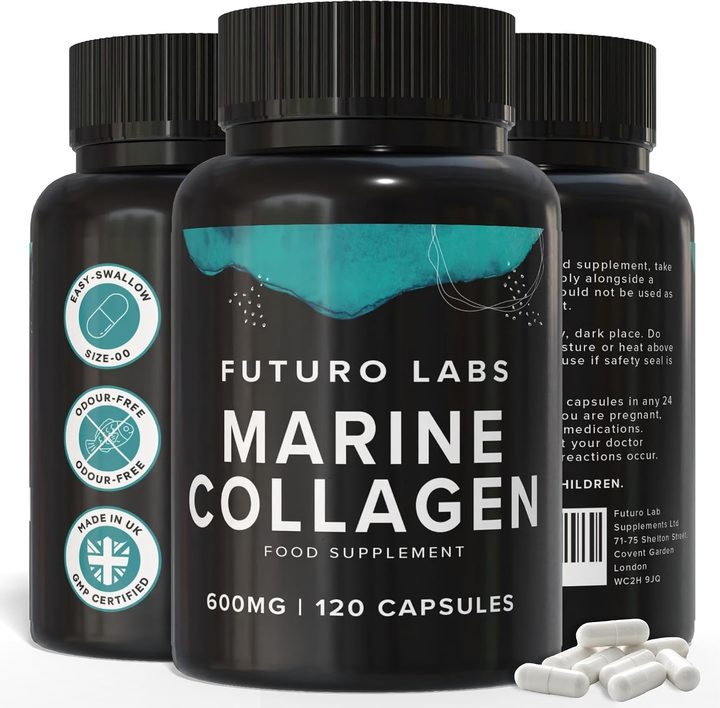
Our brand: the worked example on this page
Futuro Labs Marine Collagen
- 28p a day
- 120 capsules, 2 capsules daily
- Lab tested
- Made in the UK
The skin sentences the register allows, vitamin C and zinc, built into a capsule with a modest collagen dose: Futuro Labs Marine Collagen on Amazon UK, 2 capsules, 1200mg hydrolysed type 1 marine collagen with 12mg vitamin C and 1.5mg zinc at 15% NRV each, 120 for £16.99, 28p a day. Full label breakdown. The best time for skin is on the skin timing page; marine against bovine for skin on the marine or bovine skin page.
The instruments, what each measures and what a few percent on each means
Does collagen help with skin is a question the trials answered with instruments rather than opinions, and the honest page decodes the instruments, because a few percent on a device and a difference in a mirror are different things and the shelf reports the first as the second. The cutometer: a small suction probe placed on the cheek or the forearm pulls the skin up for a few seconds and releases it, and a sensor times how far the skin lifts and how fully and quickly it recoils, the ratio being elasticity, so a cutometer change of a few percent means the skin recoiled a few percent more completely under suction, the skin measurement literature's method, a real change in a property of the dermis and not a change anyone sees. The corneometer: a probe that reads the electrical capacitance of the outer layer, which rises with water content, so a corneometer change means the outer layer held a few percent more water, a hydration change of the kind a moisturiser also produces and that the skin turnover of around four weeks in the outer layer can carry, the skin biology literature's clock. High-frequency ultrasound: a scan of the dermis that reports its density and thickness, so a density change of a few percent means the dermis scattered the ultrasound a few percent more, read as more or denser collagen, the deepest and slowest of the four measures. Profilometry: a silicone cast of the crow's feet or a three-dimensional scan, with the wrinkle depth measured in fractions of a millimetre, so a wrinkle change of a few percent is a fraction of a fraction of a millimetre. Across the trials of oral hydrolysed collagen, bovine and marine, at 2.5 to 10 grams a day for eight to twelve weeks, those instruments reported changes of a few percent against placebo, the skin trial literature's findings, in studies that are small, short and mostly funded by the companies that sell the collagen, with no authorised claim resulting.
What the instruments mean for a reader, the marine question, the register's skin sentences, and the instruments filed
What the instruments mean for a reader is the distinction the page exists for: a few percent on a cutometer is a change the device detects and a mirror generally does not, the measurement literature's own caution, so a reader who takes collagen for skin should expect the trials' result, a small instrument-measured improvement in elasticity and hydration after two or three months, and should not expect to see it, which is not a reason not to take it and is a reason to hold a modest expectation and to keep the price modest too. The marine question, since the variants ask about marine collagen benefits for skin: marine collagen is type 1 from fish skin and scales and bovine is types 1 and 3 from hide, the trials used both, the type profile changed no outcome, and the instruments reported the same few percent for either, so marine's benefit for skin is bovine's benefit for skin at a marine price, and the source is chosen for diet, pescatarian or not, rather than for the cutometer. The register's skin sentences are where a reader finds what a label may say: collagen holds no authorised claim for skin or anything else, and the sentences a skin product may print belong to vitamin C, which contributes to normal collagen formation for the normal function of skin, and to zinc, biotin, niacin, riboflavin and vitamin A, which contribute to the maintenance of normal skin, the claims register's allocation, so a capsule with vitamin C and zinc prints two true maintenance sentences and a plain collagen powder prints none, and a reader who wants a printable reason reads the vitamin line. What helps skin more than a few percent, for the reader who came for that: sun protection, not smoking, sleep, and less sugar, the glycation literature's finding that chronically high sugar cross-links and stiffens dermal collagen, the levers with an effect a mirror does see over years. The instruments filed: cutometer, corneometer, ultrasound and profilometry as the four, a few percent after eight to twelve weeks at 2.5 to 10 grams as the result, small and industry funded as the caveat, detectable and not visible as the meaning, marine the same as bovine, and vitamin C and the skin vitamins as the printable sentences, with the worked example being those sentences built into a capsule with a modest collagen dose, £16.99 for 120 at 28p a day.
| The instrument | What it measures | What a few percent means |
|---|---|---|
| Cutometer | Elasticity: how fully and quickly skin recoils after suction | A few percent more recoil; a dermal property, not a visible change |
| Corneometer | Hydration: the outer layer's capacitance | A few percent more water in the outer layer; a moisturiser's kind of change |
| High-frequency ultrasound | Dermal density and thickness | A few percent more scatter, read as denser collagen; the slowest measure |
| Profilometry | Wrinkle depth from a cast or a scan | A fraction of a fraction of a millimetre |
| The trials | 2.5 to 10 grams a day, bovine or marine, eight to twelve weeks; small, mostly industry funded | A few percent against placebo; no claim |
| The register | Vitamin C for normal collagen formation; zinc, biotin, vitamin A for normal skin | The printable sentences; collagen holds none |
The verdict, a few percent on four instruments after two or three months, real to a device and modest to a mirror, with the printable sentences belonging to the vitamins
Does collagen help with skin: by the instruments the trials used, a little, elasticity by cutometer suction, hydration by corneometer capacitance, dermal density by high-frequency ultrasound and wrinkle depth by profilometry all reporting changes of a few percent against placebo after eight to twelve weeks at 2.5 to 10 grams of hydrolysed collagen a day, bovine or marine alike, in small, short, mostly industry-funded trials, changes a device detects and a mirror generally does not, with no authorised claim for collagen and the skin sentences a label may print belonging to vitamin C for normal collagen formation and to zinc, biotin and vitamin A for the maintenance of normal skin, and with sun protection, not smoking, sleep and less sugar being the levers a mirror does see over years. The printable skin sentences built into a capsule with a modest collagen dose: Futuro Labs Marine Collagen, 1200mg type 1 with 12mg vitamin C and 1.5mg zinc, 120 for £16.99 at 28p a day.
What to check on the label
- Read the instruments: cutometer, corneometer, ultrasound, profilometry.
- Read a few percent as a device's change: not a mirror's.
- Read the trials' caveats: small, short, industry funded, no claim.
- Buy marine for diet, not for skin: the same few percent as bovine.
- Read the vitamin line for the printable sentences: vitamin C, zinc, biotin, vitamin A.
Our brand
The worked example: Futuro Labs Marine Collagen
Futuro Labs Marine Collagen: 2 capsules daily, 1200mg hydrolysed type 1 marine collagen with 12mg vitamin C and 1.5mg zinc (15% NRV each), 120 capsules for £16.99, 60 days at 28p a day, lab-tested, UK GMP made. Slim veggie-shell capsules, odour free. Fish derived: pescatarian, not vegetarian or vegan.
- Collagen per serving
- 1200mg hydrolysed type 1 marine (fish)
- Co-factors
- vitamin C 12mg (15% NRV), zinc 1.5mg (15% NRV)
- Serving
- 2 capsules a day
- Bottle
- 120 capsules, 60 days
- Price
- £16.99 (28p a day)
- Capsule
- slim size 00, veggie shell, odour free
Questions people also ask
What are the benefits of collagen for skin?
Small instrument-measured ones: after eight to twelve weeks at 2.5 to 10 grams a day, the trials report elasticity by cutometer, hydration by corneometer, dermal density by ultrasound and wrinkle depth by profilometry improving by a few percent against placebo, in small, short, mostly industry-funded studies with no authorised claim resulting, changes a device detects and a mirror generally does not.
Is marine collagen better for skin than bovine?
No: marine is type 1 from fish skin and bovine is types 1 and 3 from hide, the trials used both, the type profile changed no outcome and the instruments reported the same few percent for either, so marine's skin benefit is bovine's at a marine price and the source is chosen for diet rather than for the cutometer.
How long does collagen take to improve skin?
The trials measured at eight to twelve weeks of daily 2.5 to 10 grams, the outer layer turning over in around four weeks and the dermis far more slowly, so a reader holds a modest expectation over two or three months and no expectation over days, and should expect the trials' result rather than a visible one.
Does collagen reduce wrinkles?
By a fraction of a fraction of a millimetre on profilometry in some trials, a cast or scan of the crow's feet showing a few percent less depth after eight to twelve weeks, which a device measures and a mirror does not, with sun protection, not smoking and less sugar being the levers a mirror does see over years.
Can a collagen supplement claim to help skin?
Not the collagen: no authorised skin claim exists for collagen in the UK, and the sentences a skin product may print belong to vitamin C, which contributes to normal collagen formation for the normal function of skin, and to zinc, biotin, niacin, riboflavin and vitamin A, which contribute to the maintenance of normal skin, so a capsule with vitamin C and zinc prints two true maintenance sentences and a plain powder prints none.
Sources
- The skin measurement literature: oral collagen trials assess skin by instrument, elasticity by cutometer suction, hydration by corneometer capacitance, dermal density by high-frequency ultrasound and wrinkle depth by profilometry, changes of a few percent that are detectable by the device and generally below what a person sees in a mirror. PubMed record
- The collagen and skin trial literature: randomised studies of oral collagen peptides on skin elasticity and hydration, mostly small, short and industry funded, with no authorised claim resulting. PubMed record
- The skin biology literature: the epidermis turns over in around four weeks while dermal collagen, the layer supplements target, turns over far more slowly, so the oral collagen skin trials measured elasticity and hydration after eight to twelve weeks of daily intake with no timing of day specified, consistency across weeks rather than time of day being the variable the trials controlled. PubMed record
- Retained Regulation (EC) No 1924/2006 on nutrition and health claims made on foods, and the Great Britain nutrition and health claims register. https://www.gov.uk/government/publications/great-britain-nutrition-and-health-claims-nhc-register