Ghost Fitness/Collagen/Is collagen good for runners?
Is collagen good for runners?
The short answer
For a runner's tendons, as an adjunct: the pre-loading protocol fits a run, and the one clinical trial, 2.5g beside calf strengthening in Achilles tendinopathy, measured return to running. Not for cartilage, which running does not wear, nor as protein.
- The two tendonsAchilles and patellar: ~15g with vitamin C an hour before a run as the loading session; a synthesis marker doubled
- The one runner-relevant trial~20 people, Achilles tendinopathy, 2.5g daily beside calf strengthening for six months: better function score and earlier return to running than placebo
- The cartilagerecreational running is not associated with more knee osteoarthritis; no supplement rebuilds cartilage
- The protein budgetrunners under-eat protein; 1.6g per kilo or more in heavy training; collagen counts toward none of it
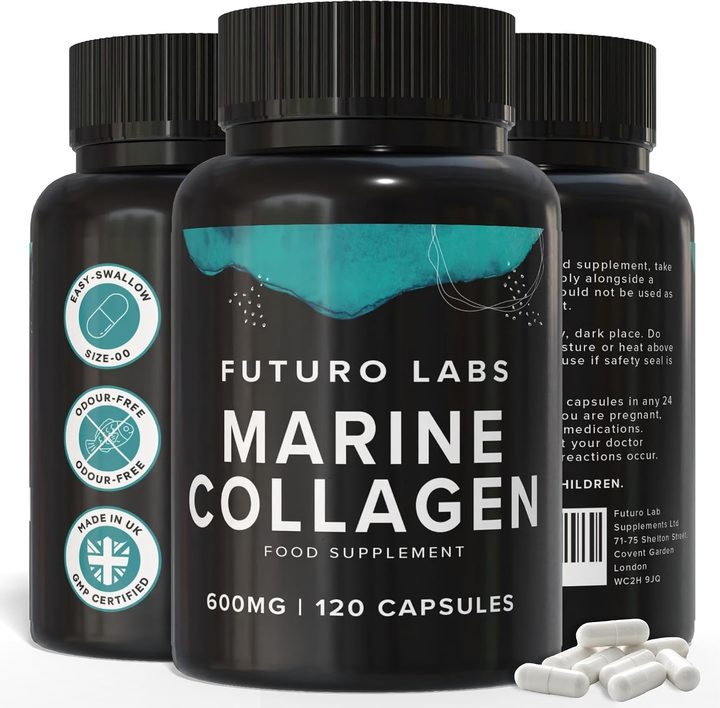
Our brand: the worked example on this page
Futuro Labs Marine Collagen
- 28p a day
- 120 capsules, 2 capsules daily
- Lab tested
- Made in the UK
The runner's adjunct at the clinical trial's dose: Futuro Labs Marine Collagen on Amazon UK, 2 capsules, 1200mg hydrolysed type 1 marine collagen with 12mg vitamin C at 15% NRV plus zinc, 120 for £16.99, 28p a day, lab tested and UK made, near the Achilles trial's 2.5g and below the protocol's 15g, taken beside the calf programme for vitamin C's collagen formation sentence. Full label breakdown. The best collagen for running is on the collagen for running page; the tendon rehabilitation ladder on the helps tendons heal faster page; the two repairs on the collagen for tendon repair page.
The two tendons, and the one trial that measured return to running
Is collagen good for runners is a question with a better answer than most collagen questions, because the one collagen trial with a clinical outcome measured something a runner cares about, return to running, and the honest page starts there after naming the two tissues a runner is actually asking about. A runner's tendon load is unusual: every stride stores energy in the Achilles and patellar tendons and returns it, thousands of times an hour, so those two tendons take the sport's repeated energy-storage load and are where runners' tendinopathies live, the Achilles above all, with the warm-up pattern, pain at the start of a run that eases as the tendon warms and returns afterwards and the next morning, and a tender spot a few centimetres above the heel. For those tendons collagen has its two pieces of evidence, and both fit a runner better than a lifter. The pre-loading protocol, around fifteen grams of gelatin or hydrolysed collagen with roughly 50mg of vitamin C an hour before loading, doubled a blood marker of collagen synthesis in a small trial whose loading was six minutes of skipping, an energy-storage load very like running, and a run is itself a loading session, so a runner using the protocol takes the dose an hour before the run or the calf session without rearranging anything, which is the natural fit the best-collagen-for-running page describes. The clinical trial is the stronger piece for a runner because of what it measured: around twenty people with chronic Achilles tendinopathy were randomised to 2.5 grams a day of specific collagen peptides or placebo, both groups doing a six-month calf-strengthening programme, and the collagen group improved more on a validated Achilles function and pain score and returned to running sooner, a result that is small, manufacturer-funded and obtained beside the loading programme that is the established treatment, and that is nonetheless the only collagen trial whose outcome a runner would recognise as their own. So for a runner's tendons collagen is an adjunct with a marker trial and one small outcome trial that measured return to running, taken beside the calf raises and the load progression that do the work, and never instead of them.
The cartilage running does not wear, the protein budget runners under-eat, and the honest verdict
The second tissue a runner asks about is knee cartilage, and the honest news is better than the folklore. Recreational running is not associated with an increased risk of knee osteoarthritis in the cohort studies and meta-analyses, and some analyses find lower rates in recreational runners than in non-runners, the cartilage being mechanosensitive and maintained by the cyclic load of running within tolerance rather than worn by it, with the exceptions being very high competitive mileage and running on a previously injured knee. So a runner's knee cartilage is not being used up by the miles, which removes the main reason runners buy a joint supplement, and the collagen joint trials, at around ten grams a day over twelve to twenty-four weeks, measured joint comfort by questionnaire rather than cartilage by imaging, finding modest gains, so a runner whose knees ache after long runs has the joint comfort research at ten grams as an option, with no cartilage claim and no supplement anywhere having rebuilt cartilage on a scan. The third item is the protein budget, and it is where runners most often go wrong with collagen. Runners under-eat protein more often than lifters, the endurance habit favouring carbohydrate and the sport's lean culture discouraging bulk, while the protein need in heavy training runs at 1.6 grams per kilo or more for muscle repair and adaptation, and a runner who adds a collagen scoop and counts it toward that need has counted protein with no tryptophan and a third of whey's leucine, so the budget is filled with complete protein, dairy, eggs, meat, fish, soya or whey, and collagen is booked separately as the tendon adjunct it is. The runner's real levers sit outside the tub: load progression that does not jump mileage faster than the tendons can adapt, the ten percent rule and its cousins, since tendon adapts over months while fitness adapts in weeks; shoes and surfaces; strength training for the calves and quadriceps, which share the tendons' load; sleep; and a physiotherapist's loading programme when a tendon complains, isometrics first for pain, then heavy slow calf work, then hopping and a return by criteria, which is the programme the Achilles trial's participants were doing while they took their 2.5 grams. The verdict: collagen is good for runners as an adjunct to tendon rehabilitation and tendon loading, by two small pieces of evidence, one of which measured return to running, and it is not good for a runner's cartilage, which running does not wear and no supplement rebuilds, nor as a runner's protein, which it is not. The worked example is the runner's adjunct at the clinical trial's dose: two capsules, 1200mg hydrolysed type 1 marine collagen with 12mg vitamin C plus zinc, 120 for £16.99 at 28p a day, lab tested and UK made, near the Achilles trial's 2.5 grams and below the protocol's fifteen, taken beside the calf programme for vitamin C's collagen formation sentence, while the protocol runner buys fifteen grams of powder for the hour before the run. Is collagen good for runners: for the two tendons, as research with a return-to-running outcome behind it; for everything else in the sport, no.
| The item | The runner's situation | Collagen's evidence | What does the work |
|---|---|---|---|
| The Achilles and patellar tendons | Repeated energy-storage load every stride; where runners' tendinopathies live | ~15g with vitamin C an hour before a run: a synthesis marker doubled; the skipping load resembled running | Load progression, calf and quadriceps strength, a physiotherapist's programme |
| The one runner-relevant trial | Chronic Achilles tendinopathy | ~20 people, 2.5g daily beside calf strengthening for six months: better function and pain score, earlier return to running; manufacturer-funded | The calf programme both groups did |
| The knee cartilage | Recreational running is not associated with more osteoarthritis; some analyses find less | Joint comfort trials at ~10g measured feel, not cartilage; nothing rebuilds cartilage on imaging | Running within tolerance; a lighter week for an ache |
| The protein budget | Runners under-eat protein; 1.6g per kilo or more in heavy training | Collagen counts toward none of it: no tryptophan, a third of whey's leucine | Complete protein: dairy, eggs, meat, fish, soya, whey |
| The runner's levers | Mileage jumps outrun tendon adaptation | None | The ten percent rule, shoes and surfaces, strength, sleep, criteria-based return |
| The worked exampleOurs | A runner's adjunct | Two capsules, 1200mg marine collagen with 12mg vitamin C plus zinc, 28p a day; near the trial's 2.5g, below the protocol's 15g | Beside the calf programme; the vitamin C line |
What to check on the label
- Treat the run as the loading session: the protocol an hour before.
- Know the one trial a runner owns: 2.5g beside calf raises, return to running.
- Stop worrying about cartilage: running does not wear it.
- Fill the protein budget with complete protein: collagen does not count.
- Progress mileage at the tendon's pace: months, not weeks.
Our brand
The worked example: Futuro Labs Marine Collagen
Futuro Labs Marine Collagen: 2 capsules daily, 1200mg hydrolysed type 1 marine collagen with 12mg vitamin C and 1.5mg zinc (15% NRV each), 120 capsules for £16.99, 60 days at 28p a day, lab-tested, UK GMP made. Slim veggie-shell capsules, odour free. Fish derived: pescatarian, not vegetarian or vegan.
- Collagen per serving
- 1200mg hydrolysed type 1 marine (fish)
- Co-factors
- vitamin C 12mg (15% NRV), zinc 1.5mg (15% NRV)
- Serving
- 2 capsules a day
- Bottle
- 120 capsules, 60 days
- Price
- £16.99 (28p a day)
- Capsule
- slim size 00, veggie shell, odour free
Questions people also ask
Does collagen help runners' Achilles tendons?
As an adjunct with the best evidence collagen has anywhere: the pre-loading protocol, around fifteen grams with vitamin C an hour before a run, doubled a collagen synthesis marker in a small trial, and one small six-month trial in Achilles tendinopathy found 2.5 grams a day beside calf strengthening improved function and pain and brought an earlier return to running than placebo, manufacturer-funded and obtained beside the loading that does the work.
Does running wear out knee cartilage, and does collagen help?
Recreational running is not associated with more knee osteoarthritis in the cohort studies, with some analyses finding less, so the miles are not wearing the cartilage, and no supplement rebuilds cartilage on imaging in any case, the collagen joint trials at around ten grams measuring comfort by questionnaire rather than structure.
Should runners take collagen as protein?
No: runners under-eat protein more than lifters, the need in heavy training running at 1.6 grams per kilo or more, and collagen lacks tryptophan and most of whey's leucine, so it counts toward none of it, and the budget is filled with dairy, eggs, meat, fish, soya or whey with collagen booked separately as a tendon adjunct.
When should a runner take collagen?
An hour before the run or the calf session if running the protocol, around fifteen grams with roughly 50mg of vitamin C, since a run is a loading session and the peptides should be in the blood as the load arrives, or daily at 2.5 grams as the Achilles trial did beside its programme, the two approaches never having been compared.
What actually prevents running tendon injuries?
Load progression at the tendon's pace, since tendon adapts over months while fitness adapts in weeks, the ten percent rule and its cousins, calf and quadriceps strength training to share the tendons' load, sensible shoes and surfaces, sleep, and a physiotherapist's programme at the first warm-up-pattern pain rather than after months of running through it.
Sources
- The Achilles tendinopathy collagen trial: a small randomised placebo-controlled trial giving 2.5 grams a day of specific collagen peptides alongside a calf-strengthening programme for six months reported greater improvement in a tendon function and pain score and earlier return to running than the exercise programme with placebo, around twenty participants, manufacturer-funded, the one collagen tendon trial with a clinical outcome, in tendinopathy alongside loading and not in rupture repair. PubMed record
- The gelatin and vitamin C pre-exercise research (Shaw, Baar and colleagues): 15g gelatin with vitamin C taken about an hour before loading, studied for markers of collagen synthesis, the protocol behind the tendon-training conversation. PubMed record
- The running and knee osteoarthritis literature: recreational running is not associated with increased knee osteoarthritis risk, with some analyses finding lower rates than in non-runners. PubMed record
- The protein intake and resistance training literature: meta-analyses support intakes around 1.6g per kilogram of body weight daily for maximising resistance-training gains, with diminishing returns above. PubMed record