Ghost Fitness/Collagen/Is type 1 collagen good for tendons?
Is type 1 collagen good for tendons?
The short answer
Anatomically it is the truest sentence in the aisle: tendons are largely made of type 1 collagen. As a supplement verb it fails: digestion pools every swallowed gram, no tendon claim exists, and loading, not eating, builds tendon.
- The anatomical readingtendon is overwhelmingly type 1: the truest sentence on the shelf
- The supplement readingeating it routes nowhere: pooled digestion, zero tendon claims
- The register's deptheven vitamin C's tissue list omits tendon entirely
- What builds tendonprogressive loading: the adaptation eating never triggers
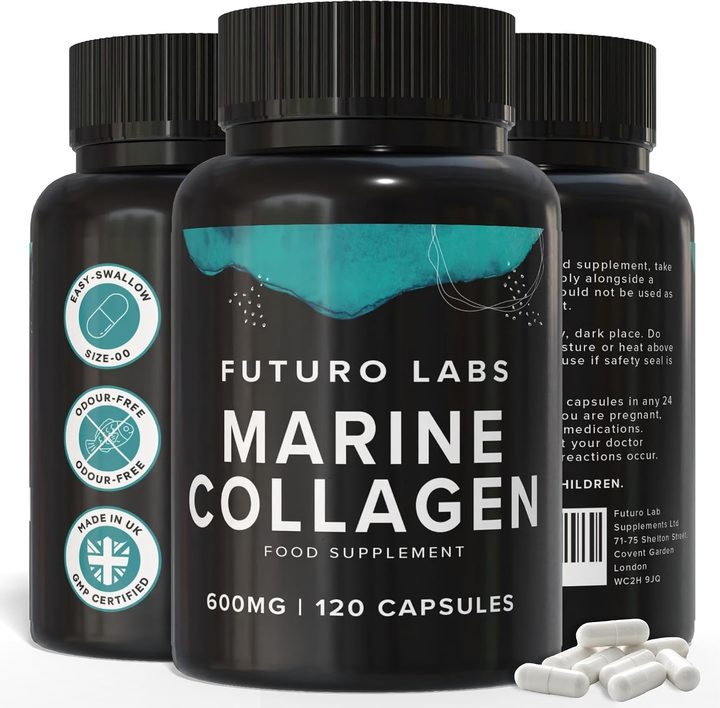
Our brand: the worked example on this page
Futuro Labs Marine Collagen
- 28p a day
- 120 capsules, 2 capsules daily
- Lab tested
- Made in the UK
The habit lane beside the loading that matters: Futuro Labs Marine Collagen on Amazon UK, 1200mg hydrolysed type 1 with vitamin C at 15% NRV, £16.99 for 60 days at 28p, silent on tendons as the law is. Full label breakdown. The protocol's receipts are on the tendon sources page; the two-item basket on the gelatin-and-C page.
The anatomical reading, given its full due: the aisle's one perfectly true sentence
Give the question's first reading everything it deserves, because it is, without irony, the most accurate sentence the collagen aisle possesses: tendon is type 1 collagen, not merely containing it but consisting of it, the dry mass of a healthy tendon running overwhelmingly type 1, dense parallel fibrils wound into the rope architecture the tissue pages describe, cross-linked for tensile strength, the very material whose biography the difference card calls the structural workhorse, and if good for is read as an anatomy exam answer, is type 1 collagen good for tendons, then yes at full marks, type 1 is what tendons are good with, the tissue being close to a monument built from the stuff. This site spends most of its tendon pages demolishing marketing, so let the record show the marketing's opening premise is not the lie: the connection between type 1 and tendon is real, intimate and structural, which is precisely what makes the aisle's next move so instructive, because the entire commercial edifice rests on converting that true anatomical is into a supplemental does, tendons are type 1, this tub is type 1, therefore this tub is for tendons, a syllogism whose first premise this paragraph has just certified and whose conclusion the next paragraph must, as everywhere on this site, take apart.
The supplement reading failed on three grounds, and the true sentence returned to its honest work
Ground one, mechanism: a swallowed type 1 peptide does not travel to tendon, digestion pooling every gram into the same unaddressed amino supply it makes of a chicken breast, glycine and proline arriving without postcodes, the routing myth's standing demolition applying with full force to the aisle's truest premise, truth about anatomy conferring nothing on a capsule. Ground two, the register, and here the silence is at its deepest anywhere in this section: no collagen holds a tendon claim, and tendon is absent even from vitamin C's authorised tissue list, cartilage, bones, skin, vessels, gums and teeth all named while the tissue this page is about goes unmentioned, the regulator declining to license even the cofactor sentence for it, an omission the tendon pages read as the register agreeing with the physiotherapist. Ground three, the biology of adaptation: tendon strengthens through mechanotransduction, its cells reading progressive load and remodelling the collagen they themselves synthesise from the general amino supply, a months-long conversation conducted in the language of training, not diet, which is why every rehab pathway is built from loading and why no eating pattern appears in one as a builder. What remains for the true sentence is its honest work: it explains why researchers reached for gelatine when designing the pre-loading protocol, roughly 15g with vitamin C an hour before tendon-loading sessions, the stop-two lane whose receipts, evidence grade and physio framing live on its own pages, and it decorates, harmlessly, the label of any hydrolysate, since nearly all of them are type 1 anyway, table stakes rather than a tendon ticket. Good for tendons, then: as anatomy, the truest yes on the shelf; as a purchase reason, no, with the loading programme holding the verb the aisle keeps trying to sell.
| The reading | The verdict | Why |
|---|---|---|
| Anatomy: tendons are type 1 | True at full marks | The tissue consists of it: the aisle's truest premise |
| Supplement: eating type 1 serves tendons | Fails | Pooled digestion: no peptide carries a postcode |
| The register's word | Silence, at its deepest | No collagen claim, and even C's list omits tendon |
| What builds tendon | Progressive loading | Mechanotransduction: adaptation speaks training, not diet |
| The sentence's honest work | Explains the protocol's design | 15g with C before loading: stop-two, physio-framed |
| On a label | Table stakes | Nearly every hydrolysate is type 1 anyway |
The verdict, with the truth kept and the sale declined
Is type 1 collagen good for tendons: read as anatomy, it is the truest sentence in the aisle, tendon being very nearly a monument built of type 1, and read as a supplement verb it fails on all three standing grounds, pooled digestion, a register silent even at the cofactor level, and an adaptation biology that answers only to loading, leaving the true sentence its honest jobs, explaining the protocol's design and decorating labels that were all type 1 regardless. The worked example keeps the same discipline: Futuro Labs Marine Collagen, 1200mg hydrolysed type 1 with 12mg vitamin C at 15% NRV, lab tested, UK made, £16.99 for 60 days at 28p a day, a type 1 tub that says nothing about tendons, in agreement with the law, the physio, and the anatomy textbook that started all this.
What to check on the label
- The anatomy is true: tendon consists overwhelmingly of type 1.
- The supplement verb fails: pooled digestion carries no postcodes.
- The register is silent: even C's tissue list omits tendon.
- Loading builds tendon: mechanotransduction speaks training.
- The protocol is the true sentence's job: 15g with C, physio-framed.
Our brand
The worked example: Futuro Labs Marine Collagen
Futuro Labs Marine Collagen: 2 capsules daily, 1200mg hydrolysed type 1 marine collagen with 12mg vitamin C and 1.5mg zinc (15% NRV each), 120 capsules for £16.99, 60 days at 28p a day, lab-tested, UK GMP made. Slim veggie-shell capsules, odour free. Fish derived: pescatarian, not vegetarian or vegan.
- Collagen per serving
- 1200mg hydrolysed type 1 marine (fish)
- Co-factors
- vitamin C 12mg (15% NRV), zinc 1.5mg (15% NRV)
- Serving
- 2 capsules a day
- Bottle
- 120 capsules, 60 days
- Price
- £16.99 (28p a day)
- Capsule
- slim size 00, veggie shell, odour free
Questions people also ask
Are tendons really made of type 1 collagen?
Very nearly entirely: the dry mass of healthy tendon is overwhelmingly type 1, dense parallel fibrils built for tensile load, the most accurate premise the collagen aisle owns.
So does eating type 1 collagen strengthen tendons?
No: digestion pools every swallowed gram into one unaddressed supply, no tendon claim exists for any collagen, and even vitamin C's authorised tissue list omits tendon.
What actually makes tendons stronger?
Progressive loading: tendon cells read mechanical signal and remodel their own collagen over months, which is why every rehab pathway is built from training rather than diet.
Where does the 15g gelatin protocol fit?
As the true sentence's honest work: roughly 15g with vitamin C an hour before loading sessions, stop-two marker research run beside training with a physio in the loop.
Should I pick a tub because it says type 1?
The words select nothing: nearly every hydrolysate is type 1 anyway, so buy on the file, stated dose, C at 15% NRV, per-batch testing, honest dates, fair pence.
Sources
- The gelatin and vitamin C pre-exercise research (Shaw, Baar and colleagues): 15g gelatin with vitamin C taken about an hour before loading, studied for markers of collagen synthesis, the protocol behind the tendon-training conversation. PubMed record
- Futuro Labs Marine Collagen listing and label: 1200mg hydrolysed type 1 marine collagen per 2-capsule serving with 12mg vitamin C and 1.5mg zinc at 15% NRV each, 120 capsules, independently lab tested, UK made. https://www.amazon.co.uk/dp/B0C2J7N364
- The collagen peptide trial literature: randomised controlled studies of hydrolysed collagen supplementation across skin, joint and connective-tissue outcomes, typically at 2.5g to 15g daily, with small effects and frequent industry funding. PubMed record
- EFSA Panel on Dietetic Products, Nutrition and Allergies. Scientific Opinion on the substantiation of health claims related to magnesium. EFSA Journal 2010;8(10):1807. https://efsa.onlinelibrary.wiley.com/doi/10.2903/j.efsa.2010.1807