Ghost Fitness/Collagen/How long does marine collagen take to work, before and after?
How long does marine collagen take to work, before and after?
The short answer
Read the photo as the trials' calendar: four weeks, nothing; eight to twelve weeks, a few percent in elasticity and hydration by instrument at 2.5 to 10g; joints, three to six months. Marine and bovine run one clock.
- Week fournothing: the epidermis has just turned over, the dermis has barely begun
- Weeks eight to twelvethe skin trials' measurement: a few percent by cutometer and corneometer at 2.5 to 10g
- Months three to sixthe joint comfort trials' window at ~10g: a questionnaire score, not a picture
- Marine versus bovinethe same type 1 hydrolysate, the same peptides, the same clock
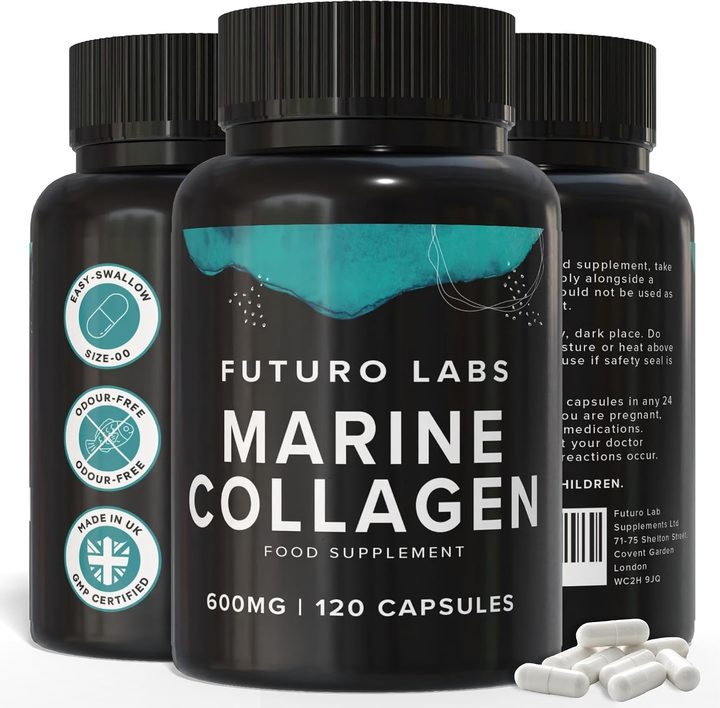
Our brand: the worked example on this page
Futuro Labs Marine Collagen
- 28p a day
- 120 capsules, 2 capsules daily
- Lab tested
- Made in the UK
On its true terms and its own clock: Futuro Labs Marine Collagen on Amazon UK, 2 capsules, 1200mg hydrolysed type 1 marine collagen with 12mg vitamin C at 15% NRV plus zinc, 120 for £16.99, 28p a day, lab tested and UK made, below the 2.5 to 10g skin trial doses and taken for the vitamin C line, with nothing to photograph promised. Full label breakdown. Whether there is anything to notice is on the how long to notice a difference page; the instruments on the does collagen help skin page.
The calendar: week four, weeks eight to twelve, months three to six
How long does marine collagen take to work, before and after, is a question shaped by a photograph, the pair of faces a fortnight apart that the shelf and the social feed use to sell the tub, and the honest way to answer it is to read the photograph as the trials' calendar, marking what the evidence says would be visible, or measurable, at each point. Week four, the first mark: nothing. The epidermis, the outer layer, turns over in around four weeks, so at week four the skin a reader sees is the first skin grown entirely since the tub was opened, and the dermis beneath, the layer where collagen lives and the layer the trials target, turns over on a clock of months and has barely begun, so a four-week before-and-after photographs hydration, sleep, the season, the lighting and the expression, and nothing the collagen could yet have done. Weeks eight to twelve, the second mark: this is where the oral collagen skin trials measured, having given 2.5 to 10 grams of hydrolysed collagen a day, and what they measured was elasticity by cutometer suction and hydration by corneometer capacitance, reporting gains of a few percent against placebo in trials that were small, mostly funded by the peptide's manufacturer and read by devices rather than eyes. A few percent of elasticity is a real number on a cutometer and is generally below what a person sees in a mirror or a camera sees in a photograph, the skin measurement literature's caution, so the honest week-twelve before-and-after is an instrument reading and not a picture, and a reader who wants to know whether their collagen did what the trials did needs a cutometer, not a camera. Months three to six, the third mark: the joint comfort trials' window, in which around ten grams a day for twelve to twenty-four weeks reduced activity-related joint discomfort on questionnaire scales in small trials, one in athletes, modest effects and no claim, and a joint score is not a photograph either. The calendar has no fourth mark, since no trial ran longer with skin as the outcome, so beyond six months the honest page has nothing to add except that the dermis keeps turning over and the habit either holds or lapses.
Marine versus bovine on the clock, the photograph itself, and the worked example
Marine versus bovine on this calendar is the question the search adds by naming marine, and the answer is that the animal does not change the clock. Marine collagen is hydrolysed type 1 collagen from fish skin and scales, bovine is hydrolysed type 1 collagen from cattle hide, both are broken by enzymes into peptides of a few hundred to a few thousand daltons, both produce the same small peptides in the blood after a dose, prolyl-hydroxyproline among them, and both were used in the skin trials with no difference in timing or size of effect that the trials can show, the marketing claim that marine absorbs faster resting on molecular weight ranges that overlap between the two and make no difference to a clock measured in weeks. So a marine collagen before-and-after is a collagen before-and-after, and the reasons to choose marine over bovine are diet, a pescatarian or a reader avoiding beef, and the fish allergy that runs the other way, not speed. The photograph itself deserves a paragraph because it is the instrument most readers will actually use, and it is a bad one unless disciplined: the clinical photography literature standardises the camera, the distance, the angle, the lighting, the background, the time of day, the make-up and the skin preparation, because unstandardised before-and-after pairs are dominated by those variables, a window versus a bulb, morning versus evening hydration, a smile versus a rest face, a phone held closer, differences that easily exceed the few percent the collagen trials report, which means the pairs on the shelf are photographs of lighting and the pair a reader takes at home will be too unless the reader fixes everything but the collagen. A reader who wants an honest home before-and-after fixes the spot, the light, the hour and the expression, takes the first picture before the first dose and the second at twelve weeks, and expects to see nothing, since nothing is what a few percent looks like. The worked example is stated on its true terms and its own clock: two capsules, 1200mg hydrolysed type 1 marine collagen with 12mg vitamin C plus zinc, 120 for £16.99 at 28p a day, lab tested and UK made, a dose below the 2.5 to 10 grams the skin trials gave, taken for vitamin C's collagen formation sentence and the habit, with nothing promised to a camera at any date. How long does marine collagen take to work, before and after: nothing at four weeks, an instrument's few percent at eight to twelve at trial doses, a joint score at three to six months, the same clock as bovine, and a photograph that measures the lighting unless it is made to measure anything else.
| The mark | What the trials say | What a photograph shows |
|---|---|---|
| Week four | Nothing measured; epidermis just turned over, dermis barely begun | Hydration, sleep, season, lighting, expression |
| Weeks eight to twelve | Skin trials' measurement: a few percent in elasticity and hydration by instrument at 2.5 to 10g | Generally nothing a camera detects |
| Months three to six | Joint comfort trials at ~10g: modest questionnaire gains | Not a photograph at all |
| Beyond six months | No skin trial ran longer | The habit holds or lapses |
| Marine versus bovine | Same type 1 hydrolysate, same peptides in blood, same clock | The same before-and-after |
| The photograph | Standardised in trials: camera, distance, light, hour, expression | Unstandardised pairs measure lighting |
| The worked exampleOurs | Two capsules, 1200mg marine collagen with 12mg vitamin C, 28p a day, below the trial doses | Nothing promised to a camera at any date |
What to check on the label
- Expect nothing at four weeks: the dermis has barely begun.
- Mark twelve weeks as the trials' date: an instrument's few percent at 2.5 to 10g.
- Give joints three to six months: a score, not a picture.
- Ignore marine-is-faster: one clock, two animals.
- Fix the light, hour and face before you photograph: or you photograph the light.
Our brand
The worked example: Futuro Labs Marine Collagen
Futuro Labs Marine Collagen: 2 capsules daily, 1200mg hydrolysed type 1 marine collagen with 12mg vitamin C and 1.5mg zinc (15% NRV each), 120 capsules for £16.99, 60 days at 28p a day, lab-tested, UK GMP made. Slim veggie-shell capsules, odour free. Fish derived: pescatarian, not vegetarian or vegan.
- Collagen per serving
- 1200mg hydrolysed type 1 marine (fish)
- Co-factors
- vitamin C 12mg (15% NRV), zinc 1.5mg (15% NRV)
- Serving
- 2 capsules a day
- Bottle
- 120 capsules, 60 days
- Price
- £16.99 (28p a day)
- Capsule
- slim size 00, veggie shell, odour free
Questions people also ask
How long before marine collagen shows results?
The trials measured at eight to twelve weeks: 2.5 to 10 grams a day produced gains of a few percent in skin elasticity and hydration by cutometer and corneometer in small, mostly industry-funded trials, changes a device detects and a mirror or camera generally does not, with nothing at four weeks because the dermis turns over on a clock of months.
Does marine collagen work faster than bovine?
No: both are hydrolysed type 1 collagen broken into peptides of overlapping size, both produce the same small peptides in blood after a dose and both were used in the skin trials without a difference in timing or effect, so the choice between them is diet and fish allergy rather than speed.
Why do collagen before-and-after photos look so convincing?
Because they photograph lighting, hydration, angle, expression and make-up, which the clinical photography literature standardises in trials precisely because unstandardised pairs are dominated by them, and those variables easily exceed the few percent the collagen trials report by instrument.
How long does marine collagen take to work on joints?
The joint comfort trials ran twelve to twenty-four weeks at around ten grams a day and reported modest reductions in activity-related discomfort on questionnaire scales, small trials with no claim, so three to six months is the window and a score rather than a picture is the measure.
Should I take marine collagen for longer than twelve weeks?
The trials have no data beyond their eight to twelve weeks for skin or twenty-four for joints, so beyond that a reader is continuing a habit rather than testing a trial, which is fine on the capsule's true terms, the vitamin C line and the habit, and honest only if nothing further is expected of it.
Sources
- The collagen and skin trial literature: randomised studies of oral collagen peptides on skin elasticity and hydration, mostly small, short and industry funded, with no authorised claim resulting. PubMed record
- The skin biology literature: the epidermis turns over in around four weeks while dermal collagen, the layer supplements target, turns over far more slowly, so the oral collagen skin trials measured elasticity and hydration after eight to twelve weeks of daily intake with no timing of day specified, consistency across weeks rather than time of day being the variable the trials controlled. PubMed record
- The clinical photography standardisation literature: skin trials that use photographs fix the camera, distance, angle, lighting, background, time of day and skin preparation, because unstandardised before-and-after pairs are dominated by lighting, hydration, expression and angle, differences that easily exceed the few percent instrument changes the collagen trials report. PubMed record
- The skin measurement literature: oral collagen trials assess skin by instrument, elasticity by cutometer suction, hydration by corneometer capacitance, dermal density by high-frequency ultrasound and wrinkle depth by profilometry, changes of a few percent that are detectable by the device and generally below what a person sees in a mirror. PubMed record