Ghost Fitness/Collagen/How long does collagen take to work on joints?
How long does collagen take to work on joints?
The short answer
Read the trials' timetable: around 10g a day, first reading at twelve weeks, second at twenty-four, on pain and function questionnaires, modest gains against placebo in small trials. Nothing before three months; no cartilage change by imaging at any point.
- The dose~10g hydrolysed collagen a day; UC-II is a different molecule at ~40mg
- The readingstwelve weeks first, twenty-four weeks second, on activity pain and function scores
- What changed and what did nothow the joint felt under load, modestly; no cartilage change by imaging
- The fair home trialone movement, one score out of ten, the same day each week, twenty-four weeks at the trial dose
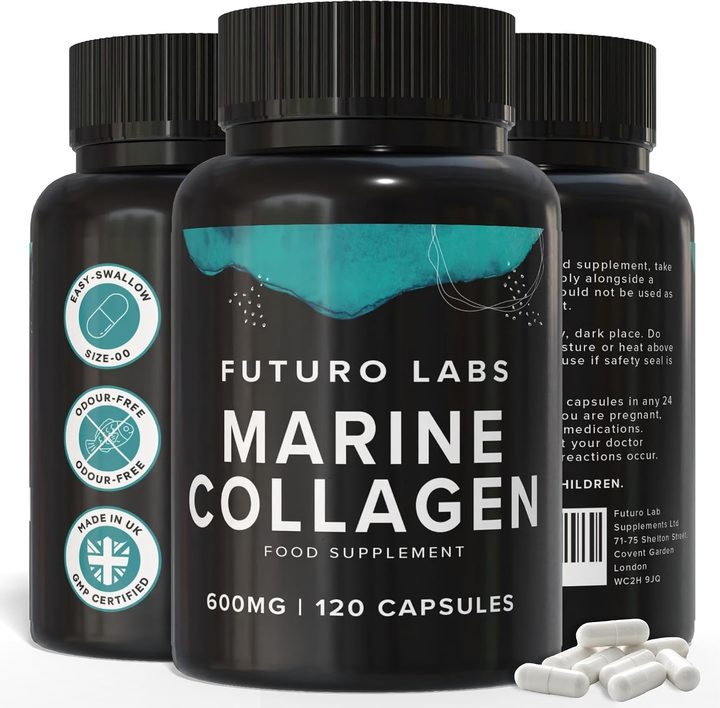
Our brand: the worked example on this page
Futuro Labs Marine Collagen
- 28p a day
- 120 capsules, 2 capsules daily
- Lab tested
- Made in the UK
Below the trial dose and stated so: Futuro Labs Marine Collagen on Amazon UK, 2 capsules, 1200mg hydrolysed type 1 marine collagen with 12mg vitamin C at 15% NRV plus zinc, 120 for £16.99, 28p a day, lab tested and UK made, taken for vitamin C's collagen formation sentence for cartilage and the habit, while a reader running the joint timetable buys ten grams of powder for six months. Full label breakdown. The lifter's three joint complaints are on the collagen for lifters' joints page; the dose by tissue on the how much for tendons and joints page.
The timetable: the dose, the two readings, and what the readings measured
How long does collagen take to work on joints is a question the tub answers with a photograph of a knee and the trials answer with a timetable, and the honest page reads the timetable, because it is the only calendar with evidence on it. The dose first, since the timetable belongs to a dose: the joint comfort trials gave around ten grams of hydrolysed collagen a day, some five and some fifteen, to active adults with activity-related knee pain and to people with osteoarthritis, and the undenatured type II collagen product, UC-II at around forty milligrams a day, is a different molecule working by a different proposed mechanism with its own small trials, so a reader on a two-capsule 1200mg dose is on neither timetable and a reader on ten grams of powder is on this one. The first reading came at twelve weeks. The trials measured how the joint felt rather than what it was made of: visual analogue scales for pain during activity, pain after activity and pain at rest, and composite scores of pain, stiffness and function in the osteoarthritis trials, filled in by the participants at the start, at twelve weeks and in most trials again at twenty-four. At twelve weeks the collagen arms generally reported less activity-related pain than the placebo arms, by modest margins, and at twenty-four weeks the difference was generally clearer, which is why six months rather than three is the honest full answer and why a reader who stopped at eight weeks because nothing had happened stopped before the first reading the trials themselves took. The trials were small, a few dozen to a couple of hundred participants, mostly funded by the manufacturer of the peptide being tested, and the meta-analyses that pool them report a benefit with the hedges that funding and size demand, so the honest expectation is a modest change on a pain scale at three months and a clearer one at six, in a joint that aches with activity, and not a change a reader would describe as fixed. What the trials did not find is as important as what they did: no trial has shown a change in cartilage structure by imaging at any reading, and none was expected to, since articular cartilage is avascular with sparse cells and famously poor intrinsic repair capacity, so the collagen timetable is a timetable of how a joint feels under load and not of what is being rebuilt inside it, and a reader who expects the six-month scan to look different has the wrong timetable.
The fair home trial, the things that speed nothing, and the worked example on the timetable
The fair home trial follows from the timetable, and the honest page sets it out because most readers judge collagen by memory, which is the least reliable instrument in the aisle. Pick one movement that provokes the joint, a bodyweight squat to a set depth, a set of stairs, the first minute of a run, the bottom of a lunge, and score the joint out of ten during and after it, on the same day of the week at the same point in the day, before the first dose and then weekly, on a sheet. Take the trial dose, around ten grams a day of hydrolysed collagen, every day including rest days, for twenty-four weeks, anchored to a fixed point in the routine so it survives the six months, since consistency was the one variable every trial controlled. Keep the training log beside the sheet, because a lighter week, a new shoe or a deload changes a joint score more than any supplement and has to be read out of the result. At twelve weeks read the sheet, at twenty-four read it again, and believe the numbers over the memory in either direction: a two-point fall over six months on a movement that was scored honestly is the size of result the trials reported, and a sheet that has not moved is a fair null for that reader at that dose, which is a better outcome than six months of uncertainty. Three things speed nothing on this timetable: a larger dose, since fifteen grams measured at the same twelve and twenty-four weeks as five; the animal, since marine and bovine hydrolysates produce the same peptides in blood and no joint trial has separated them; and the vitamin C beside the collagen, which holds the register's sentence for normal collagen formation for the normal function of cartilage and is the cofactor the tissue needs, a reason to include it and not a reason to expect an earlier reading. The register's line runs under the whole timetable: collagen holds no authorised claim for joints, so the tub's joint sentence is vitamin C's, and the trials are research a reader tests rather than a promise a reader buys. The worked example is below the trial dose and says so: two capsules, 1200mg hydrolysed type 1 marine collagen with 12mg vitamin C plus zinc, 120 for £16.99 at 28p a day, lab tested and UK made, taken for vitamin C's cartilage sentence and the habit, a dose the joint timetable does not cover, while the reader running the timetable buys ten grams of powder for six months and keeps the sheet. How long does collagen take to work on joints: twelve weeks to the first honest reading and twenty-four to the second, at ten grams a day, on how the joint feels under load, with nothing before three months and nothing on a scan at any point.
| The item | The trials | The fair home trial |
|---|---|---|
| The dose | ~10g hydrolysed collagen a day; UC-II ~40mg is a different molecule | ~10g of powder daily, rest days included, anchored to the routine |
| The baseline | Pain and function questionnaires before the first dose | One provoking movement scored out of ten before the first dose |
| The first reading | Twelve weeks: modest gains in activity-related pain against placebo | Read the sheet at twelve weeks, beside the training log |
| The second reading | Twenty-four weeks: differences generally clearer | Read the sheet at twenty-four weeks; believe the numbers either way |
| What did not change | Cartilage structure by imaging, in any trial | Do not expect a scan to look different |
| Speeds nothing | Dose above 10g, the animal, the vitamin C | The same timetable; vitamin C for its cartilage sentence |
| The worked exampleOurs | Below the trial dose | Two capsules, 1200mg marine collagen with 12mg vitamin C, 28p a day: the habit and the vitamin C line |
What to check on the label
- Take the trial dose or do not judge the trials: ~10g a day.
- Wait for the trials' readings: twelve weeks, then twenty-four.
- Score one movement weekly: a sheet, not a memory.
- Read the training log beside it: deloads move joints more than tubs.
- Expect feel, not structure: no scan changed in any trial.
Our brand
The worked example: Futuro Labs Marine Collagen
Futuro Labs Marine Collagen: 2 capsules daily, 1200mg hydrolysed type 1 marine collagen with 12mg vitamin C and 1.5mg zinc (15% NRV each), 120 capsules for £16.99, 60 days at 28p a day, lab-tested, UK GMP made. Slim veggie-shell capsules, odour free. Fish derived: pescatarian, not vegetarian or vegan.
- Collagen per serving
- 1200mg hydrolysed type 1 marine (fish)
- Co-factors
- vitamin C 12mg (15% NRV), zinc 1.5mg (15% NRV)
- Serving
- 2 capsules a day
- Bottle
- 120 capsules, 60 days
- Price
- £16.99 (28p a day)
- Capsule
- slim size 00, veggie shell, odour free
Questions people also ask
How quickly will collagen help joint pain?
Not quickly: the trials at around ten grams a day took their first reading at twelve weeks and found modest reductions in activity-related pain against placebo, clearer at twenty-four weeks, in small and mostly industry-funded trials, so nothing is expected before three months and a reader who stopped at eight weeks stopped before the first reading.
Does a higher dose of collagen work faster on joints?
No: trials at five, ten and fifteen grams all measured at the same twelve and twenty-four weeks, the joint's response running on its own clock, so ten grams a day is the dose to test and more adds calories and cost rather than speed.
Does collagen rebuild cartilage?
No trial has shown it: the joint trials measured how a joint felt under load by questionnaire and none demonstrated a change in cartilage structure by imaging, cartilage being avascular tissue with poor intrinsic repair capacity, so the timetable is one of comfort scores rather than rebuilt tissue.
How do I tell if collagen is working on my joints?
Run the trials' timetable at home: pick one movement that provokes the joint, score it out of ten at the same point each week from before the first dose, take ten grams a day for twenty-four weeks, keep the training log beside the sheet, and read the sheet at twelve and twenty-four weeks rather than trusting memory.
Do collagen capsules work for joints?
Not as a test of the trials: a two-capsule 1200mg dose sits below the ten grams the joint trials gave, so it is taken on its true terms for vitamin C's cartilage sentence and the habit, and a reader who wants to test the trials buys a powder and measures grams for six months.
Sources
- The collagen peptide trial literature: randomised controlled studies of hydrolysed collagen supplementation across skin, joint and connective-tissue outcomes, typically at 2.5g to 15g daily, with small effects and frequent industry funding. PubMed record
- The joint comfort trial methodology: oral collagen trials in active adults and in osteoarthritis measured outcomes by questionnaire, visual analogue pain scales during and after activity and composite pain, stiffness and function scores, at twelve and twenty-four weeks, with no trial demonstrating change in cartilage structure by imaging, so the outcomes are how a joint feels under load rather than what it is made of. PubMed record
- The cartilage biology literature: articular cartilage is avascular with sparse chondrocytes, giving it famously poor intrinsic repair capacity compared with vascularised tissues like bone and tendon. PubMed record
- The undenatured type II collagen (UC-II) trial literature: small randomised studies at 40mg daily against joint outcomes, a different mechanism and dose to hydrolysed collagen, with no authorised claim resulting. PubMed record