Ghost Fitness/Collagen/How long does marine collagen take to work?
How long does marine collagen take to work?
The short answer
Two lists. Noticed in the first fortnight: fullness at scoop doses, a taste in water, the habit anchoring or lapsing. Not noticed, the trials' results: skin by instrument at eight to twelve weeks, joints by score at twelve to twenty-four.
- What you will notice, the first fortnightfullness at scoop doses, a taste in water, the habit anchoring or lapsing by week three, perhaps glycine sleepiness: none of it the collagen working
- What you will not notice, skina few percent by cutometer and corneometer at 8 to 12 weeks at 2.5 to 10g
- What you will not notice, jointsa modest pain score change at 12 and 24 weeks at ~10g, seen on a sheet not in memory
- Marine versus bovinethe same clock, the same peptides, the same doses; no trial shows marine faster
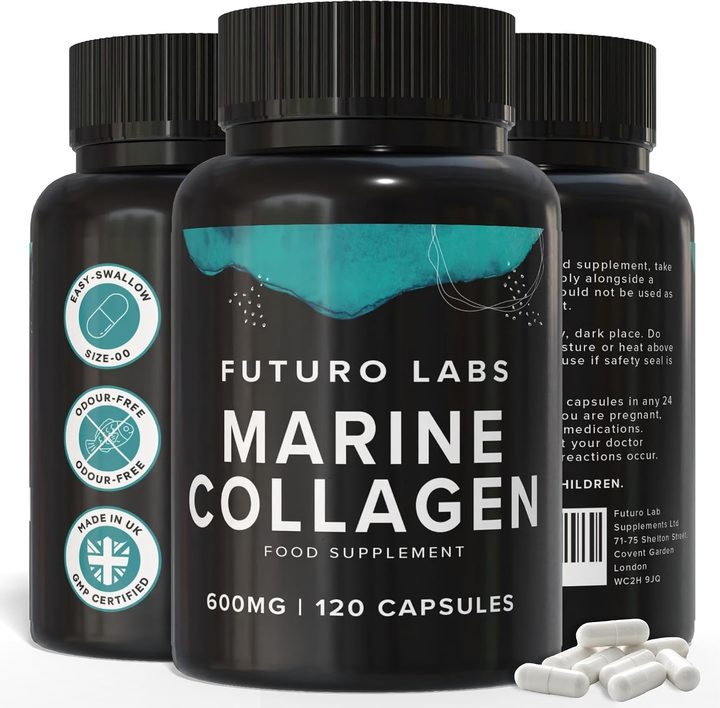
Our brand: the worked example on this page
Futuro Labs Marine Collagen
- 28p a day
- 120 capsules, 2 capsules daily
- Lab tested
- Made in the UK
On its true terms and the same clock: Futuro Labs Marine Collagen on Amazon UK, 2 capsules, 1200mg hydrolysed type 1 marine collagen with 12mg vitamin C at 15% NRV plus zinc, 120 for £16.99, 28p a day, lab tested and UK made, below the trial doses and taken for vitamin C's collagen formation sentence, with nothing on either list promised. Full label breakdown. The photograph as a calendar is on the marine before-and-after page; the three skin clocks on the collagen and skin page; the joint timetable on the collagen and joints page.
The noticing ledger: what the first fortnight on marine collagen actually feels like
How long does marine collagen take to work is usually asked alongside a second question, what will you notice when you start taking it, and the honest page answers both by keeping two lists, what a reader will notice and what a reader will not, because the things people notice in the first weeks are real and are not the collagen working, and the things the trials measured are real and are not noticeable. The noticing ledger for the first fortnight, then, in the order it arrives. Day one: the taste, if there is one, since some marine collagen powders leave a faint fishy or gelatinous note in plain water that is there from the first mouthful and does not fade, fixed by a warm drink or a smoothie or absent from a capsule, and the glass itself, since most readers drink more water on the days they take a powder and notice that. Days one to five: fullness and mild bloating at scoop doses, twenty grams of protein in a glass sitting heavily for an hour or two, especially fasted or late, and a looser stool in some, the ordinary response to a new protein load that fades over one to two weeks as the gut adapts and that a dessertspoon or a capsule avoids. Nights one to seven: sometimes a sleepiness after a night dose, which a reader files as the collagen and which is the glycine footnote, around three grams in a ten-gram dose being the amount small trials gave before bed for subjective sleep quality, a coincidence and not a claim. Week two to three: the habit either anchoring or lapsing, since a dose fixed to the morning coffee or the last glass of water is still being taken in week three and a dose floating on memory is not, the habit literature's finding and the one thing in the fortnight that decides whether the trials' clock is ever reached. And that is the whole of the ledger, because nothing on it is the collagen working: the taste is the powder, the fullness is the format, the sleepiness is an amino acid coincidence and the habit is the reader, and a reader who feels their skin is better at day ten has felt the extra water, the season, the sleep or the expectation, since the dermis has not begun to turn over.
What you will not notice: the trials' clock, and why marine runs it no faster than bovine
The second list is what a reader will not notice at any point, and it is the list the trials wrote. Skin: at 2.5 to 10 grams a day for eight to twelve weeks, elasticity by cutometer suction and hydration by corneometer capacitance rose a few percent against placebo in small, mostly industry-funded trials, with dermal density by ultrasound and eye wrinkle depth by profilometry in some, changes that the instruments detected and that are generally below what a person sees in a mirror or a camera catches in an unstandardised photograph, so the honest skin answer to how long is eight to twelve weeks, by instrument, at trial doses, and the honest answer to what you will notice is nothing you can trust. Joints: at around ten grams a day, activity-related pain scores fell modestly against placebo at twelve weeks and more clearly at twenty-four, a change a weekly scored sheet on one provoking movement detects and memory does not, with no change in cartilage on any imaging, so the honest joint answer is twelve to twenty-four weeks, by score, at ten grams. Bone: one trial at five grams for a year in postmenopausal women with low density, a change only a scan sees. Marine collagen runs this clock no faster than bovine, whatever the shelf says about fish peptides absorbing more quickly: both are type 1 hydrolysates broken into peptides of overlapping molecular weight ranges, both produce the same small peptides in blood within an hour or two of a dose, prolyl-hydroxyproline among them, the peptides peak and clear on the same day in both, and the tissues they are aimed at turn over on the same clocks of weeks and months whichever animal supplied them, so no trial has shown marine working faster and the animal is chosen by allergy, diet, faith and the tub's testing file rather than by speed. The two lists together give the honest answer: what you will notice when you start marine collagen is the fortnight's ledger, format and routine, and what it takes to work is eight to twelve weeks for skin by instrument and twelve to twenty-four for joints by score, at trial doses, measured rather than felt. The worked example is on the same clock and below the trial doses, and says so: two capsules, 1200mg hydrolysed type 1 marine collagen with 12mg vitamin C plus zinc, 120 for £16.99 at 28p a day, lab tested and UK made, taken for vitamin C's collagen formation sentence and the habit, with nothing on the noticing ledger except the glass of water and nothing on the trials' list promised. How long does marine collagen take to work: a fortnight to notice the format, three months to measure the skin, six to score the joints, and no faster for being from a fish.
| The item | When | What it is | Is it the collagen working |
|---|---|---|---|
| A taste in water | Day one | Some marine powders; fixed by a warm drink or a capsule | No: the powder |
| Fullness, mild bloating | Days one to five, fading over a fortnight | A new protein load at scoop doses | No: the format |
| Sleepiness after a night dose | The first week | ~3g glycine in 10g; small trials, no claim | No: a coincidence |
| The habit anchoring or lapsing | Weeks two to three | Fixed to a routine, or floating on memory | No: the reader, and the thing that decides the rest |
| Skin elasticity and hydration | 8 to 12 weeks at 2.5 to 10g | A few percent by cutometer and corneometer | Yes, by instrument; not by mirror |
| Joint pain scores | 12 and 24 weeks at ~10g | A modest change on a scored sheet; no cartilage change | Yes, by score; not by memory |
| Bone density | 12 months at 5g, one trial | Small gains in postmenopausal women | Yes, by scan only |
| Marine versus bovine | The same clock | Same peptides in blood, same trial doses | No trial shows marine faster |
| The worked exampleOurs | Below the trial doses | Two capsules, 1200mg marine collagen with 12mg vitamin C, 28p a day | The habit and the vitamin C line |
What to check on the label
- Expect the fortnight's ledger: taste, fullness, the habit.
- Do not read early feelings as results: the dermis has not turned over.
- Measure skin at twelve weeks: by instrument or fixed-light photograph, at trial doses.
- Score joints weekly to twenty-four: one movement, one sheet.
- Choose marine for allergy, diet or file: never for speed.
Our brand
The worked example: Futuro Labs Marine Collagen
Futuro Labs Marine Collagen: 2 capsules daily, 1200mg hydrolysed type 1 marine collagen with 12mg vitamin C and 1.5mg zinc (15% NRV each), 120 capsules for £16.99, 60 days at 28p a day, lab-tested, UK GMP made. Slim veggie-shell capsules, odour free. Fish derived: pescatarian, not vegetarian or vegan.
- Collagen per serving
- 1200mg hydrolysed type 1 marine (fish)
- Co-factors
- vitamin C 12mg (15% NRV), zinc 1.5mg (15% NRV)
- Serving
- 2 capsules a day
- Bottle
- 120 capsules, 60 days
- Price
- £16.99 (28p a day)
- Capsule
- slim size 00, veggie shell, odour free
Questions people also ask
What will you notice when you start taking collagen?
The format and the routine rather than the collagen: a taste in water from some marine powders, fullness and mild bloating at scoop doses fading over a fortnight, sometimes sleepiness after a night dose from the glycine, and the habit either anchoring to a fixed point or lapsing by week three, none of which is the collagen working.
How long does marine collagen take to work on skin?
Eight to twelve weeks by instrument at 2.5 to 10 grams a day: the trials found gains of a few percent in elasticity by cutometer and hydration by corneometer in small, mostly industry-funded trials, changes generally below what a mirror shows, with nothing at four weeks because the dermis has not yet turned over.
Does marine collagen work faster than bovine collagen?
No: both are type 1 hydrolysates with overlapping peptide sizes, both produce the same small peptides in blood within an hour or two, and the tissues they are aimed at turn over on the same clocks of weeks and months, so no trial shows marine faster and the animal is chosen by allergy, diet, faith and the tub's testing file.
How long should I take marine collagen before deciding if it works?
The trials' reading points at the trials' doses: twelve weeks for skin, measured by instrument or a photograph in fixed light rather than by feel, and twelve to twenty-four weeks for joints, measured on a weekly scored sheet for one provoking movement, with anything earlier being the fortnight's format effects.
Why do I feel different after a week on marine collagen?
Because the first week is full of things that are not the collagen: more water drunk with the powder, the routine and the expectation, fullness from the protein load, and sometimes the glycine's sleepiness, while the skin and joint tissues the trials measured have not had time to change and were measured at eight to twenty-four weeks.
Sources
- The gastrointestinal adaptation literature: fullness, bloating and stool changes after a new protein or fibre load are commonest in the first days and diminish over one to two weeks as gut motility, enzyme output and the microbiome adjust, and settle fastest when the dose is introduced gradually and taken with food. PubMed record
- The skin measurement literature: oral collagen trials assess skin by instrument, elasticity by cutometer suction, hydration by corneometer capacitance, dermal density by high-frequency ultrasound and wrinkle depth by profilometry, changes of a few percent that are detectable by the device and generally below what a person sees in a mirror. PubMed record
- The collagen peptide trial literature: randomised controlled studies of hydrolysed collagen supplementation across skin, joint and connective-tissue outcomes, typically at 2.5g to 15g daily, with small effects and frequent industry funding. PubMed record
- The collagen peptide absorption literature: after oral hydrolysed collagen, small peptides such as prolyl-hydroxyproline and hydroxyprolyl-glycine appear in blood for several hours alongside free amino acids, and in cell and animal work these peptides act on fibroblasts and chondrocytes, the mechanism proposed for why hydrolysed collagen might do more than an equal quantity of its free amino acids, a hypothesis with human marker data behind it and no human outcome claim. PubMed record