Ghost Fitness/Omega-3/Should I take more DHA or EPA?
Should I take more DHA or EPA?
The short answer
Look at what the body holds and what fish supplies. The tissues hold DHA many times over EPA, the brain and retina DHA-rich, and the body converts a little EPA onward to DHA while retaining DHA preferentially. A standard fish oil supplies EPA and DHA at about 3 to 2 and the tissues sort it. So the ratio a reader buys is decided by the register's sentences, DHA for brain, vision and pregnancy, either for the heart, and the standard oil serves nearly everyone.
- What the body holdsDHA many times over EPA: the brain, the retina and most membranes DHA-rich
- What the body doesconverts a little EPA onward to DHA; retains DHA preferentially; uses EPA for the mediators it feeds
- What fish suppliesabout 3 to 2 EPA to DHA in a standard oil: more EPA than the tissues hold; the tissues sort it
- What decides the ratio you buythe register: DHA for brain, vision and the maternal claim; either for heart, triglycerides and blood pressure
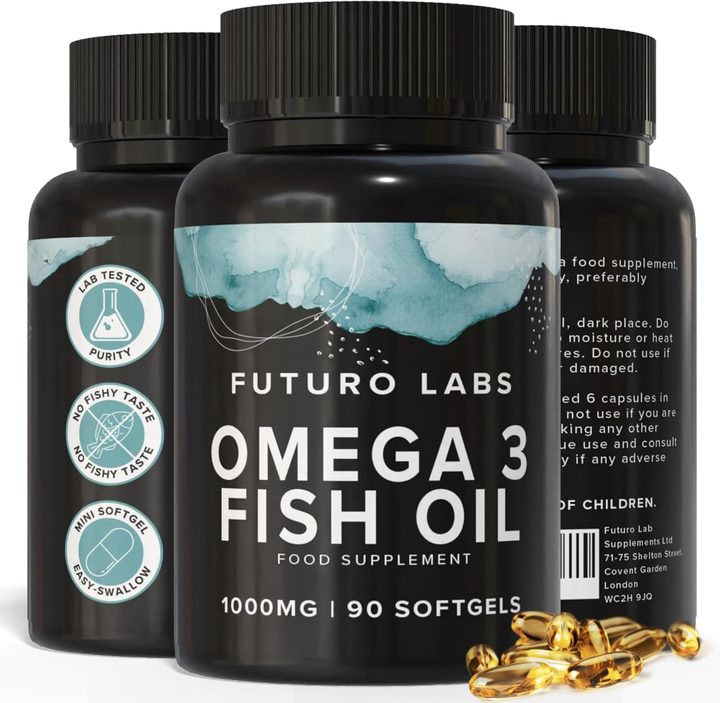
Our brand: the worked example on this page
Futuro Labs Omega 3 Fish Oil
- 17p a day
- 90 softgels, 1 softgel daily
- Lab tested
- Made in the UK
The standard ratio the tissues sort for themselves: Futuro Labs Omega 3 Fish Oil on Amazon UK, 1 softgel with food, 180mg EPA and 120mg DHA, 90 for £14.99 at 17p, the DHA claims at two or three. Full label breakdown. The decision tree is on the EPA and DHA page; DHA's four addresses on the DHA page.
What the body holds, which is DHA many times over EPA, and what it does with what it is given
Should I take more DHA or EPA, and the variants asking whether the body needs more of one, are answered by looking at two things, what the body holds and what fish supplies, because the gap between them is where the tissues do the sorting and the reason nobody needs to buy for the body's sake. What the body holds: the tissues are DHA-heavy. The brain's grey matter and synaptic membranes carry DHA as their dominant omega-3, with EPA present at a small fraction of DHA's level; the retina's photoreceptor membranes are among the most DHA-rich in the body, again with little EPA; sperm membranes are DHA-rich; and most cell membranes, red cells, heart and muscle among them, carry more DHA than EPA, the tissue fatty acid literature's consistent picture, so that if the body's need is read as what it keeps, the need is DHA many times over EPA. What the body does with what it is given: it converts a little EPA onward to DHA, the last steps of the same chain that converts plant ALA so poorly, and it retains DHA preferentially in the membranes that want it, so a supply that carries more EPA than the tissues hold is sorted, the DHA built in where DHA belongs, some EPA lengthened to DHA, and the rest of the EPA used for the resolving mediators and the other signalling roles EPA feeds and then oxidised, the tissues selecting their composition from the diet rather than mirroring it, the reason a fish eater's brain is not 3 to 2 EPA to DHA.
What fish supplies, why the mismatch does not matter, the register that decides the ratio a reader buys, and the ratio filed
What fish supplies: a standard fish oil from anchovy, sardine and mackerel body oil carries EPA and DHA at about 3 to 2, 180mg and 120mg in a 1000mg softgel, more EPA than DHA and more EPA than the tissues hold, and oily fish on a plate carries roughly the same shape, which is the supply the tissues have sorted for as long as people have eaten fish, the mismatch between a 3 to 2 supply and a DHA-heavy body being exactly the mismatch the sorting exists to handle. Why the mismatch does not matter for a reader: the tissues do the sorting whatever ratio the tub carries, so a reader on a standard oil ends up with the DHA-heavy membranes the body wants, and a reader who buys a DHA-heavy oil to match the body ends up in the same place a little sooner on the DHA side, the omega-3 index research treating EPA and DHA combined as the marker precisely because the tissues handle the split. The register decides the ratio a reader actually buys, and it decides by sentence rather than by physiology: the brain, vision and maternal sentences name DHA at 250mg and 200mg more, so a reader who wants those reads the DHA line and reaches it at two or three standard softgels or one DHA-heavy or algal capsule; the heart, triglyceride and blood pressure sentences count EPA and DHA combined in any ratio, so a reader who wants those takes either; and the EPA-heavy concentrate is reserved for the reader following the mood literature with a GP, a research choice rather than a bodily need. The standard 3 to 2 oil serves nearly everyone, reaching the heart claim in one softgel and the DHA claims in two or three, and the honest answer to whether to take more DHA or EPA is that the body will take the DHA it needs from either and the register tells you which line to read. The ratio filed: the body holds DHA many times over EPA and sorts a 3 to 2 supply into DHA-heavy tissues, fish supplies more EPA than the tissues hold and the tissues handle it, the register decides the ratio a reader buys by sentence, and the standard oil serves nearly everyone, with the worked example being that ratio, the tissues sorting it for themselves, £14.99 for 90 at 17p.
| The item | EPA | DHA |
|---|---|---|
| The brain and retina | A small fraction | The dominant omega-3 |
| Most cell membranes | Less | More; retained preferentially |
| What the body does with a supply | Uses it for mediators; converts a little onward to DHA | Builds it in where DHA belongs |
| A standard fish oil | 180mg a softgel, about 3 parts | 120mg a softgel, about 2 parts |
| The register's sentences | None alone; combined with DHA for heart, triglycerides and blood pressure | Brain and vision at 250mg; the maternal claim at 200mg more |
| The reader's decision | An EPA-heavy oil only for the mood literature with a GP | A DHA-heavy oil only to reach the DHA sentences in one capsule |
The verdict, a DHA-heavy body sorting a 3 to 2 supply, and a register that decides the tub
Should I take more DHA or EPA, and does the body need more of one: the body holds DHA many times over EPA, the brain, the retina and most membranes being DHA-rich, and it sorts whatever it is given, converting a little EPA onward to DHA, retaining DHA preferentially and using EPA for the mediators it feeds, so that a standard fish oil's 3 to 2 supply, more EPA than the tissues hold, ends up as the DHA-heavy membranes the body wants whatever the tub's ratio, and the ratio a reader buys is decided by the register's sentences instead, DHA for the brain, vision and maternal claims, either for the heart, triglyceride and blood pressure claims, with the standard oil serving nearly everyone. The standard ratio the tissues sort for themselves: Futuro Labs Omega 3 Fish Oil, one softgel with food, 180mg EPA and 120mg DHA, 90 for £14.99 at 17p a day.
What to check on the label
- Know what the body holds: DHA many times over EPA.
- Trust the sorting: the tissues select from a 3 to 2 supply.
- Buy by the register's sentence: DHA for brain, vision and pregnancy; either for the heart.
- Reserve an EPA-heavy oil for the mood literature: a research choice with a GP.
- Take the standard oil otherwise: it serves nearly everyone.
Our brand
The worked example: Futuro Labs Omega 3 Fish Oil
Futuro Labs Omega 3 Fish Oil: 1 softgel daily with food, 1000mg fish oil providing 180mg EPA and 120mg DHA (300mg combined), 90 softgels for £14.99, 17p a day, lab-tested purity, UK GMP made. Gelatin shell, so not vegetarian.
- Fish oil per softgel
- 1000mg
- EPA / DHA per softgel
- 180mg / 120mg (300mg combined)
- Serving
- 1 softgel a day
- Bottle
- 90 softgels, 90 days
- Price
- £14.99 (17p a day)
- Softgel
- mini softgel, no fishy taste
Questions people also ask
Does the body need more EPA or DHA?
It holds far more DHA, the brain, the retina and most cell membranes being DHA-rich with little EPA, and it sorts whatever it is given, converting a little EPA onward to DHA and retaining DHA preferentially, so a standard 3 to 2 fish oil supply ends up as the DHA-heavy tissues the body wants without the reader choosing.
Should I buy a DHA-heavy fish oil to match what the body needs?
Only to reach the register's DHA sentences in one capsule, the brain, vision and maternal claims naming DHA at 250mg and 200mg more; for the body's own composition a standard oil does the same job a little more slowly, the tissues building in the DHA from either.
Why does fish oil have more EPA than DHA if the body holds more DHA?
Because that is the shape of anchovy, sardine and mackerel body oil, about 3 to 2, the supply the tissues have sorted for as long as people have eaten fish, and the mismatch between a 3 to 2 supply and a DHA-heavy body is exactly what the body's sorting exists to handle.
Does the body convert EPA into DHA?
A little: the last steps of the chain that converts plant ALA so poorly also lengthen some EPA to DHA, and the body retains DHA preferentially in the membranes that want it, using the rest of the EPA for the resolving mediators and other signalling roles EPA feeds.
When should I take more EPA than DHA?
Only when following the mood literature with a GP, the depression meta-analyses favouring EPA-predominant oils at a gram or more of EPA as an adjunct to treatment, a research choice rather than a bodily need, since no register sentence names EPA alone and the tissues hold little of it.
Sources
- The tissue fatty acid literature: DHA outweighs EPA many times over in the brain, the retina and most cell membranes, the body converting a little EPA to DHA and retaining DHA preferentially, while a standard fish oil supplies EPA and DHA at about 3 to 2, the tissues selecting what they hold from what the diet supplies. PubMed record
- EFSA Panel on Dietetic Products. Scientific opinion on health claims related to DHA: maintenance of normal brain function and normal vision (250mg DHA daily condition of use). EFSA Journal 2010;8(10):1734. https://www.efsa.europa.eu/en/efsajournal/pub/1734
- Commission Regulation (EU) No 536/2013 authorising health claims for DHA and EPA: maintenance of normal blood triglyceride concentrations (2g DHA+EPA/day) and normal blood pressure (3g DHA+EPA/day), with a supplemental limit note of 5g/day. https://eur-lex.europa.eu/legal-content/EN/TXT/?uri=CELEX%3A32013R0536
- Meta-analytic evidence on EPA-predominant omega-3 formulations in depression research: better signals for EPA-heavy preparations in clinical trial populations, with no authorised claims arising. PubMed record