Ghost Fitness/Omega-3/What is EPA and DHA?
What is EPA and DHA?
The short answer
EPA and DHA are the two long marine omega-3s, made by algae and concentrated in oily fish, the forms the body uses. Whether you want more of one or the other is a decision tree by goal: the heart claim and general use take either, at 250mg combined; brain, vision and pregnancy take DHA; the mood literature favoured EPA at a gram; a vegan takes algal DHA; and the default is a standard 3 to 2 fish oil.
- EPAtwenty carbons, five bonds; the resolving mediators' precursor; the mood literature's omega-3
- DHAtwenty-two carbons, six bonds; the brain, retina and sperm membranes' omega-3
- The combined sentencesheart at 250mg of EPA and DHA; triglycerides at two grams; blood pressure at three: any ratio
- The decisionDHA for brain, vision and pregnancy; EPA for the mood literature; 3 to 2 for everyone else
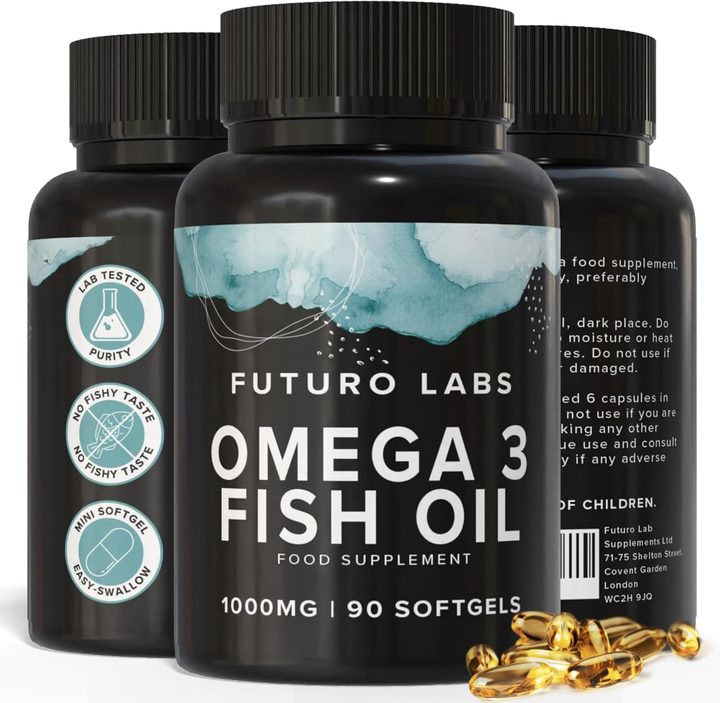
Our brand: the worked example on this page
Futuro Labs Omega 3 Fish Oil
- 17p a day
- 90 softgels, 1 softgel daily
- Lab tested
- Made in the UK
The default, a standard 3 to 2 fish oil: Futuro Labs Omega 3 Fish Oil on Amazon UK, 1 softgel with food, 180mg EPA and 120mg DHA, 90 for £14.99 at 17p. Full label breakdown. The family tree is on the omega-3, EPA and DHA page; the ratio shelf on the best ratio page.
What EPA and DHA are, in a paragraph, and the benefits they hold as a pair and separately
What EPA and DHA are takes a paragraph, and the variants asking about their benefits and whether you want more of one or the other take a decision tree. The paragraph: EPA, eicosapentaenoic acid, and DHA, docosahexaenoic acid, are the two long marine omega-3 fatty acids, EPA twenty carbons with five double bonds and DHA twenty-two with six, both made by marine algae, both concentrated up the food chain into oily fish, both available directly from algal oil, and both the forms the body actually uses, the plant omega-3 ALA converting to them at a few percent and under one percent respectively, the family tree page's account. They differ in what they do: EPA is the precursor of the resolving mediators the inflammation literature studies and the omega-3 the mood research favoured, and DHA is the structural fatty acid of brain, retina and sperm membranes, the one the brain, vision and maternal claims concern. The benefits they hold as a pair, on the register: EPA and DHA contribute to the maintenance of normal heart function at 250mg a day combined, to normal blood triglyceride levels at two grams and to normal blood pressure at three, each in any ratio, since the combined figure is the condition. The benefits DHA holds alone: the maintenance of normal brain function and normal vision at 250mg of DHA a day, and the maternal claim at 200mg more in pregnancy and breastfeeding. The benefits EPA holds alone: none on the register, its EPA-specific evidence sitting in research literatures rather than in claims, the EPA-per-day page's finding.
The decision tree, more DHA or more EPA by goal, with the default at the root, and the pair filed
Do I want more DHA or EPA is a decision tree with the reader's goal at each branch and a default at the root. Branch one, the heart claim and general use: either, the sentence counting the two combined at 250mg, so a standard oil, an EPA-heavy concentrate and a DHA-heavy oil all serve it at the right softgel count and the ratio is a matter of indifference. Branch two, brain, vision and pregnancy: DHA, the three sentences that name it, at 250mg of DHA for brain and vision and 200mg more in pregnancy and breastfeeding, so the DHA line is read rather than the total, a standard 120mg-DHA softgel reaching it at two or three and a DHA-heavy or algal oil at one. Branch three, the mood literature: EPA, the meta-analyses in depression favouring formulations that are 60% or more EPA and deliver a gram or more of EPA a day as an adjunct to standard treatment, a research finding with no claim and a GP first, served by an EPA-heavy concentrate. Branch four, the muscle protein synthesis research: a roughly 2 to 1 EPA to DHA concentrate at four grams a day, the trial's formula and a research dose with no claim and no size measured, the muscle growth page's dissection, served by four concentrate softgels for a reader who chooses to follow it. Branch five, a vegan: algal DHA, which carries the DHA sentences and the heart sentence only if it also delivers EPA at 250mg combined, the vegan page's read. The root, for everyone who is not on a branch: a standard 3 to 2 fish oil, 180mg EPA and 120mg DHA in a 1000mg softgel, which reaches the heart claim in one and the DHA claims in two or three, the ratio nature ships in anchovy, sardine and mackerel and the default the shelf should start from. The pair filed: EPA and DHA are the two marine omega-3s the body uses, the pair holding the combined sentences in any ratio, DHA holding the brain, vision and maternal sentences and EPA holding research literatures, with the decision tree sending brain, vision and pregnancy to DHA, mood to EPA, muscle research to a 2 to 1 concentrate, vegans to algal DHA and everyone else to the 3 to 2 default, the worked example being that default, one softgel at 17p, £14.99 for 90.
| The goal | The choice | The reason |
|---|---|---|
| The heart claim; general use | Either, at 250mg combined | The sentence counts the two together in any ratio |
| Brain, vision, pregnancy | DHA, at 250mg and 200mg more | The three sentences name DHA specifically |
| The mood literature | EPA, a gram or more from an EPA-predominant oil | Research; no claim; an adjunct with a GP |
| The muscle research | A 2 to 1 EPA concentrate at four grams | The trial's formula; no claim; no size measured |
| A vegan | Algal DHA | Carries the DHA sentences; the heart sentence only with EPA at 250mg combined |
| Everyone else | A standard 3 to 2 fish oil | The default: the heart claim in one softgel, the DHA claims in two or three |
The verdict, two molecules, one pair of sentences, three DHA sentences, and a tree that ends in a default
What is EPA and DHA: the two long marine omega-3 fatty acids, EPA twenty carbons with five double bonds feeding the resolving mediators and DHA twenty-two with six building brain, retina and sperm membranes, made by algae, concentrated in oily fish and the forms the body uses, holding the combined register sentences in any ratio, heart at 250mg and triglycerides and blood pressure at two and three grams, with DHA holding the brain, vision and maternal sentences alone, so that the decision of more DHA or more EPA runs by goal, DHA for brain, vision and pregnancy, EPA for the mood literature, a 2 to 1 concentrate for the muscle research, algal DHA for a vegan, and a standard 3 to 2 fish oil for everyone else. The default: Futuro Labs Omega 3 Fish Oil, one softgel with food, 180mg EPA and 120mg DHA, 90 for £14.99 at 17p a day.
What to check on the label
- Know the two molecules: EPA for mediators, DHA for membranes.
- Take the combined sentences in any ratio: heart, triglycerides, blood pressure.
- Read the DHA line for brain, vision and pregnancy: the sentences name it.
- Follow EPA only for the mood literature: research, with a GP.
- Start from the 3 to 2 default: unless a branch applies.
Our brand
The worked example: Futuro Labs Omega 3 Fish Oil
Futuro Labs Omega 3 Fish Oil: 1 softgel daily with food, 1000mg fish oil providing 180mg EPA and 120mg DHA (300mg combined), 90 softgels for £14.99, 17p a day, lab-tested purity, UK GMP made. Gelatin shell, so not vegetarian.
- Fish oil per softgel
- 1000mg
- EPA / DHA per softgel
- 180mg / 120mg (300mg combined)
- Serving
- 1 softgel a day
- Bottle
- 90 softgels, 90 days
- Price
- £14.99 (17p a day)
- Softgel
- mini softgel, no fishy taste
Questions people also ask
Do I want more DHA or more EPA?
By goal: DHA for the brain, vision and maternal sentences, which name it at 250mg and 200mg more; EPA for the mood literature, which favoured EPA-predominant oils at a gram as an adjunct; either for the heart, triglyceride and blood pressure sentences, which count the two combined; and a standard 3 to 2 fish oil for everyone else.
What are the benefits of EPA and DHA?
As a pair on the register, the maintenance of normal heart function at 250mg combined, normal blood triglycerides at two grams and normal blood pressure at three; DHA alone holds the maintenance of normal brain function and normal vision at 250mg and the maternal claim; EPA alone holds research literatures and no claim.
Is EPA or DHA better for the heart?
Neither: the heart sentence counts EPA and DHA combined at 250mg in any ratio, so a standard oil, an EPA-heavy concentrate and a DHA-heavy oil all serve it at the right softgel count.
Which is better for the brain, EPA or DHA?
DHA for the register's sentence, the maintenance of normal brain function at 250mg of DHA, since DHA is the structural fatty acid of brain membranes; EPA's brain evidence sits in the mood research, a different question with a different answer and a GP first.
What is the best EPA to DHA ratio?
For most readers the standard 3 to 2 ratio nature ships in oily fish, 180mg EPA and 120mg DHA in a 1000mg softgel, reaching the heart claim in one and the DHA claims in two or three, with a DHA-heavy or EPA-heavy oil chosen only when a specific branch of the decision tree applies.
Sources
- Commission Regulation (EU) No 536/2013 authorising health claims for DHA and EPA: maintenance of normal blood triglyceride concentrations (2g DHA+EPA/day) and normal blood pressure (3g DHA+EPA/day), with a supplemental limit note of 5g/day. https://eur-lex.europa.eu/legal-content/EN/TXT/?uri=CELEX%3A32013R0536
- EFSA Panel on Dietetic Products. Scientific opinion on health claims related to DHA: maintenance of normal brain function and normal vision (250mg DHA daily condition of use). EFSA Journal 2010;8(10):1734. https://www.efsa.europa.eu/en/efsajournal/pub/1734
- Meta-analytic evidence on EPA-predominant omega-3 formulations in depression research: better signals for EPA-heavy preparations in clinical trial populations, with no authorised claims arising. PubMed record
- Smith GI, Atherton P, Reeds DN, et al. Dietary omega-3 fatty acid supplementation increases the rate of muscle protein synthesis in older adults: a randomized controlled trial. American Journal of Clinical Nutrition 2011;93(2):402-412. PubMed record