Ghost Fitness/Lion's mane/What does lion's mane cost per day in the UK?
What does lion's mane cost per day in the UK?
The short answer
Honest capsules run 10 to 25p a day, the worked example at 13p, with powders similar per stated dose, tinctures 20 to 60p, gummies 30 to 80p, and coffees 50p upward. Annualised, 13p is about £47.
- The capsule band10-25p a day for stated fruiting-body extracts
- The benchmark13p: £15.49 over a 120-day bottle
- The format premiumstinctures 20-60p, gummies 30-80p, coffees 50p-£1+
- The annual sums13p is ~£47 a year; the coffee habit £180-365
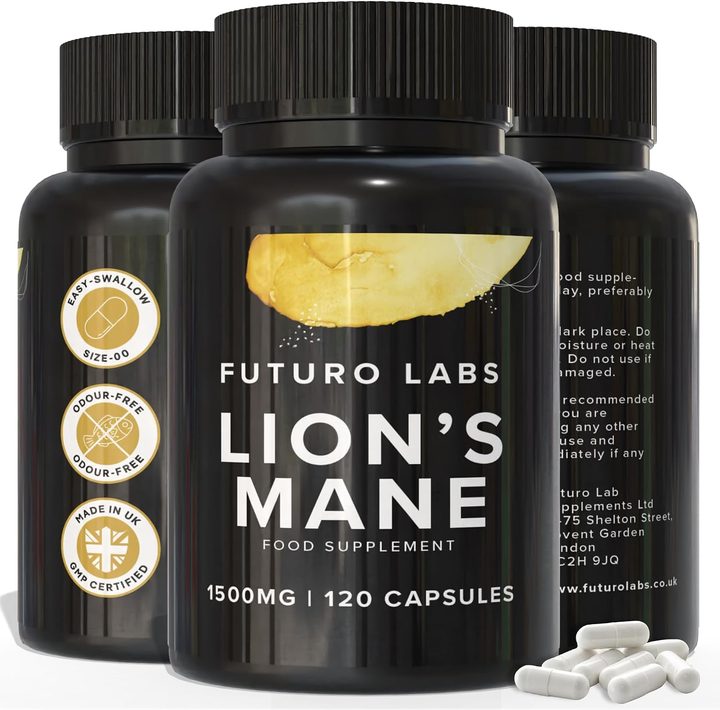
Our brand: the worked example on this page
Futuro Labs Lion's Mane
- 13p a day
- 120 capsules, 1 capsule daily
- Lab tested
- Made in the UK
The benchmark row, priced in public: Futuro Labs Lion's Mane on Amazon UK, £15.49 for 120 capsules at 1 a day: 13p, about £47 a year. Full label breakdown. The cost anatomy behind the floor is on the quality page; the ratio-proof metric on the ratio page.
The market priced format by format, on the metric that makes them comparable
Price the whole aisle once, properly, and the metric comes first: pence per day at the label's own directions is the headline column, and pence per milligram of stated mushroom equivalent is the referee behind it, the ratio page's normaliser, because a per-day figure only compares products delivering comparable stated doses, and half this market's formats state too little to enter that column at all, which is itself a price. The capsule band, the market's honest centre: stated fruiting-body extracts at 5:1-to-10:1 run roughly ten-to-twenty-five pence a day across the UK's passing labels, the quality page's bill-of-materials floor sitting under the band and the brand-tax ceiling over it, with the worked example's arithmetic setting the section's benchmark, £15.49 across a 120-day one-a-day bottle landing at 12.9p, called 13p everywhere on this site. Powder prices land beside capsules once translated, per-gram bag prices divided into stated ~300mg extract servings typically returning ten-to-twenty pence a day, the paper savings the dose-scale flip already priced at less than the measuring. Tinctures run twenty-to-sixty pence a day at their stated dropper doses, the format's alcohol extraction and small-batch economics carrying the premium, and its frequent disclosure gaps keeping many bottles out of the referee column entirely. Gummies run thirty-to-eighty pence a day at label servings whose equivalents rarely bear comparison, and the matching sum on their own page shows the true per-capsule-equivalent cost multiplying further. And the coffees top the table at fifty pence to a pound-plus per serving for the smallest and least stated doses in the aisle, the two-ingredient recipe undercutting them at any coffee the reader already owns plus 13p.
The annual sums run, the false economies flagged, and the honest budget written in one line
Annualise the table and the formats separate for good: the 13p capsule benchmark compounds to roughly £47 a year, the wider honest capsule band to £37-£91, powder to much the same, while the tincture habit runs £73-£219, the gummy jar habit £110-£292, and the daily mushroom-coffee ritual £180-£365-plus, a spread wide enough that format choice, not brand choice, is the aisle's real budget decision, a year of the coffee habit buying seven-plus years of the benchmark capsule. The false economies get flagged on the way past: the six-pound bottle under the quality page's floor is not a saving but a deletion, the too-cheap arithmetic explained there; the giant-bag powder purchase saves pennies per day and gambles them against hygroscopic clumping and a keeper's diligence; subscribe-and-save discounts are honest only applied after the base per-day comparison, a fifteen-percent discount on an eighty-pence format still losing to an undiscounted thirteen; and bundles and stacks price convenience at proprietary-line opacity, the forensics pages' standing verdict. The honest budget writes in one line because the section's economics were always simple: a stated fruiting-body 5:1 in the capsule band costs a UK buyer ten-to-twenty-five pence a day and about £47 a year at the benchmark, everything dearer in this aisle is buying format, ritual or story rather than mushroom, and everything cheaper is inviting the bill-of-materials question, which leaves cost per day, on this table as on every table this site prints, a solved problem for anyone willing to read a label and divide.
| The format | Pence per day | The annual sum |
|---|---|---|
| Capsules, stated extracts | 10-25p; benchmark 13p | £37-91; benchmark ~£47 |
| Powder, per stated servingOurs | 10-20p, plus the measuring | Much the same, minus convenience |
| Tinctures | 20-60p at dropper doses | £73-219, disclosure permitting |
| Gummies | 30-80p at label servings | £110-292, before the matching sum |
| Mushroom coffees | 50p-£1+ a serving | £180-365+: seven years of capsules |
| Fresh, as food | £3-6 a portion | Dinner, priced as dinner |
The verdict, divided and annualised
What does lion's mane cost per day in the UK: ten-to-twenty-five pence in the honest capsule band, the benchmark at 13p and roughly £47 a year, powder landing beside it per stated dose, tinctures at twenty-to-sixty pence, gummies at thirty-to-eighty, and coffees topping the table at fifty pence upward for the aisle's least stated doses, the annual sums making format the real budget decision and the referee metric, pence per stated equivalent milligram, disqualifying whatever declines to state one. The benchmark row: Futuro Labs Lion's Mane, £15.49 for 120 capsules at one a day, 13p and about £47 a year, UK made, lab tested, every number on the table printed on the label, which is why it gets to be the row the rest are divided against.
What to check on the label
- Divide at the label's directions: pence per day, honestly.
- Referee with equivalents: unstated doses exit the comparison.
- Annualise the formats: coffee-habit money buys capsule years.
- Flag the false economies: floor-breakers and discounted premiums.
- Treat format as the budget call: brand differences are pennies.
Our brand
The worked example: Futuro Labs Lion's Mane
Futuro Labs Lion's Mane: 1 capsule daily of 5:1 fruiting body extract, labelled 1500mg mushroom equivalent (about 300mg extract), 120 capsules for £15.49, 120 days at 13p a day. Vegan HPMC shell, UK made under GMP and BRC, independently lab tested, caffeine free. Lion's mane holds no authorised UK health claims; this site describes its small studies as studies.
- Extract
- fruiting body, 5:1
- Per capsule
- 1500mg mushroom equivalent
- Serving
- 1 capsule a day
- Bottle
- 120 capsules, 120 days
- Price
- £15.49 (13p a day)
- Capsule
- HPMC vegan shell, size 00
Questions people also ask
What's a fair daily price for lion's mane capsules?
Ten to twenty-five pence for stated fruiting-body extracts, with the section's benchmark at 13p from a £15.49, 120-day bottle, and the quality page's floor sitting under the band.
How much does lion's mane cost per year?
About £47 at the 13p benchmark, £37-91 across the honest capsule band, against £110-292 for gummy habits and £180-365-plus for daily mushroom coffees.
Is powder cheaper than capsules for lion's mane?
By pennies at most: per stated ~300mg servings powder lands at ten-to-twenty pence, savings the measuring, storage and drift usually spend.
Why do gummies and coffees cost so much more?
Format economics: confectionery and sachet margins around the aisle's smallest, least stated doses, with the matching sums on their own pages multiplying the true per-dose cost further.
Do subscribe-and-save deals change the rankings?
Only after the base comparison: a fifteen-percent discount on an eighty-pence format still loses to an undiscounted 13p, so divide first and discount second.
Sources
- The medicinal mushroom labelling discussion: fruiting body versus mycelium-on-grain, extract ratios and beta-glucan content as the label facts that separate concentrated extracts from diluted powders. PubMed record
- Mori K, Inatomi S, Ouchi K, Azumi Y, Tuchida T. Improving effects of the mushroom Yamabushitake (Hericium erinaceus) on mild cognitive impairment: a double-blind placebo-controlled clinical trial. Phytotherapy Research 2009;23(3):367-372. PubMed record
- Retained Regulation (EC) No 1924/2006 on nutrition and health claims made on foods, and the Great Britain nutrition and health claims register. https://www.gov.uk/government/publications/great-britain-nutrition-and-health-claims-nhc-register
- EFSA Panel on Dietetic Products, Nutrition and Allergies. Scientific Opinion on the substantiation of health claims related to magnesium. EFSA Journal 2010;8(10):1807. https://efsa.onlinelibrary.wiley.com/doi/10.2903/j.efsa.2010.1807