Ghost Fitness/Lion's mane/How much lion's mane per day teaspoon?
How much lion's mane per day teaspoon?
The short answer
A teaspoon is the wrong tool: a level teaspoon of extract powder is roughly 2 to 3 grams, ten times a capsule's dose, while a teaspoon of plain dried powder is near the trials' amounts. Weigh extract on a scale.
- A teaspoon of extractroughly 2 to 3 grams: ten times a capsule's ~300mg
- A teaspoon of plain powderroughly 2 to 3 grams of dried mushroom: near the trials' 1.8 to 3g
- The extract's real servingabout an eighth to a quarter of a teaspoon: unmeasurable by eye
- The right toola pocket scale reading to 0.1g
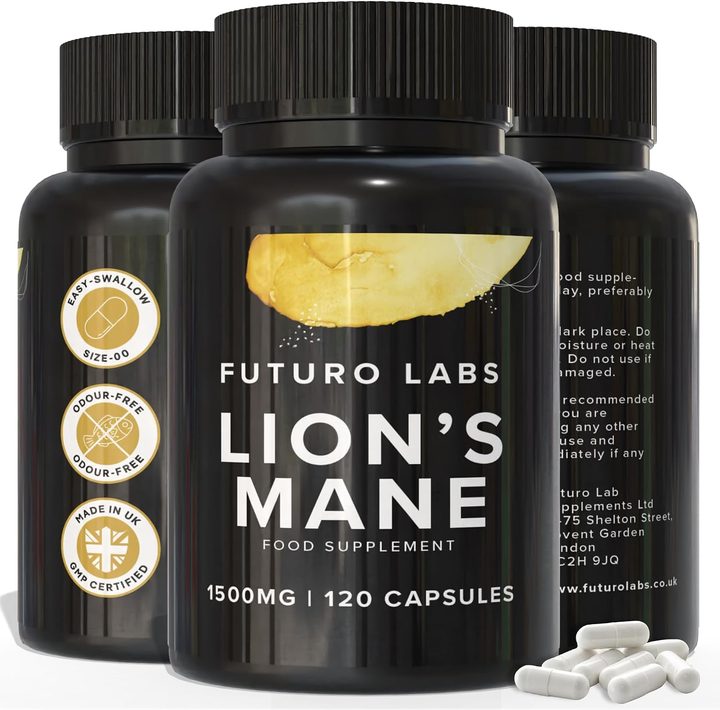
Our brand: the worked example on this page
Futuro Labs Lion's Mane
- 13p a day
- 120 capsules, 1 capsule daily
- Lab tested
- Made in the UK
The dose that needs no spoon: Futuro Labs Lion's Mane on Amazon UK, 1 capsule of about 300mg of 5:1 extract, machine-measured, £15.49 for 120 days at 13p. Full label breakdown. The two-powders trap is on the powder-versus page; the units on the milligrams page.
Why the teaspoon is the wrong tool for extract, and the arithmetic that proves it
A teaspoon is a volume, a dose is a weight, and for lion's mane extract the two are so mismatched that the spoon is the wrong tool rather than an imprecise one. Run the arithmetic: a level teaspoon holds about five millilitres, dried mushroom extract powder has a bulk density somewhere around half a gram per millilitre depending on how finely it is milled and how much it has settled, so a level teaspoon of extract weighs roughly two to three grams, and a heaped one considerably more, against which a capsule's dose is about 300mg of extract, the worked example's 1500mg equivalent, meaning a level teaspoon of extract is something like ten times a label's daily portion, 10,000-to-15,000mg of mushroom equivalent at 5:1, far beyond any direction any tub prints and beyond the trials' amounts several times over. The serving an extract label actually states, typically 300-to-500mg, is therefore about an eighth to a quarter of a level teaspoon, a quantity no eye measures reliably and no kitchen spoon set includes, the drift between a scant eighth and a generous quarter being the whole dose again, so a reader asking how many teaspoons of extract to take has asked a question whose honest answer is a fraction too small to spoon, and the tool that answers it is a pocket scale reading to a tenth of a gram, the powder page's standing instruction for anyone who buys the loose format.
The two powders the teaspoon confuses, the one case where the spoon is nearly right, and the instruction
The teaspoon question survives because the shelf sells two different powders under one name, and for one of them the spoon is nearly right, which is the confusion in full. Plain dried lion's mane powder, the whole fruiting body milled at 1:1, chitin walls intact, the culinary product: a level teaspoon of it is roughly two to three grams of dried mushroom, which happens to sit near the amounts the human trials used, Mori's roughly three grams and Docherty's 1.8 grams of dried fruiting body daily, so a reader spooning plain powder is, by accident of density, in the trials' range, a fact offered as context and not as advice, with the caveats that plain powder is unextracted and delivers less of its contents than the trials' processed tablets did, and that no dose is established for anything. Extract powder, the concentrated product this section prices: the same teaspoon is ten times the label's serving, and the spoon is wrong. So the first instruction is to read the bag, extract with a stated ratio meaning the spoon is the wrong tool and a scale is the right one, plain powder or no ratio meaning a culinary product whose teaspoon is roughly the trials' weight of mushroom and whose supplement value is unquantifiable, the two-powders trap in kitchen form. The instruction that closes the page: for extract, weigh the label's stated serving on a scale, or buy the capsule that weighed it for you at 13p; for plain powder, spoon it into food as the ingredient it is; and never convert between the two by volume, because a teaspoon of one is dinner and a teaspoon of the other is a fortnight.
| The item | Extract powder | Plain dried powder |
|---|---|---|
| A level teaspoon weighs | About 2 to 3 grams | About 2 to 3 grams |
| That is, in mushroom equivalent | 10,000 to 15,000mg at 5:1 | 2,000 to 3,000mg: dried mushroom itself |
| Against the label's serving | Ten times a ~300mg extract dose | No supplement serving exists: a food |
| Against the trials | Several times their amounts | Roughly in their range, unextracted |
| The right tool | A scale to 0.1g, or the capsule | A spoon, into food |
| The verdict | The spoon is wrong | The spoon is nearly right, for dinner |
The verdict, weighed rather than spooned
How much lion's mane per day in teaspoons: for extract powder, no teaspoon fits, a level one weighing roughly two to three grams and delivering ten times a label's serving, the real dose being an eighth to a quarter of a spoon that only a scale measures, while for plain dried powder a teaspoon happens to weigh roughly the trials' amount of mushroom and belongs in food as an ingredient, the two powders never converting by volume. The dose that needed no spoon: Futuro Labs Lion's Mane, one capsule of about 300mg of 5:1 extract, machine-weighed, UK made, lab tested, £15.49 for 120 days at 13p a day, the arithmetic done at the factory so the kitchen drawer stays closed.
What to check on the label
- Treat a teaspoon as a volume: a dose is a weight.
- Run the extract arithmetic: a level spoon is ten times the serving.
- Read which powder you have: extract with ratio, or plain 1:1.
- Weigh extract on a scale: an eighth of a spoon is not measurable by eye.
- Or buy the capsule: the factory already weighed it.
Our brand
The worked example: Futuro Labs Lion's Mane
Futuro Labs Lion's Mane: 1 capsule daily of 5:1 fruiting body extract, labelled 1500mg mushroom equivalent (about 300mg extract), 120 capsules for £15.49, 120 days at 13p a day. Vegan HPMC shell, UK made under GMP and BRC, independently lab tested, caffeine free. Lion's mane holds no authorised UK health claims; this site describes its small studies as studies.
- Extract
- fruiting body, 5:1
- Per capsule
- 1500mg mushroom equivalent
- Serving
- 1 capsule a day
- Bottle
- 120 capsules, 120 days
- Price
- £15.49 (13p a day)
- Capsule
- HPMC vegan shell, size 00
Questions people also ask
How many teaspoons of lion's mane extract should I take?
None that fits: a level teaspoon of extract weighs roughly two to three grams, about ten times a label's 300-to-500mg serving, so the real dose is an eighth to a quarter of a spoon that only a scale measures.
How much does a teaspoon of lion's mane powder weigh?
Roughly two to three grams, level, for either powder, the bulk density of milled mushroom being around half a gram per millilitre and varying with milling and settling.
Is a teaspoon of plain lion's mane powder a reasonable dose?
By accident of density it sits near the trials' 1.8-to-3-gram amounts of dried mushroom, offered as context, though plain powder is unextracted and delivers less than processed preparations, and no dose is established.
What tool should I use for extract powder?
A pocket scale reading to a tenth of a gram, weighing the label's stated serving, or the capsule that did the weighing at the factory, since the drift between a scant and generous fraction of a spoon is the whole dose.
Can I convert capsule doses to teaspoons?
No: a capsule holds about 300mg of extract and a teaspoon holds two to three grams, so the conversion is a fraction of a spoon no eye measures, which is why the two formats are never compared by volume.
Sources
- The medicinal mushroom labelling discussion: fruiting body versus mycelium-on-grain, extract ratios and beta-glucan content as the label facts that separate concentrated extracts from diluted powders. PubMed record
- Mori K, Inatomi S, Ouchi K, Azumi Y, Tuchida T. Improving effects of the mushroom Yamabushitake (Hericium erinaceus) on mild cognitive impairment: a double-blind placebo-controlled clinical trial. Phytotherapy Research 2009;23(3):367-372. PubMed record
- Docherty S, Doughty FL, Smith EF. The acute and chronic effects of lion's mane mushroom supplementation on cognitive function, stress and mood in young adults: a double-blind, parallel groups, pilot study. Nutrients 2023;15(22):4842. PubMed record
- EFSA Panel on Dietetic Products, Nutrition and Allergies. Scientific Opinion on the substantiation of health claims related to magnesium. EFSA Journal 2010;8(10):1807. https://efsa.onlinelibrary.wiley.com/doi/10.2903/j.efsa.2010.1807