Ghost Fitness/Lion's mane/How much lion's mane is safe to take a day?
How much lion's mane is safe to take a day?
The short answer
Safe and effective are different questions: the label's portion is the assessed ceiling, the trials' 1.8 to 3 grams of dried mushroom were tolerated, and the species has centuries of food history. No upper level exists.
- The label's ceilingthe stated portion with a do-not-exceed warning: the only assessed figure
- The trials' tolerated doses1.8 to 3 grams of dried fruiting body daily, no serious adverse events
- The food historya culinary species eaten by the plateful for centuries
- The reported issuesmild stomach upset in some; allergic reactions rarely
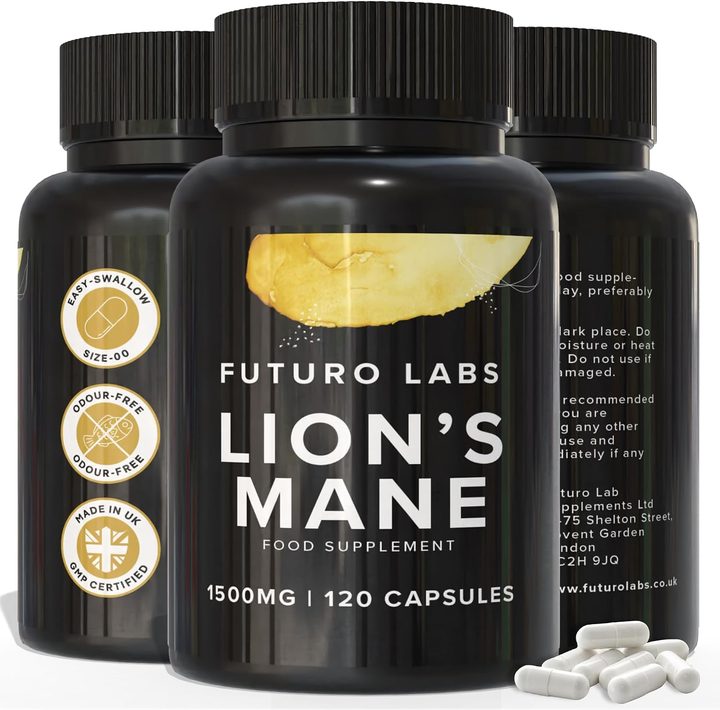
Our brand: the worked example on this page
Futuro Labs Lion's Mane
- 13p a day
- 120 capsules, 1 capsule daily
- Lab tested
- Made in the UK
A portion with its warning printed: Futuro Labs Lion's Mane on Amazon UK, 1 capsule daily, do not exceed the stated dose, 5:1 fruiting body extract, £15.49 for 120 days at 13p. Full label breakdown. The dose page is here; the exclusions on the cannot-be-taken page.
Safe and effective separated, because the safety picture is clearer than the effect picture and deserves its own answer
How much is safe is a different question from how much works, and lion's mane's safety picture is clearer than its effect picture, so answer it on its own terms. The first fact is that no established effective dose exists, the dose pages' standing finding, so the safe question cannot be answered as the dose that works without harm, there being no dose that works to compare, and the honest safe answer instead has four parts. The label's ceiling: a food supplement must state a recommended daily portion and a warning not to exceed it, and that portion, one capsule daily on the worked example, is the only figure any assessment has attached to a specific product, the manufacturer's chosen amount within the law's frame, so the label is the ceiling a reader can point to as assessed and the answer to how much is safe for that tub. The trials' tolerated doses: the human studies gave roughly 1.8 grams and roughly 3 grams of dried fruiting body daily for 28 days and sixteen weeks respectively, and reported no serious adverse events, the tolerability picture being uneventful at grams-scale, which translates through the ratio maths to roughly 360-to-600mg of 5:1 extract, amounts above the worked example's capsule that were, in those trials, tolerated, offered as tolerability context and not as a suggestion to exceed a label. The food history: lion's mane is a culinary mushroom eaten by the plateful in East Asian and increasingly Western kitchens for centuries, a plate being tens of grams of fresh mushroom, a few grams dried, so the species carries a long food-safety record at amounts well above any capsule, the reassurance being that the extract concentrates a food and the capsule delivers a fraction of a dinner.
What no upper level means, the issues that are actually reported, and the safe answer filed
No upper level exists for lion's mane, and the absence needs interpreting rather than celebrating: tolerable upper intake levels are set for nutrients, vitamins and minerals with defined toxicity thresholds, vitamin D at 100 micrograms, and lion's mane is not a nutrient but a food extract, so no regulator has set a ceiling because none has been characterised, which means the absence of an upper level is the absence of a study rather than a finding of unlimited safety, and the sensible reading is that the label's portion and the trials' grams-scale amounts are the territory where safety has actually been observed, with anything far beyond them being untested rather than known-safe. The issues that are actually reported are modest and worth naming plainly: mild gastrointestinal upset in some users, the with-a-meal direction's reason, and rare allergic reactions, lion's mane being a fungus and mushroom allergy being real, the fungal-allergy exclusion the interaction pages hold, alongside the categorical exclusions for pregnancy and breastfeeding, where no data exists and the default is avoidance, and for under-eighteens, whom this site does not advise, and the theoretical bench signals on clotting and glucose that earn a pharmacist mention for those on the relevant medicines. The safe answer filed: the label's portion is the assessed ceiling for any given tub and the only lawful instruction, the trials' 1.8-to-3 grams of dried mushroom daily were tolerated without serious events, the species has centuries of food history at amounts above any capsule, no upper level exists because none has been studied, and the reported issues are stomach upset and rare allergy, the worked example printing its portion and its warning and, on this safety picture, offering one capsule a day of a food extract to a healthy adult with nothing more alarming behind it than a plate of mushrooms.
| The item | The finding | The reading |
|---|---|---|
| The label's ceiling | The stated portion, do not exceed | The only assessed figure for a given tub |
| The trials' doses | 1.8 to 3g dried fruiting body daily, tolerated | Context for tolerability, not a suggestion |
| The food history | Centuries as a culinary mushroom, by the plateful | A capsule is a fraction of a dinner |
| No upper level | None set: not a nutrient, not characterised | Untested beyond the trials, not known-safe |
| The reported issues | Mild stomach upset; rare allergy | The with-a-meal direction; the fungal-allergy exclusion |
| The exclusions | Pregnancy, breastfeeding, minors, fungal allergy | Avoid where no data exists |
The verdict, safe by label, trial and dinner
How much lion's mane is safe to take a day: safe being a different question from effective, the label's portion is the assessed ceiling for any tub, the trials' 1.8-to-3 grams of dried fruiting body daily were tolerated without serious adverse events, the species carries centuries of food history at amounts well above any capsule, no upper level exists because none has been studied rather than because none is needed, and the reported issues are mild stomach upset and rare fungal allergy, with pregnancy, breastfeeding and minors excluded for want of data. The portion with its warning printed: Futuro Labs Lion's Mane, one capsule daily, do not exceed, 5:1 fruiting body extract, UK made, lab tested, £15.49 for 120 days at 13p a day, a food extract at a fraction of a dinner's worth.
What to check on the label
- Separate safe from effective: no effective dose exists to anchor either.
- Treat the label as the ceiling: the only assessed figure per tub.
- Read the trials as tolerability: grams-scale, no serious events.
- Remember the plate: centuries of food history above any capsule.
- Interpret no upper level correctly: unstudied, not unlimited.
Our brand
The worked example: Futuro Labs Lion's Mane
Futuro Labs Lion's Mane: 1 capsule daily of 5:1 fruiting body extract, labelled 1500mg mushroom equivalent (about 300mg extract), 120 capsules for £15.49, 120 days at 13p a day. Vegan HPMC shell, UK made under GMP and BRC, independently lab tested, caffeine free. Lion's mane holds no authorised UK health claims; this site describes its small studies as studies.
- Extract
- fruiting body, 5:1
- Per capsule
- 1500mg mushroom equivalent
- Serving
- 1 capsule a day
- Bottle
- 120 capsules, 120 days
- Price
- £15.49 (13p a day)
- Capsule
- HPMC vegan shell, size 00
Questions people also ask
Is lion's mane safe to take every day?
On the evidence, yes for healthy adults: the trials ran daily for up to sixteen weeks at grams-scale doses without serious adverse events, and the species has centuries of food history, with the label's portion as the assessed daily ceiling.
What is the maximum safe dose of lion's mane?
No upper level has been set, because lion's mane is a food extract rather than a nutrient with a characterised toxicity threshold, so the label's stated portion is the only assessed ceiling and amounts far beyond the trials' grams are untested rather than known-safe.
What side effects does lion's mane have?
Mild gastrointestinal upset in some users, addressed by the with-a-meal direction, and rare allergic reactions, since it is a fungus and mushroom allergy is real.
Who should not take lion's mane at all?
Anyone pregnant or breastfeeding, where no safety data exists, anyone with a mushroom or fungal allergy, and anyone under eighteen, with those on anticoagulant, antiplatelet, diabetes or immunosuppressant medication mentioning it to a pharmacist or clinician.
Can I take more than the label says if the trials used more?
That is your decision against the label's printed warning: the trials' grams-scale doses were tolerated in their populations, but no dose is established as effective and the label's portion is the only figure assessed for your tub.
Sources
- The Hericium erinaceus tolerability literature: human trials at grams-scale daily doses of fruiting-body preparations reported no serious adverse events, with mild gastrointestinal complaints and rare allergic reactions the reported issues, and a long history of the species as food. PubMed record
- Mori K, Inatomi S, Ouchi K, Azumi Y, Tuchida T. Improving effects of the mushroom Yamabushitake (Hericium erinaceus) on mild cognitive impairment: a double-blind placebo-controlled clinical trial. Phytotherapy Research 2009;23(3):367-372. PubMed record
- Docherty S, Doughty FL, Smith EF. The acute and chronic effects of lion's mane mushroom supplementation on cognitive function, stress and mood in young adults: a double-blind, parallel groups, pilot study. Nutrients 2023;15(22):4842. PubMed record
- The Food Supplements (England) Regulations 2003. https://www.legislation.gov.uk/uksi/2003/1387/contents/made