Ghost Fitness/Lion's mane/How much lion's mane dosage should you take for memory?
How much lion's mane dosage should you take for memory?
The short answer
No memory dose exists because no memory claim exists: the one reference point is the Mori trial, about 3 grams of dried fruiting body daily for sixteen weeks in older adults with mild impairment. Take the label's direction.
- The claimnone: memory is unclaimed by any nutrient, let alone a mushroom
- The one reference pointMori 2009: about 3g of dried fruiting body daily, 16 weeks
- The populationolder adults with diagnosed mild cognitive impairment
- The instructionthe label's direction: one capsule daily on the worked example
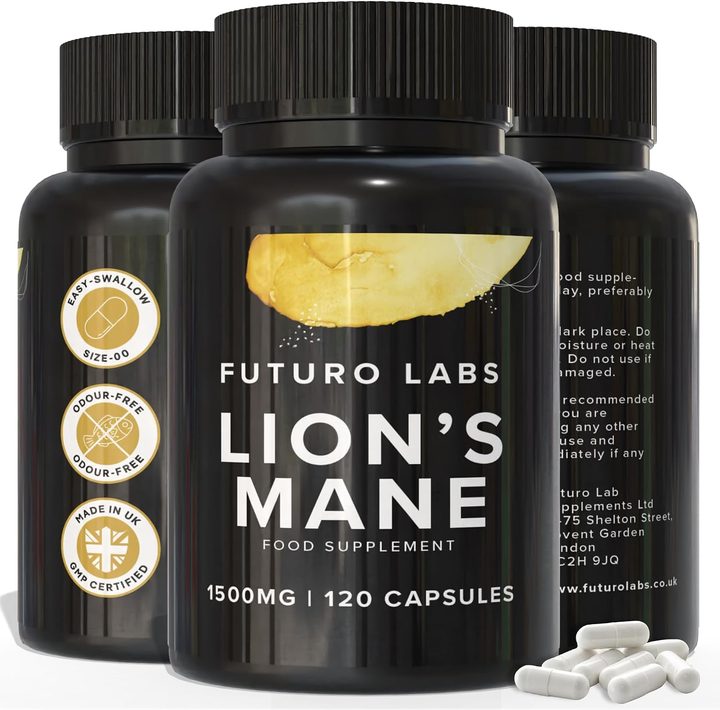
Our brand: the worked example on this page
Futuro Labs Lion's Mane
- 13p a day
- 120 capsules, 1 capsule daily
- Lab tested
- Made in the UK
A stated portion, no memory word: Futuro Labs Lion's Mane on Amazon UK, 1 capsule daily, 1500mg mushroom equivalent, £15.49 for 120 days at 13p. Full label breakdown. The absent-word teach is on the memory page; the general dose page is here.
Why no memory dose can exist, and the single trial that is the only reference point anyone has
A dose for memory presupposes that lion's mane does something for memory at some amount, and the register removes the premise before any number is discussed: memory holds no authorised claim for any nutrient in the UK, not for the minerals, B vitamins or DHA that hold the nearest cognitive sentences, and certainly not for a mushroom, so no memory dose has ever been assessed, no product may print one, and the question's honest answer is that no such dose exists because no such claim exists, the memory page's absent-word teach applied to milligrams. What remains is the single reference point anyone has, and this page states it precisely because the marketing states it vaguely: the Mori 2009 trial gave older Japanese adults, fifty to eighty, with diagnosed mild cognitive impairment, fruiting-body tablets totalling roughly three grams of dried mushroom powder a day, in three divided doses, for sixteen weeks, with cognitive scores on a standard scale improving against placebo and declining after supplementation stopped, one small trial, one preparation, one population, the closest thing to a memory-adjacent dose in the literature and a reference point rather than a recommendation for four reasons, that it studied impaired older adults rather than healthy lifters, that it used dried powder tablets rather than a modern extract, that no dose-response was tested so nobody knows whether more or less would have done the same, and that no replication has confirmed it since.
The reference point translated, the extrapolation gap kept in view, and the instruction that actually governs a capsule
Translate the reference point honestly for the reader holding an extract capsule: three grams of dried mushroom is 3000mg of mushroom equivalent, which the ratio maths renders as about 300mg of a 10:1 extract or 600mg of a 5:1, and the worked example's single capsule delivers 1500mg equivalent, about 300mg of 5:1, half the Mori daily amount, a comparison offered as context and not as a suggestion to double anything, because the extrapolation gap stays in view the whole way, the trial's population being older adults whose scores had room to move, its outcome a clinical scale rather than a healthy lifter's recall of a workout log, and the sensible inference for a healthy adult being that nothing has been shown at any dose, three grams included. The instruction that actually governs a capsule is therefore the label's, one daily on the worked example, with the warning not to exceed it printed as the law requires, and the honest position for the reader who wants a memory dose is the section's standing one: take the label's direction, treat the Mori trial as the only reference point and read it at its true size, run the sixteen-week clock with expectations flat, and know that a product printing a memory dose has printed a memory claim, the instant fail, since the two cannot be separated. The worked example prints neither, a stated portion with its equivalent maths and no memory word anywhere, which is what an honest label looks like on a question whose answer the register has already given.
| The item | The finding | The consequence |
|---|---|---|
| The memory claim | None exists for any nutrient | No memory dose can be assessed or printed |
| The reference point | Mori 2009: ~3g dried fruiting body daily, 16 weeks | Context, not recommendation |
| The population | Older adults with mild cognitive impairment | The extrapolation gap to healthy lifters |
| The translation | 3g dried is ~300mg of 10:1 or ~600mg of 5:1 | The worked example's capsule is half the Mori amount |
| The instruction | The label's direction | One capsule daily; do not exceed |
| The tell | A printed memory dose | A printed memory claim: instant fail |
The verdict, a reference point and a label
How much lion's mane dosage for memory: none, because no memory claim exists for any nutrient and no memory dose can therefore be assessed or printed, the single reference point being the Mori trial's roughly three grams of dried fruiting body daily for sixteen weeks in older adults with mild impairment, translated for context to about 300-to-600mg of extract and kept behind its extrapolation gap, with the label's direction governing any actual capsule. The stated portion, worked: Futuro Labs Lion's Mane, one capsule daily, 1500mg mushroom equivalent, about 300mg of 5:1 extract, UK made, lab tested, £15.49 for 120 days at 13p a day, printing its maths and no memory word, which is the only honest label on this question.
What to check on the label
- No claim, no dose: memory is unclaimed by everything.
- Know the one reference point: Mori, ~3g dried daily, 16 weeks, MCI adults.
- Translate it honestly: ~300-600mg of extract, as context.
- Keep the gap in view: impaired older adults are not healthy lifters.
- Follow the label: a printed memory dose is a printed memory claim.
Our brand
The worked example: Futuro Labs Lion's Mane
Futuro Labs Lion's Mane: 1 capsule daily of 5:1 fruiting body extract, labelled 1500mg mushroom equivalent (about 300mg extract), 120 capsules for £15.49, 120 days at 13p a day. Vegan HPMC shell, UK made under GMP and BRC, independently lab tested, caffeine free. Lion's mane holds no authorised UK health claims; this site describes its small studies as studies.
- Extract
- fruiting body, 5:1
- Per capsule
- 1500mg mushroom equivalent
- Serving
- 1 capsule a day
- Bottle
- 120 capsules, 120 days
- Price
- £15.49 (13p a day)
- Capsule
- HPMC vegan shell, size 00
Questions people also ask
Is there a recommended lion's mane dose for memory?
No: memory holds no authorised claim for any nutrient, so no memory dose has been assessed and none may be printed, the label's stated daily portion being the only instruction a product can give.
What dose did the memory study use?
The Mori 2009 trial used fruiting-body tablets totalling about three grams of dried mushroom powder daily, in divided doses, for sixteen weeks, in older adults with diagnosed mild cognitive impairment.
How does that compare to a capsule?
Three grams of dried mushroom is 3000mg equivalent, about 300mg of a 10:1 or 600mg of a 5:1 extract; the worked example's capsule delivers 1500mg equivalent, half the Mori amount, a comparison offered as context only.
Should I take more to match the study?
Nothing has been shown at any dose in healthy adults, the trial studied impaired older people with room to improve, and exceeding a label's portion is your decision against its printed warning, not this site's advice.
What if a product states a memory dose?
It has stated a memory claim, since the two cannot be separated, and that is the forensics pages' instant fail regardless of the number attached.
Sources
- Mori K, Inatomi S, Ouchi K, Azumi Y, Tuchida T. Improving effects of the mushroom Yamabushitake (Hericium erinaceus) on mild cognitive impairment: a double-blind placebo-controlled clinical trial. Phytotherapy Research 2009;23(3):367-372. PubMed record
- The GB nutrition and health claims register, cognitive entries: iron, zinc and iodine hold normal cognitive function; B vitamins hold normal psychological function; pantothenic acid holds normal mental performance; DHA holds maintenance of normal brain function at 250mg. https://www.gov.uk/government/publications/great-britain-nutrition-and-health-claims-nhc-register
- Retained Regulation (EC) No 1924/2006 on nutrition and health claims made on foods, and the Great Britain nutrition and health claims register. https://www.gov.uk/government/publications/great-britain-nutrition-and-health-claims-nhc-register
- The medicinal mushroom labelling discussion: fruiting body versus mycelium-on-grain, extract ratios and beta-glucan content as the label facts that separate concentrated extracts from diluted powders. PubMed record