Ghost Fitness/Lion's mane/How many mg of lion's mane per day?
How many mg of lion's mane per day?
The short answer
Milligrams of what: one capsule can be 300mg of extract, 1500mg of mushroom equivalent, and a fraction of the trials' 1,800 to 3,000mg of dried mushroom, all at once. Read which unit the label uses, then follow its direction.
- Unit one: extract milligramsthe actual powder in the capsule: ~300mg on the worked example
- Unit two: mushroom equivalentextract times ratio: 1500mg on the worked example
- Unit three: dried mushroomthe trials' unit: about 1,800 to 3,000mg a day
- The instructionthe label's direction in whatever unit it uses
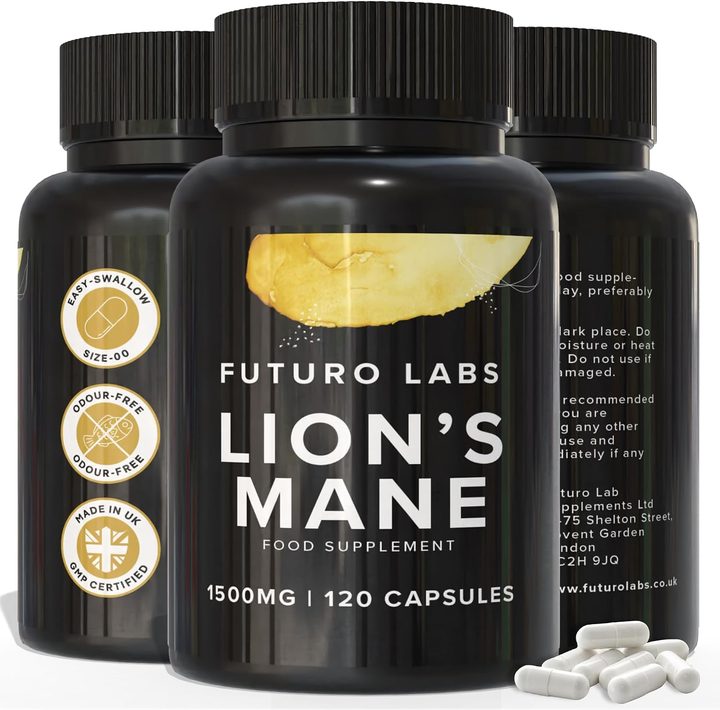
Our brand: the worked example on this page
Futuro Labs Lion's Mane
- 13p a day
- 120 capsules, 1 capsule daily
- Lab tested
- Made in the UK
Both units printed on one label: Futuro Labs Lion's Mane on Amazon UK, 1500mg mushroom equivalent from about 300mg of 5:1 extract per capsule, £15.49 for 120 days at 13p. Full label breakdown. The dose page is here; the ratio maths on the ratio page.
The three milligrams one capsule can be, because the question cannot be answered until the unit is named
How many milligrams of lion's mane per day cannot be answered until the unit is named, because a single capsule can be honestly described in three different milligram figures at once, and the shelf uses all three without saying which. Unit one, extract milligrams: the actual weight of dried extract powder inside the capsule, the number the factory filled to, roughly 300mg on the worked example, the figure the ratio pages call the real milligrams and the denominator every honest comparison needs. Unit two, mushroom equivalent: the extract milligrams multiplied by the extract ratio, describing how much dried mushroom that extract represents, 300mg of 5:1 being 1500mg equivalent, 300mg of 10:1 being 3000mg equivalent, the number most labels print largest and the one that inflates with the ratio while the capsule stays the same size, the high-strength page's banner trap. Unit three, dried mushroom milligrams: the unit the human trials used, dried fruiting-body powder by weight, roughly 3,000mg a day in the Mori trial and 1,800mg a day in the Docherty pilot, grams of mushroom rather than milligrams of extract, so that a trial's 3,000mg and a label's 3,000mg equivalent describe the same amount of mushroom while a label's 300mg extract describes a tenth of the weight and the same thing. One capsule, three honest numbers, and a forum thread quoting milligrams without units is comparing extract to equivalent to dried mushroom as if they were one currency, which is how 300mg and 3,000mg end up in the same argument about the same product.
The units converted on one line, the label read in its own unit, and the direction that follows
Convert the units on one line and the confusion clears: extract milligrams times ratio equals mushroom-equivalent milligrams, which equals dried-mushroom milligrams for comparison with the trials, so 300mg of 5:1 extract is 1500mg equivalent is 1.5g of dried mushroom, half the Mori daily amount and a little under the Docherty one, and 600mg of 5:1 or 300mg of 10:1 would be 3000mg equivalent, the Mori amount, arithmetic offered as context and never as a suggestion to exceed a label. Read any label in its own unit before comparing it to anything: a panel stating 500mg lion's mane with no ratio is stating extract milligrams, or possibly plain powder, and cannot be converted at all, the incomplete-ratio tell; a panel stating 3000mg equivalent with no extract weight or ratio is stating unit two without the two numbers that make it checkable; and a panel stating both, extract milligrams and ratio with the equivalent printed, has given all three units and can be compared with any trial and any competitor on pence per equivalent milligram. The direction that follows is the section's standing one, because no established dose exists in any unit: the label's stated daily portion is the instruction, one capsule daily on the worked example, with its milligrams honestly printed in two units, about 300mg of extract and 1500mg mushroom equivalent, and its warning not to exceed the portion being a legal particular rather than a hint, so the honest answer to how many milligrams per day is whatever your label directs, in whatever unit it uses, read correctly, with the trials' grams-scale dried-mushroom figures as context for the reader who wants to know how the one reference range compares.
| The unit | What it measures | The worked example |
|---|---|---|
| Extract milligrams | The powder actually in the capsule | About 300mg of 5:1 |
| Mushroom equivalentOurs | Extract times ratio: dried mushroom represented | 1500mg |
| Dried mushroom, the trials' unit | Dried fruiting body by weight | The same 1.5g; Mori used ~3g, Docherty ~1.8g |
| The conversion | Extract x ratio = equivalent = dried mushroom | One line, three units |
| The unreadable label | A bare milligram with no ratio | Cannot be converted or compared |
| The direction | The label's portion, in its own unit | One capsule daily; do not exceed |
The verdict, in the right unit
How many milligrams of lion's mane per day: milligrams of what, since one capsule is honestly about 300mg of extract, 1500mg of mushroom equivalent and 1.5g of dried mushroom at once, the trials having used the third unit at roughly 1,800 to 3,000mg a day, the conversion running extract times ratio equals equivalent equals dried mushroom, and the instruction being the label's portion in whatever unit it prints, read correctly, with no established dose existing in any of them. The label that prints two units honestly: Futuro Labs Lion's Mane, one capsule daily, about 300mg of 5:1 extract at 1500mg mushroom equivalent, UK made, lab tested, £15.49 for 120 days at 13p a day, a milligram figure that means something because the unit stands beside it.
What to check on the label
- Name the unit first: extract, equivalent, or dried mushroom.
- Convert on one line: extract times ratio equals equivalent.
- Read the trials in their unit: 1,800-3,000mg of dried mushroom.
- Reject unitless milligrams: a bare figure cannot be compared.
- Follow the label's portion: in its own unit, no dose being established.
Our brand
The worked example: Futuro Labs Lion's Mane
Futuro Labs Lion's Mane: 1 capsule daily of 5:1 fruiting body extract, labelled 1500mg mushroom equivalent (about 300mg extract), 120 capsules for £15.49, 120 days at 13p a day. Vegan HPMC shell, UK made under GMP and BRC, independently lab tested, caffeine free. Lion's mane holds no authorised UK health claims; this site describes its small studies as studies.
- Extract
- fruiting body, 5:1
- Per capsule
- 1500mg mushroom equivalent
- Serving
- 1 capsule a day
- Bottle
- 120 capsules, 120 days
- Price
- £15.49 (13p a day)
- Capsule
- HPMC vegan shell, size 00
Questions people also ask
How many mg of lion's mane extract should I take daily?
The label's stated portion: no established dose exists, and the worked example's one capsule holds about 300mg of 5:1 extract, 1500mg mushroom equivalent, printed with both units so the figure means something.
Why do lion's mane doses range from 300mg to 3000mg online?
Different units: 300mg of extract, 1500mg of mushroom equivalent and 3000mg of dried mushroom can describe similar amounts, and forum threads quoting milligrams without units compare three currencies as one.
What is the difference between extract mg and mushroom equivalent mg?
The ratio: extract milligrams are the powder in the capsule, and multiplying by the extract ratio gives the mushroom equivalent, the dried mushroom the extract represents, 300mg of 5:1 being 1500mg equivalent.
How do the trial doses compare in these units?
The trials used dried mushroom by weight, about 3,000mg a day in Mori and 1,800mg in Docherty, which equals 3,000 and 1,800mg equivalent, or 600 and 360mg of 5:1 extract, offered as context and not as advice.
What if a label just says 500mg lion's mane?
It has stated extract milligrams, or possibly plain powder, with no ratio, so the figure cannot be converted to equivalent or compared with anything, the incomplete-ratio tell that walks a buyer past.
Sources
- Mori K, Inatomi S, Ouchi K, Azumi Y, Tuchida T. Improving effects of the mushroom Yamabushitake (Hericium erinaceus) on mild cognitive impairment: a double-blind placebo-controlled clinical trial. Phytotherapy Research 2009;23(3):367-372. PubMed record
- Docherty S, Doughty FL, Smith EF. The acute and chronic effects of lion's mane mushroom supplementation on cognitive function, stress and mood in young adults: a double-blind, parallel groups, pilot study. Nutrients 2023;15(22):4842. PubMed record
- The medicinal mushroom labelling discussion: fruiting body versus mycelium-on-grain, extract ratios and beta-glucan content as the label facts that separate concentrated extracts from diluted powders. PubMed record
- The mushroom polysaccharide analysis literature: beta-glucan content marks fungal material while high alpha-glucan readings indicate grain starch, the analytical distinction between fruiting body extracts and mycelium-on-grain powders. PubMed record