Ghost Fitness/Collagen/How to make collagen a complete protein?
How to make collagen a complete protein?
The short answer
Two meanings of complete. On paper: adding tryptophan supplies the one essential amino acid collagen lacks entirely and lifts its quality score off zero, a real change to the number. For muscle: no addition works, since collagen stays low in leucine and the other essential amino acids relative to whey, milk and egg. The honest route is pairing collagen with a complete protein in the same meal, which completes the meal rather than the collagen.
- Complete on paperadd tryptophan: the missing essential amino acid supplied; the quality score lifts off zero
- Complete for muscleno addition: leucine stays low; the essential amino acid profile stays below whey, milk and egg; the comparisons stay lost
- The honest routea complete protein in the same meal: whey in the shake, eggs at breakfast; the meal is complete, not the collagen
- The reasoncollagen for its own reason; the muscle target from complete sources
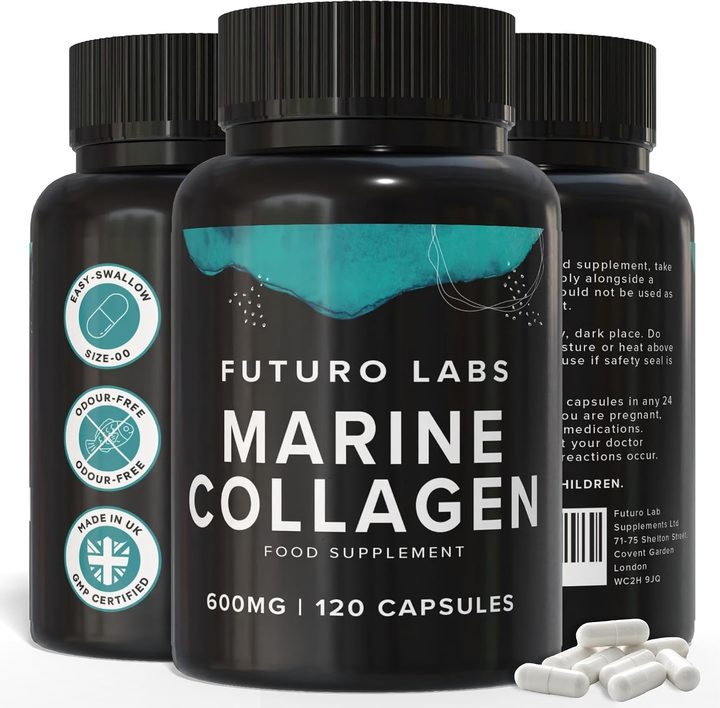
Our brand: the worked example on this page
Futuro Labs Marine Collagen
- 28p a day
- 120 capsules, 2 capsules daily
- Lab tested
- Made in the UK
A collagen dose taken for its own reason beside a complete plate: Futuro Labs Marine Collagen on Amazon UK, 2 capsules, 1200mg hydrolysed type 1 marine collagen with 12mg vitamin C at 15% NRV plus zinc, 120 for £16.99, 28p a day. Full label breakdown. Collagen against whey on amino acids is on the amino acid profile page; the shake's ledger on the together page.
Complete on paper, what adding tryptophan does to the score and what it leaves alone
How to make collagen a complete protein is a question with two meanings of complete inside it, and the honest page answers each, because one can be done on a label and the other cannot be done at all. Complete on paper: a protein's quality score, PDCAAS or DIAAS, counts the nine essential amino acids against a reference pattern and takes the lowest as the limiting one, and collagen's limiting amino acid is tryptophan, which it lacks entirely, so its score is at or near zero however much of the others it carries, the protein quality literature's arithmetic, and the fix on paper is to add tryptophan, which some fortified collagen products do, blending in enough free tryptophan to supply the missing essential and lifting the score off zero to a number that can be printed, the fortified collagen scoring literature's finding, a real change to the number and an honest one as far as it goes. What it leaves alone is the rest of the profile: collagen is glycine at roughly every third residue with proline and hydroxyproline in quantity, the collagen composition literature's profile, and after the tryptophan is added it remains low in leucine, at a fraction of whey's ten percent, and low in the other essential amino acids relative to whey, milk and egg, so the score rises from zero to a modest figure and stops well below the complete proteins a lifter eats, which is why complete on paper is a label's achievement and not a nutritional one, and why a tub that prints complete protein after fortification has told a reader something true about a score and nothing about muscle.
Complete for muscle, which no addition achieves, the honest route through the meal, and the meanings filed
Complete for muscle is what a lifter means, and no fortification achieves it. Muscle protein synthesis is switched on by a leucine dose, two to three grams in a serving, delivered with the full set of essential amino acids that the rebuild uses, the synthesis literature's trigger, and whey, milk, egg and meat supply that in twenty to forty grams, while collagen supplies a fraction of the leucine at any serving size and cannot be made to supply more by adding tryptophan, since the leucine was never the missing piece the tryptophan fixes, the leucine literature's finding that a protein's leucine content drives its synthesis response and that whey outperforms collagen in direct comparison, and the whey-versus-collagen trials finding whey producing the greater anabolic response on synthesis and lean mass. A reader could in principle add leucine too, and at that point they have built a poor whey out of an expensive collagen and should have bought the whey. The honest route runs through the meal rather than the tub: pair collagen with a complete protein in the same meal, a scoop in the whey shake, a scoop in the porridge beside the eggs, a scoop in the yoghurt, and the meal is complete, its leucine and essential amino acids supplied by the whey, the eggs or the yoghurt and its glycine, proline and hydroxyproline supplied by the collagen, the together page's ledger, which is exactly how a meal of chicken and rice is complete without the rice being a complete protein. That route makes the meal complete and leaves the collagen what it is, an incomplete protein taken for its own reason, the tendon protocol at around 15 grams with vitamin C or the skin trials' dose, recorded on the label and not toward the muscle target, the two-column page's tracker, with the register holding no collagen claim and the muscle sentences belonging to protein from complete sources. The meanings filed: complete on paper achieved by adding tryptophan and lifting the score off zero, complete for muscle unachievable since leucine stays low and the comparisons stay lost, the honest route being a complete protein in the same meal, and collagen taken for its own reason, with the worked example being a collagen dose beside a complete plate, £16.99 for 120 at 28p a day.
| The meaning | Can it be done? | How, and what it leaves |
|---|---|---|
| Complete on paper | Yes | Add tryptophan: the missing essential supplied; the quality score lifts off zero to a modest figure |
| What fortification leaves alone | Unchanged | Leucine at a fraction of whey's; the essential amino acid profile below whey, milk and egg |
| Complete for muscle | No | Muscle protein synthesis needs a leucine dose with the full essential set; collagen cannot be fortified into that without becoming a poor whey |
| The honest route | Yes, for the meal | Pair collagen with a complete protein in the same meal: whey, eggs, yoghurt; the meal is complete, the collagen is not |
| What collagen is for | Its own reason | The tendon protocol with vitamin C; the skin trials' dose; on the label, not the target |
| The register | No collagen claim | Muscle sentences belong to protein from complete sources |
The verdict, a score that tryptophan can fix and a muscle protein that nothing can make of it, with the meal as the honest place to be complete
How to make collagen a complete protein: on paper, by adding tryptophan, the one essential amino acid collagen lacks entirely, which lifts its quality score off zero to a modest figure as some fortified products do, and for muscle, not at all, since collagen stays low in leucine and the other essential amino acids relative to whey, milk and egg however much tryptophan is added and cannot supply the leucine dose that switches muscle protein synthesis on, so the honest route is to pair collagen with a complete protein in the same meal, whey in the shake or eggs at breakfast, which makes the meal complete rather than the collagen, and to take the collagen for its own reason on the label and not toward the muscle target. A collagen dose beside a complete plate: Futuro Labs Marine Collagen, 1200mg type 1 with 12mg vitamin C, 120 for £16.99 at 28p a day.
What to check on the label
- Name which complete you mean: on paper or for muscle.
- Read a fortified label for what it fixed: the score, via tryptophan.
- Read what it left: the leucine, and the comparisons with whey.
- Complete the meal instead: whey, eggs or yoghurt beside the scoop.
- Take collagen for its own reason: not as a muscle protein.
Our brand
The worked example: Futuro Labs Marine Collagen
Futuro Labs Marine Collagen: 2 capsules daily, 1200mg hydrolysed type 1 marine collagen with 12mg vitamin C and 1.5mg zinc (15% NRV each), 120 capsules for £16.99, 60 days at 28p a day, lab-tested, UK GMP made. Slim veggie-shell capsules, odour free. Fish derived: pescatarian, not vegetarian or vegan.
- Collagen per serving
- 1200mg hydrolysed type 1 marine (fish)
- Co-factors
- vitamin C 12mg (15% NRV), zinc 1.5mg (15% NRV)
- Serving
- 2 capsules a day
- Bottle
- 120 capsules, 60 days
- Price
- £16.99 (28p a day)
- Capsule
- slim size 00, veggie shell, odour free
Questions people also ask
Can adding tryptophan make collagen a complete protein?
On paper, yes: tryptophan is the essential amino acid collagen lacks entirely and the one that pins its quality score at zero, so a fortified product that adds it lifts the score to a modest figure, while the leucine and the rest of the essential profile stay well below whey, milk and egg, so the number changes and the muscle-building capacity does not.
Does collagen build muscle if you add other amino acids?
Only if you add so much leucine and the other essentials that you have built a poor whey out of an expensive collagen: muscle protein synthesis needs a leucine dose with the full essential set, whey supplies it in twenty to forty grams, and collagen fortified with tryptophan alone still carries a fraction of the leucine, with the direct comparisons still favouring whey.
What should I eat with collagen to make it complete?
A complete protein in the same meal: whey in the shake, eggs at breakfast, yoghurt or milk with the scoop, meat or fish at the meal, which supplies the leucine and essential amino acids the collagen lacks and makes the meal complete, in the way chicken and rice make a complete meal without the rice being a complete protein.
Why does a collagen tub say complete protein?
Because it has been fortified with tryptophan and its quality score has been lifted off zero, which is true about the score and silent about the leucine, so a reader reads complete protein on a collagen label as a fortification claim about a scale and not as a statement that the tub builds muscle like whey.
Is collagen worth taking if it is not a complete protein?
For its own reason, yes: the tendon pre-loading protocol at around 15 grams with vitamin C an hour before loading, or the skin trials' 2.5 to 10 grams with modest expectation, taken on top of a complete diet, counted on the label and not toward the muscle target, and never as a replacement for the whey or the meal.
Sources
- The amino acid scoring of fortified collagen: adding tryptophan to a collagen peptide product lifts its protein quality score off zero by supplying the one essential amino acid it lacks entirely, while leaving it low in leucine and the other essential amino acids relative to whey, milk and egg, so the score rises without the product becoming a muscle-building protein. PubMed record
- The protein quality literature: scoring systems such as PDCAAS and DIAAS rate proteins by essential amino acid completeness and digestibility, with collagen scoring at or near zero for lacking tryptophan. PubMed record
- Comparative protein research: the leucine content of a protein drives its muscle protein synthesis response, with whey outperforming collagen in direct comparisons. PubMed record
- The direct comparison trials: randomised studies pitting whey against collagen peptides on muscle protein synthesis and lean mass, in which whey consistently produced the greater anabolic response. PubMed record