Ghost Fitness/Collagen/Collagen protein vs whey protein: which is better?
Collagen protein vs whey protein: which is better?
The short answer
Read the two panels side by side: per 25g, whey carries around three times the leucine, complete amino acids and the register's protein claims, while collagen scores near zero on protein quality scales. For muscle, whey wins by knockout.
- The leucine linewhey ~2.5g per 25g serving; collagen under 1g
- The completeness linewhey complete; collagen missing tryptophan entirely
- The quality scoreswhey at the scale's top; collagen at or near zero
- The claims linewhey holds protein's muscle claims; collagen holds none
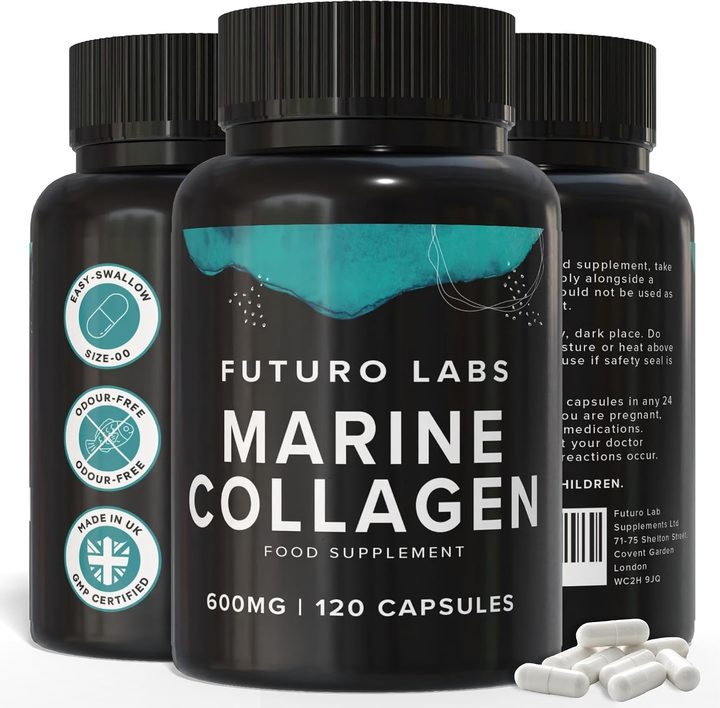
Our brand: the worked example on this page
Futuro Labs Marine Collagen
- 28p a day
- 120 capsules, 2 capsules daily
- Lab tested
- Made in the UK
Collagen kept to its honest lane: Futuro Labs Marine Collagen on Amazon UK, 1200mg hydrolysed type 1 with vitamin C and zinc at 15% NRV, £16.99 for 60 days at 28p, never counted toward protein targets. Full label breakdown. The blend dilution is on the collagen protein powder page; the muscle audit on the muscle growth page.
The panels read side by side, line by line, and the scores that formalise it
Put a whey tub and a collagen tub on the counter, turn both around, and read the panels against each other line by line, because the comparison decides itself in print. Protein per 25g serving: both claim roughly 22 to 24g, the one line where they look like peers, and the last. Leucine, the amino acid that triggers muscle protein synthesis: whey delivers around 2.5 to 2.7g per serving, comfortably clearing the per-meal threshold the muscle literature discusses, while collagen delivers well under 1g, a third or less, the arithmetic the muscle pages run and the single line that ends most of this contest. Completeness: whey carries all nine essential amino acids; collagen is missing tryptophan entirely, which is not a shortfall but an absence, and the reason formal protein quality systems, the PDCAAS and DIAAS scores that rate proteins by essential amino acid completeness and digestibility, place whey at the top of the scale and collagen at or near zero, a scoring so stark that in some regulatory contexts collagen alone cannot even be counted as contributing protein for labelling purposes. Claims: whey, as protein, lawfully carries the register's muscle sentences, protein contributes to the growth and maintenance of muscle mass and to normal bones; collagen carries none, at any dose, from any source. Four lines below the headline, and the knockout is on paper before a scoop is mixed.
Each tub's honest job, the blend temptation declined, and the budget answer
A knockout for muscle is not a verdict of uselessness, and the honest close assigns each tub its actual job. Whey's job is the protein target: 1.2 to 2.2g per kilogram across the day for a training adult, food first, whey as the convenient topper, the tub that earns its place in nearly every lifter's cupboard on its leucine, completeness and claims. Collagen's jobs are the two its own pages defend and only those: the daily habit at capsule scale, bought for the vitamin C and zinc claim-holders an honest label carries at 15% NRV, and the 15g-with-C pre-loading protocol at powder scale for the connective-tissue reader with a physiotherapist in the loop, stop-two research with expectations flattened, a lane whey has never occupied because the protocol literature simply was not built on it. The blend temptation, collagen-plus-whey tubs promising both jobs in one scoop, declines itself on the dilution page's arithmetic, every collagen gram displacing a complete gram and dragging the leucine below plain whey at similar money, two mediocre halves sold as synergy. And the budget answer, for the reader who can stock one tub only: whey, without hesitation, the protein target outranking the collagen habit in every honest hierarchy this site draws, with collagen added later, if at all, as the 28p rider its pricing was always meant to be. Better, then, is a question with a job attached, and once the jobs are named, the tubs stop competing.
| The line | Whey, per ~25g | Collagen, per ~25g |
|---|---|---|
| Protein stated | ~22-24g | ~22-24g: the one matching line |
| Leucine | ~2.5-2.7g: clears the synthesis threshold | Under 1g: the knockout line |
| Essential amino acids | All nine present | Tryptophan absent entirely |
| Quality score (PDCAAS/DIAAS) | At the top of the scale | At or near zero |
| Register claims | Muscle mass and bone maintenance, as protein | None, at any dose or source |
| The honest jobOurs | The protein target's topper | The 28p habit or the 15g protocol, never the target |
The verdict, and the tubs sent to their own shelves
Collagen protein vs whey protein: read side by side, the panels end it by the second line, whey carrying roughly triple the leucine, full essential completeness, top marks on the formal quality scales where collagen registers near zero, and the register's actual muscle claims, a knockout for every protein purpose, with collagen's defensible lanes lying entirely elsewhere, the claim-holder habit and the physio-adjacent protocol its own pages price honestly. One tub each, jobs named, blends declined, and whey first on any single-tub budget. The worked example keeps collagen exactly in its lane: Futuro Labs Marine Collagen, 1200mg hydrolysed type 1 with 12mg vitamin C and 1.5mg zinc at 15% NRV, lab tested, UK made, £16.99 for 60 days at 28p a day, never counted toward a protein target, and never pretending to be the other tub.
What to check on the label
- The leucine line decides it: whey triple collagen's, per serving.
- Tryptophan is absent, not low: collagen is formally incomplete.
- Quality scores make it official: whey at the top, collagen near zero.
- Blends dilute both jobs: two mediocre halves sold as synergy.
- One-tub budgets buy whey: collagen joins later as the 28p rider.
Our brand
The worked example: Futuro Labs Marine Collagen
Futuro Labs Marine Collagen: 2 capsules daily, 1200mg hydrolysed type 1 marine collagen with 12mg vitamin C and 1.5mg zinc (15% NRV each), 120 capsules for £16.99, 60 days at 28p a day, lab-tested, UK GMP made. Slim veggie-shell capsules, odour free. Fish derived: pescatarian, not vegetarian or vegan.
- Collagen per serving
- 1200mg hydrolysed type 1 marine (fish)
- Co-factors
- vitamin C 12mg (15% NRV), zinc 1.5mg (15% NRV)
- Serving
- 2 capsules a day
- Bottle
- 120 capsules, 60 days
- Price
- £16.99 (28p a day)
- Capsule
- slim size 00, veggie shell, odour free
Questions people also ask
Is collagen or whey better for building muscle?
Whey, by knockout: roughly triple the leucine per serving, all nine essential amino acids, top protein quality scores and the register's muscle claims, none of which collagen carries.
Why does collagen score near zero on protein quality scales?
The scales rate essential amino acid completeness and digestibility, and collagen is missing tryptophan entirely: an absence, not a shortfall, that zeroes the score.
Can collagen count toward my daily protein target?
Honestly, no: its incomplete profile keeps it off the 1.2-to-2.2g-per-kilogram line, which food and complete proteins like whey carry.
Is a collagen-whey blend the best of both?
It is the worse of both: every collagen gram displaces a complete gram, dragging leucine below plain whey at similar prices. Buy the jobs separately.
What is collagen actually for, then?
Its own two lanes: the daily habit carrying vitamin C and zinc at 15% NRV, and the 15g pre-loading protocol before connective-tissue work, raised with a physio, expectations flat.
Sources
- The protein quality literature: scoring systems such as PDCAAS and DIAAS rate proteins by essential amino acid completeness and digestibility, with collagen scoring at or near zero for lacking tryptophan. PubMed record
- Comparative protein research: the leucine content of a protein drives its muscle protein synthesis response, with whey outperforming collagen in direct comparisons. PubMed record
- Review literature on protein intake and muscle mass in older adults: higher protein intakes support the maintenance of muscle in ageing, the evidence base behind the register's protein and muscle-mass claims mattering more with age. PubMed record
- The gelatin and vitamin C pre-exercise research (Shaw, Baar and colleagues): 15g gelatin with vitamin C taken about an hour before loading, studied for markers of collagen synthesis, the protocol behind the tendon-training conversation. PubMed record