Ghost Fitness/Collagen/Collagen vs whey protein: which is better for muscle growth?
Collagen vs whey protein: which is better for muscle growth?
The short answer
Walk the production line: growth needs a leucine trigger and a complete amino supply, and collagen fails both stations, low leucine, no tryptophan, so it cannot alone build muscle protein even in principle. Whey passes both. No contest.
- Station one: the signaltraining provides it: no powder replaces the stimulus
- Station two: the triggerleucine fires synthesis: whey ~2.5g, collagen under 1g
- Station three: the supplyall nine essentials required: collagen's tryptophan is absent
- The in-principle pointan incomplete protein cannot alone build muscle protein
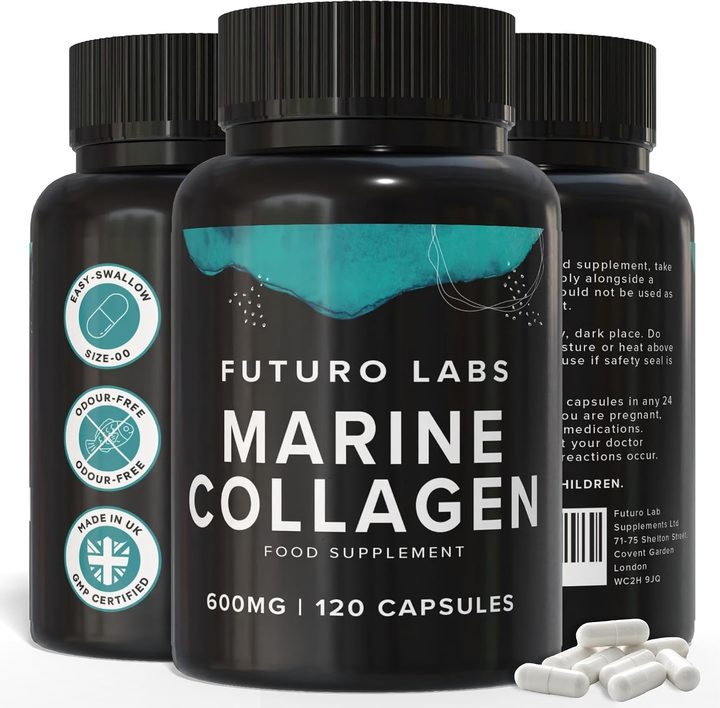
Our brand: the worked example on this page
Futuro Labs Marine Collagen
- 28p a day
- 120 capsules, 2 capsules daily
- Lab tested
- Made in the UK
Kept off the muscle shelf, employed in its own lanes: Futuro Labs Marine Collagen on Amazon UK, 1200mg hydrolysed type 1 with vitamin C and zinc at 15% NRV, £16.99 for 60 days at 28p. Full label breakdown. The two-jobs interviews are on the interview page; the muscle claim audit on the muscle growth page.
The production line walked: signal, trigger, supply, and where each candidate stands
Muscle growth is a production line with known stations, so walk it and inspect both candidates at each, because the format turns a marketing contest into an engineering report. Station one, the signal: growth begins with training, mechanical tension telling the muscle to adapt, and no powder of any kind clocks in here, the station belonging to the programme, sets, progression and sleep, which is why every honest supplement page this site writes puts the word supplement in its place before the aisle opens. Station two, the trigger: with the signal sent, synthesis fires when the amino acid leucine crosses its per-meal threshold, the switch the literature discusses at roughly two to three grams per feeding, and here the candidates separate immediately, whey delivering around 2.5 grams per standard serving, comfortably throwing the switch, collagen delivering under a gram, a third or less, arriving at the station without the key. Station three, the supply: a fired trigger builds nothing without complete raw material, muscle protein requiring all nine essential amino acids on the floor at once, and here collagen does not merely underperform, it fails in principle, its tryptophan content being zero, an absence rather than a shortfall, meaning muscle protein literally cannot be assembled from collagen alone, no dose fixing a missing part, while whey stocks every bin, the completeness its top quality scores formalise. Three stations, and one candidate has failed the two a powder can even enter.
The double failure priced, the retreat positions cleared, and the line's honest staffing
The inspection's finding deserves its plain sentence: collagen fails the muscle production line twice, at the trigger for want of leucine and at the supply for want of tryptophan, and the second failure is categorical, not a matter of degree, which is why the register holds no muscle claim for collagen at any dose while protein's lawful wording, contributes to the growth and maintenance of muscle mass, rides whey's label by right. The retreat positions marketing rebuilds are cleared in a line each, the muscle-growth page's audit compressed: the still-protein defence dissolves on the two-rulers paradox, quantity without quality; the glycine story is real chemistry with no growth claim and no growth trial; and the connective-tissue flank, the idea that collagen supports the tendons around the muscle, retreats off this production line entirely into the 15g protocol's separate, marker-level lane, an adjunct to rehab loading, never a growth pathway. Which leaves the line's honest staffing, and it is the two-jobs verdict in overalls: whey, or any complete protein, mans stations two and three, dosed around training toward the day's 1.2-to-2.2 grams per kilogram, food first and the scoop as topper; the programme mans station one, outranking every scoop; and collagen is employed elsewhere in the building, the 28p habit carrying vitamin C and zinc's lawful sentences and the pre-loading protocol beside a physiotherapist's plan, honest jobs on other floors, with the blend option, collagen stapled into the whey, rejected at the door for diluting the one candidate that passes, every collagen gram displacing a complete one. No contest was the answer; the production line is why.
| The station | What it requires | The inspection |
|---|---|---|
| The signal | Training: tension, progression, recovery | No powder clocks in: the programme's station |
| The trigger | Leucine over the per-meal threshold | Whey ~2.5g passes; collagen's sub-gram fails |
| The supply | All nine essentials on the floor at once | Collagen's zero tryptophan fails in principle; whey stocks every bin |
| The register's word | Claims follow the evidence | Protein's growth wording rides whey; collagen holds none |
| The retreat positions | Quantity, glycine, connective flank | Cleared: paradox, no trial, a different lane entirely |
| The staffing | Complete protein on the line | Collagen employed elsewhere: the habit and the protocol |
The verdict, signed off at the end of the line
Collagen vs whey protein for muscle growth: walk the line and the report writes itself, the signal belonging to training, the trigger to leucine that whey carries and collagen does not, and the supply to a completeness collagen fails in principle, its absent tryptophan meaning muscle protein cannot be built from it alone at any dose, a double failure the register's silence formalises against whey's lawful growth wording. No contest, with collagen employed honestly on other floors, the cofactor habit and the physio-adjacent protocol. The worked example stays off the muscle shelf by design: Futuro Labs Marine Collagen, 1200mg hydrolysed type 1 with 12mg vitamin C and 1.5mg zinc at 15% NRV, lab tested, UK made, £16.99 for 60 days at 28p a day, sold for the sentences its panel holds and never for the station it could not pass.
What to check on the label
- Training mans the first station: no powder replaces the signal.
- Leucine throws the switch: whey ~2.5g passes, collagen's third fails.
- Completeness is the supply: zero tryptophan fails in principle.
- The register agrees: growth wording rides whey, collagen holds none.
- Blends dilute the passer: every collagen gram displaces a complete one.
Our brand
The worked example: Futuro Labs Marine Collagen
Futuro Labs Marine Collagen: 2 capsules daily, 1200mg hydrolysed type 1 marine collagen with 12mg vitamin C and 1.5mg zinc (15% NRV each), 120 capsules for £16.99, 60 days at 28p a day, lab-tested, UK GMP made. Slim veggie-shell capsules, odour free. Fish derived: pescatarian, not vegetarian or vegan.
- Collagen per serving
- 1200mg hydrolysed type 1 marine (fish)
- Co-factors
- vitamin C 12mg (15% NRV), zinc 1.5mg (15% NRV)
- Serving
- 2 capsules a day
- Bottle
- 120 capsules, 60 days
- Price
- £16.99 (28p a day)
- Capsule
- slim size 00, veggie shell, odour free
Questions people also ask
Is collagen or whey better for building muscle?
Whey, without contest: it passes the leucine trigger at roughly 2.5g per serving and stocks all nine essentials, while collagen fails both stations, under a gram of leucine and zero tryptophan.
Why can't collagen build muscle even at high doses?
The failure is categorical: muscle protein requires all nine essential amino acids simultaneously, and collagen's tryptophan content is zero, an absent part no dose supplies.
Does collagen help muscles indirectly through tendons?
That idea lives in a different lane: the 15g pre-loading protocol is a marker-level adjunct to physio-led rehab loading, never a growth pathway, and holds no claim.
Should I use a collagen-whey blend for growth?
No: every collagen gram displaces a complete gram, diluting the one candidate that passes the line, so buy the jobs separately.
What actually drives muscle growth, then?
Station one: training with progression and recovery, fed by complete protein toward 1.2 to 2.2g per kilogram daily, food first with whey as the convenient topper.
Sources
- Comparative protein research: the leucine content of a protein drives its muscle protein synthesis response, with whey outperforming collagen in direct comparisons. PubMed record
- The protein quality literature: scoring systems such as PDCAAS and DIAAS rate proteins by essential amino acid completeness and digestibility, with collagen scoring at or near zero for lacking tryptophan. PubMed record
- The milk protein literature: whey is the soluble protein fraction separated during cheesemaking, its composition of beta-lactoglobulin, alpha-lactalbumin and related proteins containing essentially no collagen. PubMed record
- EFSA Panel on Dietetic Products, Nutrition and Allergies. Scientific Opinion on the substantiation of health claims related to magnesium. EFSA Journal 2010;8(10):1807. https://efsa.onlinelibrary.wiley.com/doi/10.2903/j.efsa.2010.1807