Ghost Fitness/Collagen/Collagen vs whey protein amino acid profile: which is better?
Collagen vs whey protein amino acid profile: which is better?
The short answer
Read the table both ways: whey wins every essential, roughly triple the leucine, with collagen's tryptophan at zero. Collagen wins glycine and proline massively. The inversion explains everything: a poor protein, a distinctive niche material.
- The essentials sweepwhey wins all nine; collagen's tryptophan reads zero
- The leucine rowroughly 2.5g versus under 1g per 25g serving
- The inversion rowsglycine and proline: collagen several-fold richer
- What the shape meansbuilt for milk versus built for rope: both panels make sense
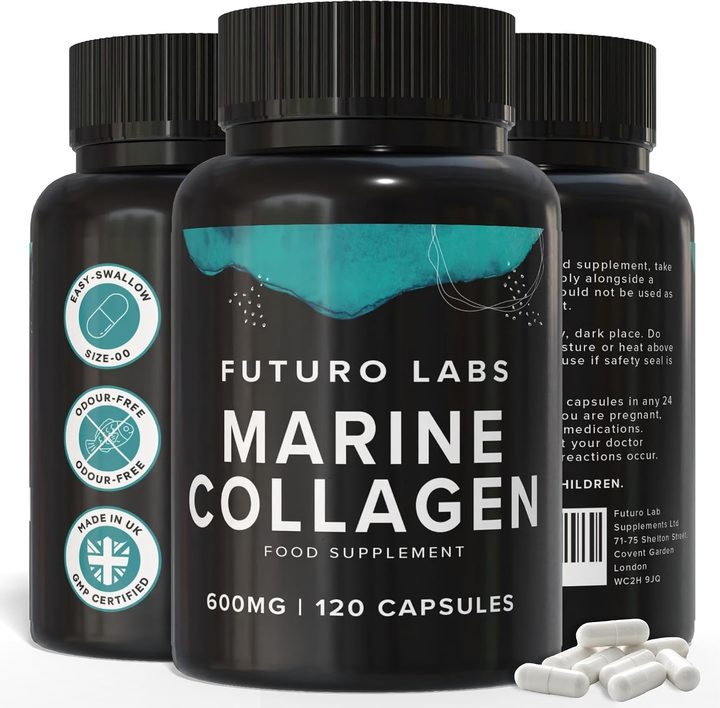
Our brand: the worked example on this page
Futuro Labs Marine Collagen
- 28p a day
- 120 capsules, 2 capsules daily
- Lab tested
- Made in the UK
The inverted profile, sold for its own lanes: Futuro Labs Marine Collagen on Amazon UK, 1200mg hydrolysed type 1 with vitamin C and zinc at 15% NRV, £16.99 for 60 days at 28p, never counted toward protein targets. Full label breakdown. The quality-score knockout is on the panels page; the fingerprint chemistry on the source-of-protein page.
The table, read the expected way: the essentials column and the sweep it records
This query asks for the actual profiles, so put the table on the page and read it twice, because it rewards both directions. Read the expected way, down the essentials, it records a sweep: whey carries all nine essential amino acids in quantities that top the quality scales, leucine around 2.5 to 2.7 grams per 25-gram serving against collagen's sub-gram third, the synthesis trigger row that decides every muscle page; isoleucine and valine completing a branched-chain trio collagen cannot match; lysine, threonine, methionine and the rest all comfortably whey's; and tryptophan, the row that ends arguments, reading a healthy fraction of a gram for whey and a literal zero for collagen, the absence that zeroes its PDCAAS and DIAAS scores and keeps its grams off every protein target this site sets. Nine rows, nine wins, and if the table stopped at the essentials the page could stop with it: for every job protein quality measures, building muscle, guarding it in a deficit, feeding recovery, whey's column is better in the only sense the word carries there, and the muscle, weight-loss and two-jobs pages have already spent that verdict in full.
The table read the other way: the inversion rows, and what the two shapes were built for
Read the unexpected way, down the non-essentials, the table inverts, and the inversion is the page's genuine finding: collagen is not uniformly poorer, it is differently shaped, spectacularly rich exactly where whey is ordinary. Glycine, whey's modest fraction of a gram per serving, occupies roughly a third of collagen's entire sequence, several-fold whey's content; proline and its collagen-specific derivative hydroxyproline, the fingerprint amino the same-as-protein page teaches, together approach another third, hydroxyproline barely existing in whey at all; and the shape makes perfect structural sense read as biology, whey being milk's nutrition protein, evolved to feed growth and therefore stocked with essentials, collagen being rope, a structural polymer whose tight triple helix demands the smallest amino acid at every third position, glycine, and the ring-shaped prolines to kink and lock the coil, two molecules built for different jobs wearing the different panels those jobs require. What the inversion licenses, and what it does not, the site's standing lines settle: it licenses collagen's identity as a distinctive niche material, the reason the 15g pre-loading protocol used gelatine rather than whey, the glycine-and-proline load being the point of that research lane, and the reason glycine's own quiet literature, the sleep-adjacent work the glycine pages grade cautiously, attaches to collagen conversations at all; it does not license a single claim, the register holding none for glycine, proline or collagen at any dose, and it does not rescue the essentials column, an inverted profile still building no muscle. Better, then, splits exactly along the table's two readings: for protein quality, whey, by sweep; for collagen's own two lanes, the shape is the product; and for the reader, the table itself is the keeper, one glance at the tryptophan and glycine rows now decoding every label in the aisle.
| The row | Whey, approximately | Collagen, approximately |
|---|---|---|
| Leucine | 2.5 to 2.7g: clears the trigger | Under 1g: the knockout row |
| Tryptophan | A healthy fraction of a gram | Zero: the absence that zeroes the scores |
| Other essentials | All present, quality-scale topping | All trailing: a nine-row sweep |
| Glycine | A modest fraction of a gram | Several-fold more: a third of the sequence |
| Proline and hydroxyproline | Ordinary to absent | Approaching another third: the fingerprint |
| The shape's meaning | Milk's nutrition protein: built to feed | Rope's structural protein: built to coil |
The verdict, read off both directions at once
Collagen vs whey amino acid profile: read down the essentials, whey sweeps all nine rows with triple the leucine and collagen's tryptophan at zero, settling better for every job protein quality measures; read down the non-essentials, the table inverts, collagen carrying several-fold the glycine and nearly a third proline and hydroxyproline, the shape of rope rather than food, which explains its protocol niche without licensing a single claim. A poor protein and a distinctive material, both facts printed in the same two columns. The worked example sells the inverted shape for its honest lanes only: Futuro Labs Marine Collagen, 1200mg hydrolysed type 1 with 12mg vitamin C and 1.5mg zinc at 15% NRV, lab tested, UK made, £16.99 for 60 days at 28p a day, its profile never counted toward a target and never needing to be.
What to check on the label
- Read the table both ways: essentials one direction, the inversion the other.
- Whey sweeps the essentials: nine rows, triple the leucine.
- Tryptophan reads zero for collagen: the row that zeroes the scores.
- Collagen wins glycine and proline massively: rope's shape, not food's.
- The inversion licenses no claims: a niche material, honestly priced.
Our brand
The worked example: Futuro Labs Marine Collagen
Futuro Labs Marine Collagen: 2 capsules daily, 1200mg hydrolysed type 1 marine collagen with 12mg vitamin C and 1.5mg zinc (15% NRV each), 120 capsules for £16.99, 60 days at 28p a day, lab-tested, UK GMP made. Slim veggie-shell capsules, odour free. Fish derived: pescatarian, not vegetarian or vegan.
- Collagen per serving
- 1200mg hydrolysed type 1 marine (fish)
- Co-factors
- vitamin C 12mg (15% NRV), zinc 1.5mg (15% NRV)
- Serving
- 2 capsules a day
- Bottle
- 120 capsules, 60 days
- Price
- £16.99 (28p a day)
- Capsule
- slim size 00, veggie shell, odour free
Questions people also ask
How do collagen and whey amino profiles actually compare?
Whey wins all nine essentials with roughly triple the leucine and collagen's tryptophan at literal zero, while collagen carries several-fold the glycine and nearly a third proline and hydroxyproline: an inversion, not a uniform loss.
Why does collagen have so much glycine and proline?
Structure: the triple helix demands glycine at every third position and prolines to lock the coil, so rope's protein is stocked where milk's nutrition protein is ordinary.
Does the glycine content make collagen better for anything?
It defines its niche: the 15g pre-loading protocol used gelatine for exactly that load, and glycine's own quiet literature attaches here, but no claim exists for any of it.
Which profile is better for building muscle?
Whey's, without contest: the essentials sweep and the leucine trigger decide it, and collagen's inverted shape builds no muscle however distinctive it is.
What is hydroxyproline and why does it matter?
Collagen's fingerprint amino, barely present in other proteins: labs use it to identify collagen, and its abundance is the clearest single marker of the profile's structural, non-nutritional shape.
Sources
- The milk protein literature: whey is the soluble protein fraction separated during cheesemaking, its composition of beta-lactoglobulin, alpha-lactalbumin and related proteins containing essentially no collagen. PubMed record
- The hydroxyproline literature: this amino acid is nearly unique to collagen and is used analytically as its marker, the fingerprint by which laboratories quantify collagen content. PubMed record
- Comparative protein research: the leucine content of a protein drives its muscle protein synthesis response, with whey outperforming collagen in direct comparisons. PubMed record
- The protein quality literature: scoring systems such as PDCAAS and DIAAS rate proteins by essential amino acid completeness and digestibility, with collagen scoring at or near zero for lacking tryptophan. PubMed record