Ghost Fitness/Collagen/What is the downside of taking collagen powder?
What is the downside of taking collagen powder?
The short answer
The powder's downsides are the format's: a scoop, a serving size not a research dose, a drifting measure, clumping cold, a taste in water, sugar in flavoured versions, a whey shake it gets blamed with. One advantage: price per gram.
- The scoop and the measure~20g a scoop, a brand's serving size; heaped, level and dessertspoon differ by two: weigh it
- The clumping and the tasteclumps cold, needs warmth or a whisk; some marine powders taste of the sea in water
- The flavour and the tubflavoured versions add sugar or sweeteners; an opened tub is best finished in months
- The shake and the pricemixed into whey and blamed for it; the cheapest form per gram at trial doses
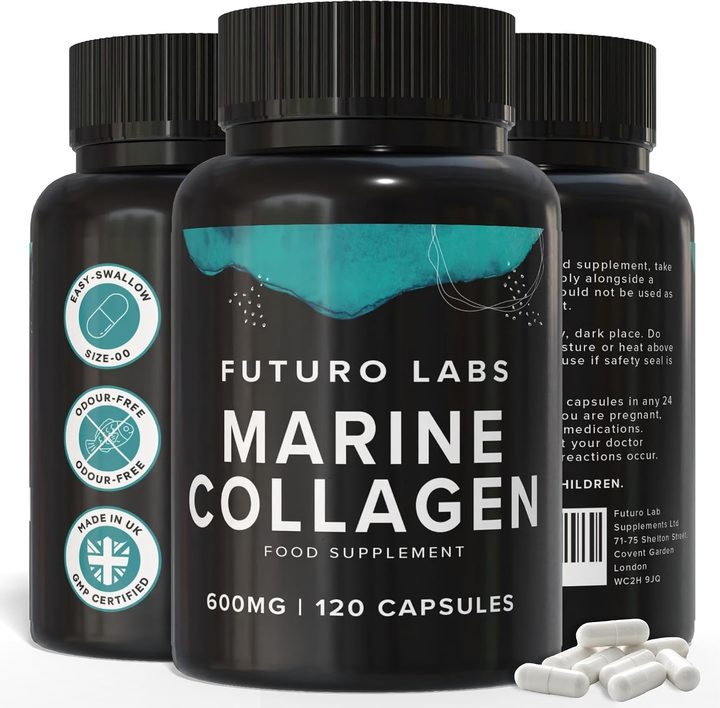
Our brand: the worked example on this page
Futuro Labs Marine Collagen
- 28p a day
- 120 capsules, 2 capsules daily
- Lab tested
- Made in the UK
The format that sidesteps six of the eight lines: Futuro Labs Marine Collagen on Amazon UK, 2 capsules, 1200mg hydrolysed type 1 marine collagen with 12mg vitamin C at 15% NRV plus zinc, 120 for £16.99, 28p a day, lab tested and UK made, no scoop, no measure, no clumping, no taste, no sugar and no shake, at a dose below the research band and stated so. Full label breakdown. The six collagen downsides ranked are on the downside of collagen page; the format comparison on the pills versus powder versus liquid page.
The first four lines of the audit: the scoop, the measure, the clumping and the taste
What is the downside of taking collagen powder is a question about a format more than a molecule, because collagen's own downsides, cost above whey, incomplete protein, fullness at large doses, the oxalate footnote and fish allergy with marine, are the same in every form, and what the powder adds is a set of downsides that belong to the tub, so the honest page audits the format on eight lines and scores the capsule and the gummy against it. Line one, the scoop. A tub's scoop holds around twenty grams, and twenty grams is a serving size chosen by the brand, not a dose chosen by a trial: the joint comfort trials gave around ten grams, the skin trials 2.5 to 10, the bone trial five, and only the tendon protocol reached fifteen, so a reader who follows the scoop takes double the joint dose and eight times the low skin dose without ever deciding to, pays for it, and sits heavily on it. Line two, the measure. A heaped scoop, a level scoop and a dessertspoon of the same powder differ from one another by roughly a factor of two, so a powder dose taken by eye drifts between ten and twenty-five grams from day to day, which matters to a reader trying to run the trials' dose for the trials' duration and is fixed only by a kitchen scale for the first week until the eye is calibrated. Line three, the clumping. Hydrolysed collagen is a fine, light powder that clumps when it hits cold liquid, forming a skin on the surface and lumps at the bottom, so it wants a warm drink or the whisk method, a paste made with a little liquid first and the rest added, a small chore every day for years. Line four, the taste. Some marine collagen powders leave a faint fishy or gelatinous note in plain water, present from the first mouthful and no fainter at week six because it is the powder's property and not the palate's, fixed by a coffee, a smoothie or a soup rather than by time, and absent from a capsule. Four lines in and none of them is a side effect of collagen; each is a cost of buying collagen as a powder, paid daily.
The last four lines, the women's version of the question, and the format scored
Line five, the flavour. Because of line four, many powders come flavoured, and a flavoured collagen powder carries sugar, several grams a serving in some, or sweeteners and flavourings in others, added to hide a taste the capsule never has, so a reader who chose collagen over a sweet drink for their skin is drinking a sweet drink, and the gummy takes this line to its extreme at two to four grams of sugar a piece for a fraction of a gram of collagen. Line six, the tub. An opened tub of powder absorbs moisture from the air each time it is opened, cakes, and is best finished within a few months, while a sealed capsule bottle sits unbothered for the printed shelf life, a small line that matters to the reader who takes a dessertspoon and finds the kilo tub still half full at month eight. Line seven, the shake. Most collagen powder in a lifter's kitchen goes into the whey shake, where it is stirred in and then blamed: the bloating from the whey's lactose, the acne the dairy literature associates with whey through insulin signalling, the fullness of forty grams of mixed protein at once, all land on the collagen because it was the thing added last, and a reader who wants to know what the collagen does drinks it alone for a fortnight. Line eight, the price, which is the powder's one advantage and the reason to buy it anyway: per gram of collagen, powder in a large tub is the cheapest form on the shelf, so a reader running the joint trials' ten grams a day for six months or the tendon protocol's fifteen before each session buys powder because the capsule cannot reach those grams affordably, and accepts the seven lines above as the price of the eighth. The secondary question, the side effects of collagen powder for women, has the same list as for anyone, because no collagen trial found anything sex-specific: fullness and bloating at scoop doses fading over a fortnight, the oxalate footnote for calcium stone formers, fish allergy with marine, and nothing else above placebo in trials whose participants were mostly women, so the women's version of this page is this page. The format scored: the powder wins on price per gram at trial doses and loses on the other seven lines; the gummy loses on all eight and adds sugar; and the capsule sidesteps six of the eight, the scoop, the measure, the clumping, the taste, the flavour and the shake, at a dose that is modest and has to be stated as such. The worked example is that capsule on its true terms: two capsules, 1200mg hydrolysed type 1 marine collagen with 12mg vitamin C plus zinc, 120 for £16.99 at 28p a day, lab tested and UK made, a measured dose below the research band taken for vitamin C's collagen formation sentence, with none of the tub's chores. What is the downside of taking collagen powder: the scoop, the measure, the clumps, the taste, the sugar, the shelf life and the shake, in exchange for the cheapest grams on the shelf.
| The line | Powder | Capsule | Gummy |
|---|---|---|---|
| The scoop | ~20g, a brand's serving size, not a research dose | A fixed measured dose, stated | A fraction of a gram a piece |
| The measure | Heaped, level and spoon differ by two; weigh it | Two capsules, always | Two to four pieces, always |
| The clumping | Clumps cold; warm drink or whisk | None | None |
| The taste | Some marine powders taste of the sea in water | None | Sweet |
| The flavour | Sugar or sweeteners in flavoured versions | None | 2 to 4g sugar a piece |
| The tub | Absorbs moisture once opened; finish within months | Sealed for the shelf life | Sealed |
| The shake | Mixed into whey and blamed for it | Taken alone with water | Taken alone |
| The price | Cheapest per gram at trial doses | Modest dose, 28p a day | Dearest per gram of collagen |
| The worked exampleOurs | For trial doses | Two capsules, 1200mg marine collagen with 12mg vitamin C, 28p a day, on its true terms | Not this |
What to check on the label
- Ignore the scoop: dose by the trial you are testing.
- Weigh it for a week: eyes drift by a factor of two.
- Warm it or whisk it: cold liquid clumps.
- Buy unflavoured: or accept the sugar.
- Drink it alone for a fortnight: not in the whey.
Our brand
The worked example: Futuro Labs Marine Collagen
Futuro Labs Marine Collagen: 2 capsules daily, 1200mg hydrolysed type 1 marine collagen with 12mg vitamin C and 1.5mg zinc (15% NRV each), 120 capsules for £16.99, 60 days at 28p a day, lab-tested, UK GMP made. Slim veggie-shell capsules, odour free. Fish derived: pescatarian, not vegetarian or vegan.
- Collagen per serving
- 1200mg hydrolysed type 1 marine (fish)
- Co-factors
- vitamin C 12mg (15% NRV), zinc 1.5mg (15% NRV)
- Serving
- 2 capsules a day
- Bottle
- 120 capsules, 60 days
- Price
- £16.99 (28p a day)
- Capsule
- slim size 00, veggie shell, odour free
Questions people also ask
What are the side effects of collagen powder for women?
The same as for anyone, since no collagen trial found anything sex-specific and most trial participants were women: fullness and bloating at scoop doses fading over a fortnight, the oxalate footnote for calcium stone formers, fish allergy with marine collagen, and nothing else above placebo.
Is a scoop of collagen powder too much?
It is more than most trials gave: a tub's scoop is around twenty grams, a serving size chosen by the brand, while the joint trials gave around ten grams and the skin trials 2.5 to 10, so a reader following the scoop takes double the joint dose without deciding to, and a dessertspoon of around ten grams is the trial-sized measure.
Why does my collagen powder clump?
Because hydrolysed collagen is a fine, light powder that skins and lumps in cold liquid, so it wants a warm drink, in which it dissolves with a stir, or the whisk method, a paste made with a small amount of liquid first and the rest added after, which works cold as well as warm.
Is collagen powder or capsules better?
By the job: powder is the cheapest form per gram and the only affordable way to reach the ten to fifteen grams the joint and tendon research used, while capsules sidestep the scoop, the measure, the clumping, the taste, the flavour and the shake at a modest dose stated as such, so the trial-runner buys powder and the habit-keeper buys capsules.
Does collagen powder go off once opened?
It deteriorates rather than spoils: an opened tub absorbs moisture each time it is opened, cakes and loses freshness, so it is best finished within a few months, which a dessertspoon-a-day reader with a kilo tub should factor in, while sealed capsules sit unbothered for the printed shelf life.
Sources
- The collagen peptide trial literature: randomised controlled studies of hydrolysed collagen supplementation across skin, joint and connective-tissue outcomes, typically at 2.5g to 15g daily, with small effects and frequent industry funding. PubMed record
- The gummy supplement format literature: gummies carry small active doses per piece, typically a fraction of a gram of collagen, alongside two to four grams of sugar or sugar alcohols each, with dose accuracy and stability lower than tablets and capsules and the serving needed to reach a research dose of collagen running to dozens of pieces. PubMed record
- The dairy, whey and acne literature: observational studies and case series associate dairy intake and whey protein supplements with acne in some adolescents and young adults, a proposed mechanism through insulin and IGF-1 signalling from dairy proteins, with collagen, a non-dairy protein without that signalling profile, absent from the acne literature. PubMed record
- The supplement gastrointestinal tolerance literature: oral iron produces nausea, constipation and upper abdominal pain in a large share of users, magnesium oxide and high magnesium doses loosen stools, zinc taken fasted causes nausea, creatine at loading doses causes bloating in some, whey concentrate causes lactose symptoms, and fish oil at standard doses causes belching and, rarely, nausea when taken fasted, with loose stools only at gram doses. PubMed record