Ghost Fitness/Collagen/What is the best powder collagen in the UK?
What is the best powder collagen in the UK?
The short answer
The best collagen powder is unflavoured hydrolysed peptides with a stated gram dose, a clean ingredients line and third-party testing, judged in pence per 10g. Powder wins at research doses; capsules win on convenience and the vitamin C route.
- Pence per 10gthe powder aisle's honest unit: divide before admiring the pouch
- 10-15gthe research band only powder practically reaches
- ~20 capsuleswhat 10g would take in capsule form: the format's dividing line
- The capsule lane1200mg with 15% NRV vitamin C: the convenience-and-claims route
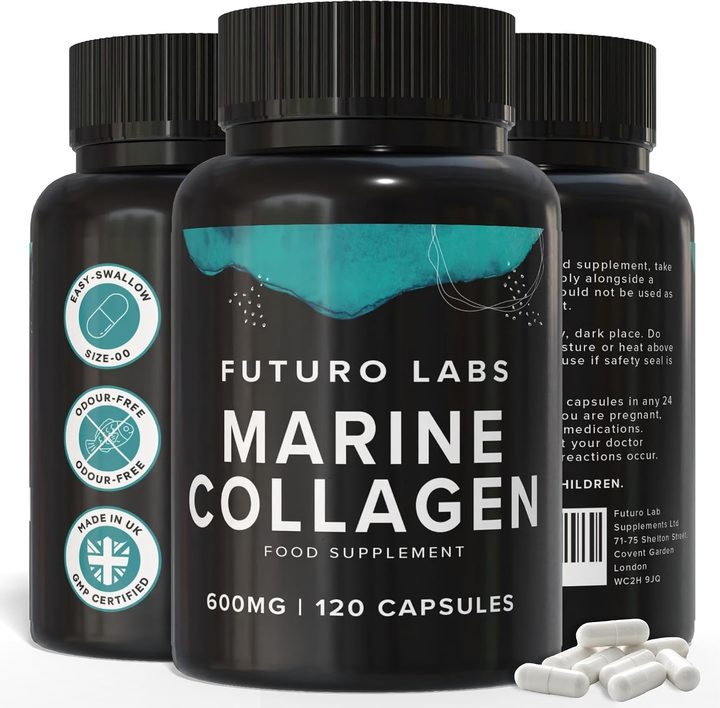
Our brand: the worked example on this page
Futuro Labs Marine Collagen
- 28p a day
- 120 capsules, 2 capsules daily
- Lab tested
- Made in the UK
The capsule lane's worked example: Futuro Labs Marine Collagen on Amazon UK, 1200mg hydrolysed type 1 with vitamin C and zinc at 15% NRV, 2 slim capsules, £16.99 for 60 days at 28p. Full label breakdown. The overall standard is on the best-for-lifters page; the ten checks on the top-10 page.
What best means in the powder aisle specifically
Powder is collagen's serious-dose format, so the powder-specific standard starts from what the format is for: reaching gram-scale intakes, the 2.5g-to-15g band the trial literature dosed and the 15g-with-vitamin-C pre-training protocol made famous, quantities that would take twenty-odd capsules and take one scoop. Best, in that aisle, is therefore: hydrolysed collagen peptides, type 1 or 1 and 3, bovine or marine, stated by name; a scoop or serving dose declared in grams with the scoop actually supplied; unflavoured as the default, because flavoured tubs buy their taste with sweeteners, acids and a shorter honest shelf of uses, while unflavoured dissolves into coffee, porridge or shakes invisibly; an ingredients line of one item, or close to it; named third-party testing, heavy metals and microbiology, the same bar as every aisle; honest dating with runway on a tub that may last months; and the division that ends every powder comparison, pence per 10g, the unit that deflates premium pouches and rewards plain workhorses, since peptide powders are commodity-adjacent and the price spread is mostly branding. A powder passing that list is the best powder, whoever made it, and the criteria travel to every shelf the way a brand name cannot.
Powder versus capsules: the honest fork, and who takes which lane
The format decision is a fork with honest signage, not a ranking. Take powder when the goal is gram scale: anyone deliberately running the research protocols, the 15g pre-loading pattern with vitamin C alongside, or the 10g daily habits the joint literature used, is a powder customer by arithmetic, capsules at that scale being a fistful and a false economy, and the powder buyer supplies their own vitamin C, a glass of orange juice or a cheap tablet, since most plain peptide tubs carry none. Take capsules when the goal is the honest daily habit at label scale: no scoop, no taste, no mixing, travel-proof, dose-consistent, and, in the worked example's case, the vitamin C and zinc built in at the 15% NRV threshold where the register's collagen-formation and skin claims actually switch on, which is the capsule lane's quiet advantage, the claim-holders aboard by design rather than bought separately. What neither lane escapes is scale honesty: a capsule product is a 1-to-2g habit and must say so, and this site's worked example does, 1200mg stated plainly; a powder implying its scoop does what no claim authorises fails the same test from the other side. Two lanes, one standard, and the reader's goal, protocol or habit, picks the lane before any label is read.
| The question | Powder | Capsules |
|---|---|---|
| Reaching the 10-15g research band | One scoop: the format's whole purpose | Twenty-odd capsules: the wrong tool |
| The daily convenience habit | Scoop, mix, taste, tub on the counter | Two slim capsules, done: travels anywhere |
| Vitamin C, the claim-holder | Usually absent: supply your own | Built in at 15% NRV in the worked example |
| The honest unit of price | Pence per 10g | Pence per day at the label dose |
| Flavour and additives | Unflavoured default; flavoured buys sweeteners | Odour-free shells: nothing to flavour |
| Scale honesty | No claim implications at any scoop | State the 1-2g reality plainly, as the example does |
The verdict, and the two best answers this fork produces
What is the best powder collagen in the UK: an unflavoured hydrolysed peptide tub, type stated, gram dose stated, one-line ingredients, third-party tested and dated, bought by pence per 10g, a specification that names no brand because it does not need to, any tub meeting it being the best tub on its shelf, with the buyer's own vitamin C alongside if the famous protocol is the point. And the fork's other tine deserves its equal sentence: for the reader whose real goal was the honest daily habit rather than the 15g protocol, the best answer was never a powder at all, and the capsule lane's worked example is its specification, Futuro Labs Marine Collagen, 1200mg hydrolysed type 1 in two slim veggie-shell capsules with the vitamin C and zinc claim-holders aboard at 15% NRV, lab tested, UK made, £16.99 for 60 days at 28p, the format decision made honest by stating exactly what scale it is playing at.
What to check on the label
- Powder exists for gram scale: the 10-15g band is one scoop, not twenty capsules.
- Unflavoured, stated, tested, dated: the powder aisle's four-line spec.
- Pence per 10g is the powder unit: divide before admiring the pouch.
- Powder buyers supply their own vitamin C: most plain tubs carry none.
- Capsules win the habit lane: convenience plus the claim-holders built in.
Our brand
The worked example: Futuro Labs Marine Collagen
Futuro Labs Marine Collagen: 2 capsules daily, 1200mg hydrolysed type 1 marine collagen with 12mg vitamin C and 1.5mg zinc (15% NRV each), 120 capsules for £16.99, 60 days at 28p a day, lab-tested, UK GMP made. Slim veggie-shell capsules, odour free. Fish derived: pescatarian, not vegetarian or vegan.
- Collagen per serving
- 1200mg hydrolysed type 1 marine (fish)
- Co-factors
- vitamin C 12mg (15% NRV), zinc 1.5mg (15% NRV)
- Serving
- 2 capsules a day
- Bottle
- 120 capsules, 60 days
- Price
- £16.99 (28p a day)
- Capsule
- slim size 00, veggie shell, odour free
Questions people also ask
What should I look for in a collagen powder?
Hydrolysed peptides with the type stated, a gram dose with the scoop supplied, unflavoured with a one-line ingredients list, named third-party testing, and a fair pence-per-10g price.
Is flavoured collagen powder worse?
It buys taste with sweeteners and acids and narrows what it mixes into: unflavoured is the versatile default, and the flavour decision should be made knowingly, not by the pouch.
How much collagen powder did the studies use?
Mostly 2.5g to 15g daily, with the famous pre-training protocol at about 15g of gelatin with vitamin C an hour before loading: research described as research, holding no authorised claim.
Do I need vitamin C with collagen powder?
The register's collagen-formation claims belong to vitamin C, and the famous protocol paired them deliberately: most plain tubs carry none, so powder buyers supply their own.
Why would anyone choose capsules over powder?
The habit lane: two slim capsules, no taste or mixing, dose consistency, and, in the worked example, vitamin C and zinc built in at the 15% NRV claim threshold, at 28p a day.
Sources
- Futuro Labs Marine Collagen listing and label: 1200mg hydrolysed type 1 marine collagen per 2-capsule serving with 12mg vitamin C and 1.5mg zinc at 15% NRV each, 120 capsules, independently lab tested, UK made. https://www.amazon.co.uk/dp/B0C2J7N364
- The gelatin and vitamin C pre-exercise research (Shaw, Baar and colleagues): 15g gelatin with vitamin C taken about an hour before loading, studied for markers of collagen synthesis, the protocol behind the tendon-training conversation. PubMed record
- The collagen peptide trial literature: randomised controlled studies of hydrolysed collagen supplementation across skin, joint and connective-tissue outcomes, typically at 2.5g to 15g daily, with small effects and frequent industry funding. PubMed record
- EFSA Panel on Dietetic Products, Nutrition and Allergies. Scientific Opinion on the substantiation of health claims related to magnesium. EFSA Journal 2010;8(10):1807. https://efsa.onlinelibrary.wiley.com/doi/10.2903/j.efsa.2010.1807