Ghost Fitness/Collagen/Collagen pills vs powder vs liquid: which is better?
Collagen pills vs powder vs liquid: which is better?
The short answer
Price all three to pence per gram of collagen and the league table decides: powder cheapest, capsules a small convenience premium, liquids a large multiple for water and packaging. Absorption ties, so pay for convenience knowingly or not at all.
- The common denominatorpence per gram of actual collagen: divide every label to it
- The league orderpowder, then capsules, then tablets, then liquids
- What each premium buysconvenience, compression, or water and a bottle
- The tie underneathabsorption identical: no format wins chemistry
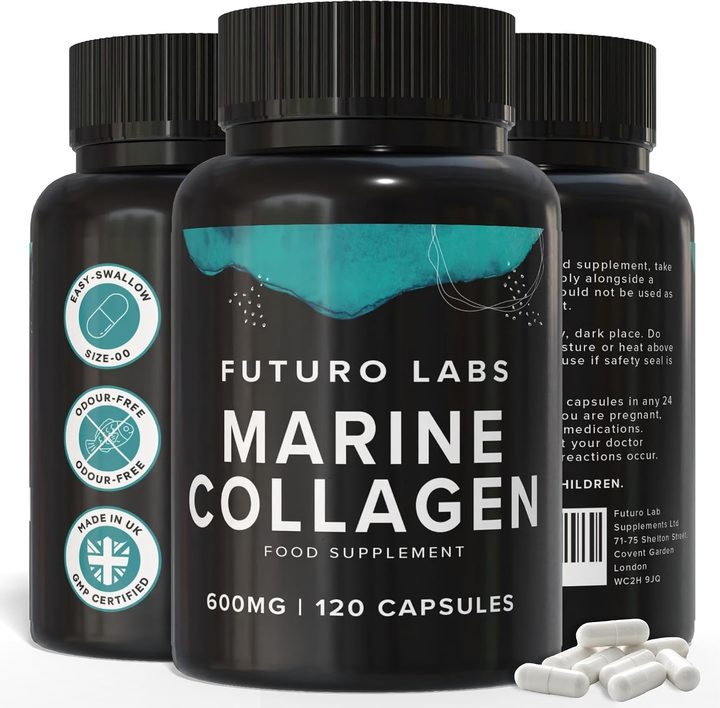
Our brand: the worked example on this page
Futuro Labs Marine Collagen
- 28p a day
- 120 capsules, 2 capsules daily
- Lab tested
- Made in the UK
A capsule row that survives the division: Futuro Labs Marine Collagen on Amazon UK, 1200mg hydrolysed type 1 daily at 28p, vitamin C and zinc at 15% NRV, £16.99 for 60 days. Full label breakdown. The pills split into capsules and tablets on the tablets page; the use-diary on the routines page.
The league table built: every format divided to the same denominator
Three formats invite three marketing stories, so strip all three to the one number that compares them, pence per gram of actual collagen, and build the league table any shelf can be run through in a phone calculator. Powder tops the table almost everywhere: a plain hydrolysate tub is the ingredient with nothing around it, no shell, no compression, no bottle, and at gram scale its division routinely lands lowest, the reason every protocol-dose page ends there. Pills come second and split in two, a split this query's wording glosses: capsules, a shell around a fill, carry a small and usually fair convenience premium, the worked example's 28p per 1.2g day being the benchmark division this site quotes, while tablets, compressed powder plus the binder-and-coating cast of the excipient audit, carry less collagen per unit than capsules and rarely win any division, the format that adds the most and carries the least. Liquids sit at the table's foot by a distance: shots and ready-to-drink bottles deliver modest peptide grams in flavoured water at per-serving prices that divide to several times powder's figure, sometimes an order of magnitude, the premium buying water, flavouring, glass and the ritual of a little bottle, real conveniences with a real price the division finally makes visible.
What the premiums actually buy, the chemistry that ties everything, and the knowing-purchase rule
The table read, name what each premium purchases, because the honest verdict is not that premiums are sins but that they should be bought knowingly. The capsule premium buys ergonomics, the ten-second travel-proof routine the diary page runs, worth its pennies to the habit reader and worthless to the protocol reader whose dose it cannot carry. The tablet premium buys nothing the capsule premium does not, plus excipients, the reason the tablets page confines the format to narrow niches. The liquid premium buys the largest bundle, zero preparation, portability, flavour, a ritual, and the reader who genuinely values that bundle at its multiple is making a legitimate choice this page will not sneer at, provided the division was run first, which it almost never is, the little bottles selling precisely to readers who have not converted per-serving charm into per-gram arithmetic. Chemistry, meanwhile, ties every row: dissolved tablet, opened capsule, stirred scoop and swigged shot all deliver identical factory-hydrolysed peptides to identical gut chemistry, the absorption pages' standing verdict, so no premium anywhere on the table buys better delivery, and every liquid label implying faster or superior uptake is charging for theatre. The knowing-purchase rule that falls out: run the division, name what the premium buys, decide if you want that thing at that price, and let the standing checks outrank format entirely, stated dose at true scale, vitamin C at 15% NRV, single source, per-batch testing, honest dates, because a cheap gram that fails the checks loses to an honest gram that costs a little more, which is the only upset the league table permits.
| The format | Typical division | The premium purchases |
|---|---|---|
| Powder | Lowest pence per gram | Nothing: the ingredient with nothing around it |
| Capsules | A small, usually fair premium | The ten-second travel-proof routine |
| Tablets | Above capsules, below their carry | Excipients: the audit's adds-most-carries-least verdict |
| Liquids and shots | A large multiple, sometimes tenfold | Water, flavour, glass and ritual: priced at last |
| Absorption | Tied across every row | No premium buys better delivery: theatre otherwise |
| The checks | Outrank the whole table | An honest gram beats a cheap one that fails them |
The verdict, read off the table
Collagen pills vs powder vs liquid: divide everything to pence per gram and the league settles, powder first, capsules a fair second whose premium buys a real routine, tablets a weak third carrying excipients, and liquids last at multiples that purchase water, flavour and ritual, legitimately bought only by readers who ran the division and wanted the bundle anyway, with absorption tied across every row and the format-blind checks outranking the entire table. The worked example is the capsule row surviving its own arithmetic: Futuro Labs Marine Collagen, 1200mg hydrolysed type 1 daily with 12mg vitamin C and 1.5mg zinc at 15% NRV, lab tested, UK made, £16.99 across 60 days dividing to 28p, a premium small enough to name and a routine worth naming it for.
What to check on the label
- Divide to pence per gram: the one number all three formats share.
- Powder tops the table: the ingredient with nothing around it.
- Pills split in two: fair capsule premiums, excipient-heavy tablets.
- Liquids pay for the bundle: water, flavour, ritual, at multiples.
- No premium buys absorption: chemistry ties every row.
Our brand
The worked example: Futuro Labs Marine Collagen
Futuro Labs Marine Collagen: 2 capsules daily, 1200mg hydrolysed type 1 marine collagen with 12mg vitamin C and 1.5mg zinc (15% NRV each), 120 capsules for £16.99, 60 days at 28p a day, lab-tested, UK GMP made. Slim veggie-shell capsules, odour free. Fish derived: pescatarian, not vegetarian or vegan.
- Collagen per serving
- 1200mg hydrolysed type 1 marine (fish)
- Co-factors
- vitamin C 12mg (15% NRV), zinc 1.5mg (15% NRV)
- Serving
- 2 capsules a day
- Bottle
- 120 capsules, 60 days
- Price
- £16.99 (28p a day)
- Capsule
- slim size 00, veggie shell, odour free
Questions people also ask
Which collagen format is best value?
Powder, almost everywhere: divide any label to pence per gram of collagen and the plain tub lands lowest, with capsules a fair second and liquids at large multiples.
Are liquid collagens worth the price?
Only knowingly: the multiple buys water, flavour, packaging and ritual, never better peptides, so run the per-gram division first and buy the bundle only if you still want it.
Whats the difference between collagen pills?
The word covers two formats: capsules, a shell around a fill with a small premium, and tablets, compressed powder plus binders and coatings carrying the least collagen per unit.
Do liquids absorb faster than pills or powder?
No: every format delivers identical factory-hydrolysed peptides once dissolved, and superior-absorption liquid marketing is theatre the division exposes.
Can a cheaper format still be the wrong buy?
Yes: the checks outrank the table, so a bargain gram without a stated dose, vitamin C at 15% NRV, testing and honest dates loses to a slightly dearer gram with them.
Sources
- The collagen peptide trial literature: randomised controlled studies of hydrolysed collagen supplementation across skin, joint and connective-tissue outcomes, typically at 2.5g to 15g daily, with small effects and frequent industry funding. PubMed record
- Futuro Labs Marine Collagen listing and label: 1200mg hydrolysed type 1 marine collagen per 2-capsule serving with 12mg vitamin C and 1.5mg zinc at 15% NRV each, 120 capsules, independently lab tested, UK made. https://www.amazon.co.uk/dp/B0C2J7N364
- EFSA Panel on Dietetic Products, Nutrition and Allergies. Scientific Opinion on the substantiation of health claims related to magnesium. EFSA Journal 2010;8(10):1807. https://efsa.onlinelibrary.wiley.com/doi/10.2903/j.efsa.2010.1807
- EFSA Panel on Dietetic Products. Scientific opinion on Dietary Reference Values for fats: Adequate Intake of 250mg combined EPA and DHA per day for adults. EFSA Journal 2010;8(3):1461. https://www.efsa.europa.eu/en/efsajournal/pub/1461