Ghost Fitness/Collagen/Collagen tablets vs powder: which is better?
Collagen tablets vs powder: which is better?
The short answer
A tablet is compressed powder plus binders, coatings and bulking agents, with the lowest collagen per unit of any format. Read the other-ingredients line: powder is collagen alone, capsules add a shell, tablets add the most and carry the least.
- What a tablet iscompressed powder plus binders, coatings, glidants, bulkers
- The per-unit ceilingtablets typically carry less collagen per unit than capsules
- The other-ingredients auditpowder shortest, capsule short, tablet longest
- The unchanged chemistryabsorption identical once dissolved: the factory solved it
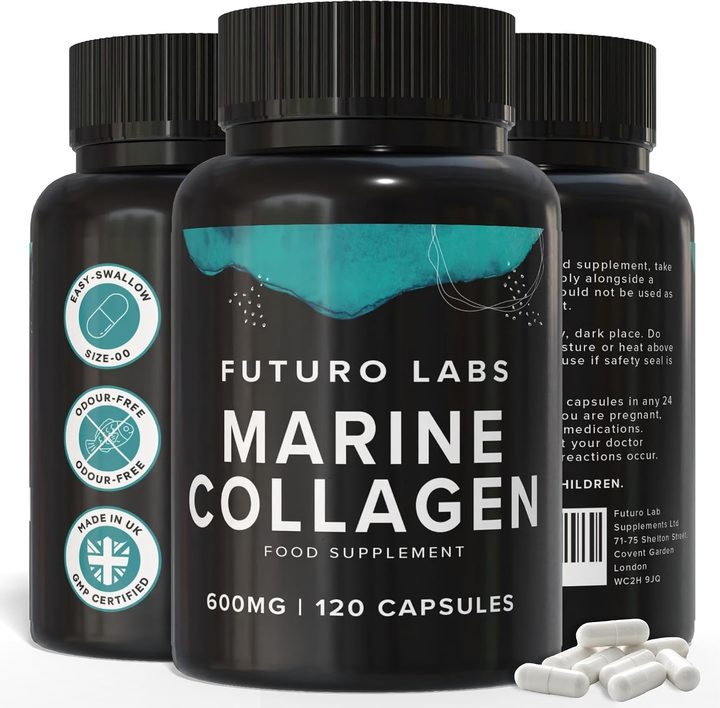
Our brand: the worked example on this page
Futuro Labs Marine Collagen
- 28p a day
- 120 capsules, 2 capsules daily
- Lab tested
- Made in the UK
The short-list format between the two: Futuro Labs Marine Collagen on Amazon UK, 1200mg hydrolysed type 1 in two capsules, shell plus fill and little else, vitamin C and zinc at 15% NRV, £16.99 for 60 days at 28p. Full label breakdown. The capsule-powder tree is on the capsules page; the purity paradox on the pure powder page.
The excipient audit: what each format contains besides collagen
Tablets are the format this section has barely mentioned, and the reason becomes the page: audit what each format contains besides collagen, and the tablet reads longest. Powder, the baseline: an honest unflavoured tub's ingredients line is one item, hydrolysed collagen peptides, occasionally two with an added vitamin C, the format that is the ingredient. Capsules: the fill plus a shell, gelatine or a vegetal cellulose, the worked example's slim veggie shells being two ingredients doing one job, containment, a short list still. Tablets: compressed powder plus the pressing's supporting cast, because collagen powder does not hold tablet shape on its own, so the manufacturer adds binders to make it cohere, bulking agents to fill the die, glidants and anti-caking agents so the machinery runs, often a coating so the result swallows and stores, standard pharmaceutical excipients, individually mundane and collectively the longest other-ingredients line in the category, wrapped around the format's second property, the per-unit ceiling: compression and excipient share cap how much collagen each tablet can actually carry, typically below even a capsule's 500-to-600mg, which is why tablet products so often quote their dose per 3 or per 6 tablets, the multi-tablet serving being the format confessing its arithmetic. None of this makes tablets unsafe, excipients are regulated and ordinary; it makes them the format that adds the most and carries the least, a poor trade the label prints in full for anyone who turns it around.
The tie-breakers that remain, and better assigned with the tree's help
Chemistry, as ever, breaks no ties: a dissolved tablet, an opened capsule and a stirred scoop all deliver the same factory-hydrolysed peptides to the same gut, absorption identical once the format has done its brief mechanical job, so the decision runs on the capsule-versus-powder page's tree with one extra branch. Dose first: the protocol band's 15g is a powder question outright, tablets failing the capsule page's 25-unit arithmetic even harder given their lower per-unit carry; the 1-to-2g habit is where tablets audition, and there they compete against capsules directly, same swallow count territory, and usually lose on three checks, the other-ingredients line above, the per-unit dose forcing more swallows for the same grams, and the pence division, tablet manufacture's extra steps rarely making them the cheap option per gram. The niches where a tablet honestly wins exist and are narrow: a reader who cannot take capsule shells of either kind, or a specific product whose tablet happens to pass every check at a fair price, the checks being format-blind by design, stated type and true dose per serving, vitamin C at 15% NRV, single source, testing, honest dates, pence divided. Better, assigned: powder for gram scale and the shortest label in the category, capsules for the clean two-swallow habit, and tablets for the reader with a specific reason, entering the same checklist as everything else and forgiven nothing for their shape.
| The format | Besides collagen, it contains | The honest read |
|---|---|---|
| Powder | Nothing, or an added vitamin C | The format that is the ingredient: shortest label |
| Capsules | A shell: gelatine or vegetal cellulose | Containment, two swallows, short list |
| Tablets | Binders, bulkers, glidants, coatings | The longest line: adds most, carries least per unit |
| The per-unit ceiling | Tablets below capsules below the scoop | Why tablet doses quote per 3 or per 6 |
| Absorption | Identical once dissolved | The factory solved it: no format wins chemistry |
| The checks | Format-blind by design | Dose, C at 15% NRV, testing, pence: as everywhere |
The verdict, read off the ingredients line
Collagen tablets vs powder: powder wins the audit this page runs, the format that is its own ingredient against the format that needs binders, bulkers and coatings to exist and still carries the least collagen per unit, with capsules sitting between them as the clean habit option and chemistry refusing to referee since every dissolved format feeds the same gut identically. Tablets survive only for the reader with a specific reason and a product that passes the format-blind checks at fair pence. The worked example holds the middle ground it always has: Futuro Labs Marine Collagen, 1200mg hydrolysed type 1 in two slim capsules, shell plus fill and the vitamin C and zinc claim-holders at 15% NRV, lab tested, UK made, £16.99 for 60 days at 28p a day, a short label in a category where the ingredients line was the whole contest.
What to check on the label
- Turn the tub around: the other-ingredients line is the contest.
- Tablets add the most: binders, bulkers, glidants, coatings.
- And carry the least per unit: hence the per-3 and per-6 servings.
- Chemistry referees nothing: dissolved formats feed the gut identically.
- The checks stay format-blind: dose, C at threshold, testing, pence.
Our brand
The worked example: Futuro Labs Marine Collagen
Futuro Labs Marine Collagen: 2 capsules daily, 1200mg hydrolysed type 1 marine collagen with 12mg vitamin C and 1.5mg zinc (15% NRV each), 120 capsules for £16.99, 60 days at 28p a day, lab-tested, UK GMP made. Slim veggie-shell capsules, odour free. Fish derived: pescatarian, not vegetarian or vegan.
- Collagen per serving
- 1200mg hydrolysed type 1 marine (fish)
- Co-factors
- vitamin C 12mg (15% NRV), zinc 1.5mg (15% NRV)
- Serving
- 2 capsules a day
- Bottle
- 120 capsules, 60 days
- Price
- £16.99 (28p a day)
- Capsule
- slim size 00, veggie shell, odour free
Questions people also ask
Are collagen tablets as good as powder?
They deliver the same peptides once dissolved, but the format adds the most excipients and carries the least collagen per unit, forcing multi-tablet servings: powder wins the audit at gram scale.
What is actually in a collagen tablet besides collagen?
The pressing's supporting cast: binders for cohesion, bulking agents, glidants for the machinery, and often a coating: regulated, ordinary, and the category's longest other-ingredients line.
Why do tablet doses say per 3 or per 6 tablets?
The per-unit ceiling: compression and excipient share cap each tablet's collagen below even a capsule's, so honest doses need multiples, which is the format confessing its arithmetic.
Do tablets absorb differently?
No: a dissolved tablet, an opened capsule and a stirred scoop all deliver identical factory-hydrolysed peptides, so no format wins the chemistry.
When would a tablet be the right choice?
Narrow niches: a reader who cannot take either capsule shell, or a specific tablet passing every format-blind check at fair pence: stated dose, C at 15% NRV, testing, honest division.
Sources
- The collagen peptide trial literature: randomised controlled studies of hydrolysed collagen supplementation across skin, joint and connective-tissue outcomes, typically at 2.5g to 15g daily, with small effects and frequent industry funding. PubMed record
- Futuro Labs Marine Collagen listing and label: 1200mg hydrolysed type 1 marine collagen per 2-capsule serving with 12mg vitamin C and 1.5mg zinc at 15% NRV each, 120 capsules, independently lab tested, UK made. https://www.amazon.co.uk/dp/B0C2J7N364
- EFSA Panel on Dietetic Products, Nutrition and Allergies. Scientific Opinion on the substantiation of health claims related to magnesium. EFSA Journal 2010;8(10):1807. https://efsa.onlinelibrary.wiley.com/doi/10.2903/j.efsa.2010.1807
- EFSA Panel on Dietetic Products. Scientific opinion on Dietary Reference Values for fats: Adequate Intake of 250mg combined EPA and DHA per day for adults. EFSA Journal 2010;8(3):1461. https://www.efsa.europa.eu/en/efsajournal/pub/1461