Ghost Fitness/Collagen/Is collagen protein good for weight loss?
Is collagen protein good for weight loss?
The short answer
Interview it for the protein's four duties in a deficit. Satiety: small, mixed trials. Lean mass preservation: fails, lacking leucine and tryptophan; whey wins every comparison. Thermic effect: like any protein. Counting towards the target: near zero. A top-up.
- Duty one, satietyprotein is the most satiating macronutrient; collagen's own trials are small and mixed
- Duty two, lean mass preservationcollagen fails: little leucine, no tryptophan; whey beat collagen in every direct comparison
- Duty three, thermic effectlike any protein
- Duty four, countingnear zero on PDCAAS and DIAAS; do not count it towards 1.6 to 2.2g per kilogram
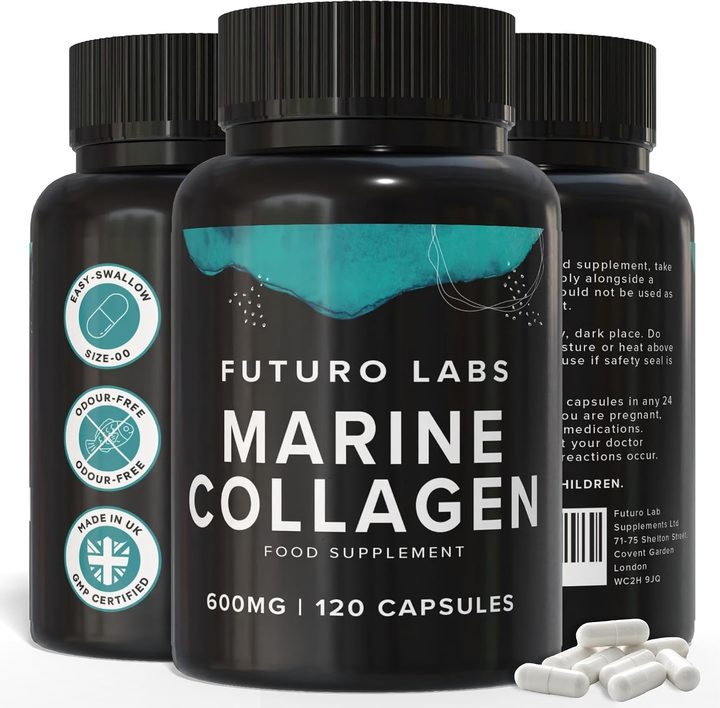
Our brand: the worked example on this page
Futuro Labs Marine Collagen
- 28p a day
- 120 capsules, 2 capsules daily
- Lab tested
- Made in the UK
For the habit, never as the protein: Futuro Labs Marine Collagen on Amazon UK, 2 capsules, 1200mg hydrolysed type 1 marine collagen with 12mg vitamin C at 15% NRV plus zinc, 120 for £16.99, 28p a day, lab tested and UK made, 1.2g that counts for nothing towards a protein target and makes no weight claim. Full label breakdown. The marketing chain is on the collagen and weight loss page; the fat-mass trial read closely on the collagen and belly fat page; the loose skin question on the loose skin during weight loss page.
The job description, and the first two duties: satiety and lean mass preservation
Is collagen protein good for weight loss is a question that treats collagen as a protein and asks whether it is a good one for the purpose, so the honest page writes the job description a protein has in a calorie deficit and interviews collagen for it, duty by duty, because the word protein on the tub is doing all the work in the question and the interview tests whether it deserves to. A protein in a deficit has four duties. The first is satiety: protein is the most satiating of the three macronutrients per calorie, and a higher-protein deficit is easier to hold because hunger is lower, the reason protein intake is raised rather than lowered when dieting. Collagen's performance here is unclear rather than bad: the trials that have compared gelatin or collagen with other proteins for appetite are small, short and mixed, some finding gelatin satiating and others finding it weaker than whey or casein, and none of them measuring weight, so the satiety duty is scored as unproven and a reader should not build a weight claim on it. The second duty is the one that matters most in a deficit, lean mass preservation. When calories fall the body draws on muscle as well as fat, and the two things that hold muscle are resistance training and enough protein of the right kind, where the right kind means protein that triggers and sustains muscle protein synthesis. Synthesis is triggered by leucine crossing a threshold of around two to three grams in a serving, and collagen is poor in leucine, carrying roughly a third of whey's per gram; synthesis is sustained by a complete supply of the essential amino acids, and collagen is not complete, containing no tryptophan at all, which is why it scores at or near zero on the protein quality scales. The direct comparisons settle the duty: in randomised trials pitting whey against collagen peptides on muscle protein synthesis and lean mass, whey produced the greater anabolic response every time. So a dieter who makes collagen their protein, the shake at breakfast and the scoop after training, has chosen the protein least able to hold muscle in a deficit, and will come out of the diet lighter on the scale and smaller in the muscle than the dieter who chose whey, eggs, dairy, meat, fish, soya or a complete plant blend. The interview is going badly for the lead role by the end of duty two, and duties three and four do not rescue it.
Duties three and four, the verdict, and the role collagen can be hired for
The third duty is the thermic effect of feeding, the energy the body spends digesting and processing what it eats, which is higher for protein than for carbohydrate or fat and is one of the minor reasons a higher-protein diet helps in a deficit. Collagen performs here like any protein, since the cost is in digesting peptide bonds and processing amino acids and does not depend on the profile, so this duty is a pass, though a small one, worth perhaps a few tens of calories a day at a 15g dose and not a lever anyone should pull for. The fourth duty is counting: a dieter is told to eat around 1.6 to 2.2 grams of protein per kilogram of body weight in a deficit to protect muscle, and the figure assumes complete protein, so the question is whether collagen's grams count towards it. They should not. The quality scales, PDCAAS and DIAAS, score proteins by essential amino acid completeness and digestibility against the body's needs, and collagen scores at or near zero for its missing tryptophan, so 15g of collagen contributes 15g to the nitrogen total and roughly nothing to the muscle-protecting total, and a dieter who counts it has an inflated protein number and an under-protected muscle mass. The verdict from the four duties is that collagen fails the interview for the lead role, the protein of the diet, on the duty that matters most, and the honest page says so plainly because the shelf says the opposite in letters an inch high. What collagen can be hired for is a different role, the top-up: a reader who has their complete protein in place, the 1.6 to 2.2g per kilogram from food and whey, can add a collagen dose on top of it for collagen's own reasons, the skin trials at 2.5g and above, the joint trials at 5 to 10g, the tendon protocol at 15g before loading, with the collagen's calories, around four per gram, counted in the deficit and the grams not counted as protein. That reader loses weight through the deficit, holds muscle through the complete protein and training, and takes collagen beside the diet rather than for it, which is the only arrangement the evidence supports, since no trial has tested collagen for weight loss, no weight claim is authorised for it in the UK, and the one fat-mass trial the shelf quotes, in older men with sarcopenia adding 15g to training, had no protein comparator and shows protein's work and not collagen's. The worked example is a habit dose and says what it is: two capsules, 1200mg hydrolysed type 1 marine collagen with 12mg vitamin C plus zinc, 120 for £16.99 at 28p a day, lab tested and UK made, 1.2g that counts for nothing towards a protein target, carries no weight claim, and sits below the 2.5 to 15g research band on its true terms. Is collagen protein good for weight loss: it is a poor protein for a deficit and an acceptable top-up on one, and the weight comes off through the deficit either way.
| The duty | What a protein must do | Collagen's performance | Score |
|---|---|---|---|
| Satiety | Reduce hunger per calorie so the deficit holds | Small, short, mixed trials; no weight measured | Unproven |
| Lean mass preservation | Trigger synthesis with leucine; sustain it with a complete profile | Low leucine, no tryptophan; whey won every direct comparison | Fails |
| Thermic effect | Cost energy to digest | Like any protein; a few tens of calories at 15g | Pass, minor |
| Counting towards the target | Contribute to 1.6 to 2.2g per kilogram of complete protein | PDCAAS and DIAAS at or near zero | Do not count |
| The lead role | Be the protein of the diet | Fails on the duty that matters most | Not hired |
| The top-up role | Sit on top of complete protein for its own reasons | 2.5g skin band, 5 to 10g joints, 15g tendon protocol; calories counted, grams not | Hired, if wanted |
| The weight claim | An authorised sentence | None exists for collagen in the UK | No |
| The worked exampleOurs | A habit dose | Two capsules, 1200mg marine collagen with 12mg vitamin C plus zinc, 28p a day; counts for nothing towards protein | Honest |
What to check on the label
- Keep complete protein as the protein of the diet: whey, dairy, eggs, meat, fish, soya.
- Do not count collagen towards the target: near zero on the quality scales.
- Hold muscle with training and leucine: collagen supplies neither.
- Add collagen on top, if at all: for its own reasons, calories counted.
- Credit the deficit for the weight: no collagen weight claim exists.
Our brand
The worked example: Futuro Labs Marine Collagen
Futuro Labs Marine Collagen: 2 capsules daily, 1200mg hydrolysed type 1 marine collagen with 12mg vitamin C and 1.5mg zinc (15% NRV each), 120 capsules for £16.99, 60 days at 28p a day, lab-tested, UK GMP made. Slim veggie-shell capsules, odour free. Fish derived: pescatarian, not vegetarian or vegan.
- Collagen per serving
- 1200mg hydrolysed type 1 marine (fish)
- Co-factors
- vitamin C 12mg (15% NRV), zinc 1.5mg (15% NRV)
- Serving
- 2 capsules a day
- Bottle
- 120 capsules, 60 days
- Price
- £16.99 (28p a day)
- Capsule
- slim size 00, veggie shell, odour free
Questions people also ask
Is collagen a complete protein?
No. Collagen contains no tryptophan and is low in leucine and the other essential amino acids, so it scores at or near zero on the PDCAAS and DIAAS protein quality scales; it is protein by nitrogen and incomplete by profile, which is why it should not be counted towards a protein target in a deficit.
Is collagen or whey better for weight loss?
Whey, for the duty that matters: holding muscle while calories fall. Whey carries the leucine that triggers muscle protein synthesis and a complete amino acid profile, and beat collagen in every direct comparison on synthesis and lean mass; collagen may be added on top of whey for its own reasons but not in its place.
Does collagen protein keep you full?
Protein in general is the most satiating macronutrient, but the trials comparing gelatin or collagen with other proteins for appetite are small, short and mixed, and none measured weight, so collagen's own satiety is unproven and no weight claim can be built on it; complete protein's satiety is the better documented.
How much protein should I eat when losing weight?
Research intakes of around 1.6 to 2.2 grams per kilogram of body weight a day of complete protein, spread over three or four meals each carrying enough leucine, beside resistance training, preserve lean mass in a deficit better than lower intakes; collagen's grams are not counted in that figure because of its incomplete profile.
Can I take collagen while dieting?
Yes, as a top-up on complete protein and not as the protein: its calories, around four per gram, are counted in the deficit, its grams are not counted towards the protein target, and it is taken for collagen's own reasons such as the skin trials at 2.5g and above or the tendon protocol at 15g before loading, with the weight loss belonging to the deficit.
Sources
- The protein quality literature: scoring systems such as PDCAAS and DIAAS rate proteins by essential amino acid completeness and digestibility, with collagen scoring at or near zero for lacking tryptophan. PubMed record
- The direct comparison trials: randomised studies pitting whey against collagen peptides on muscle protein synthesis and lean mass, in which whey consistently produced the greater anabolic response. PubMed record
- The protein and energy-restriction literature: higher protein intakes during a calorie deficit are studied for satiety and for preserving lean mass, the guard rails of sensible weight management. PubMed record
- The energy balance literature: body weight changes when energy intake and expenditure diverge over weeks, protein providing around four kilocalories a gram, with higher protein intakes tending to increase satiety and the thermic effect of feeding, so adding a protein supplement leads to weight gain only when its calories are added on top of intake rather than displacing other food. PubMed record