Ghost Fitness/Omega-3/Is ethyl ester fish oil absorbed well?
Is ethyl ester fish oil absorbed well?
The short answer
Well enough, with one condition: ethyl esters need bile and pancreatic enzymes that a fatty meal summons, so fed absorption approaches triglyceride forms while fasted absorption lags meaningfully. Take EE with dinner and the question mostly disappears.
- The extra stepEE must be de-esterified before absorption: the pathway's toll
- Fastedthe condition where EE lags triglyceride forms meaningfully
- The fatty mealwhat summons the bile and enzymes: absorption rises sharply fed
- Dinnerthe free fix that retires the question for practical purposes
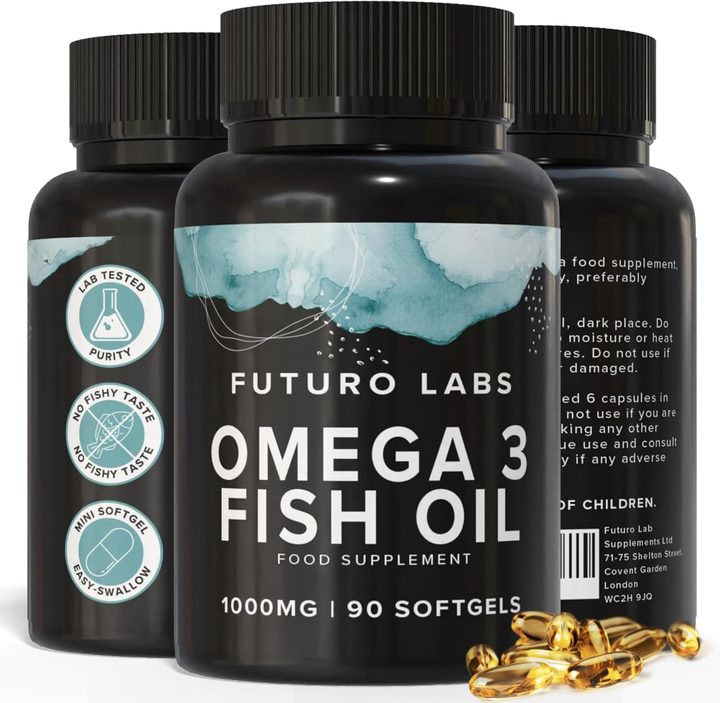
Our brand: the worked example on this page
Futuro Labs Omega 3 Fish Oil
- 17p a day
- 90 softgels, 1 softgel daily
- Lab tested
- Made in the UK
The form that skips the whole question: Futuro Labs Omega 3 Fish Oil on Amazon UK, natural triglyceride oil, 300mg EPA+DHA with dinner, £14.99 for 90 days. Label breakdown. The form chemistry is on the EE explainer; the buying tree on which form to buy.
The pathway: why an ethyl ester asks more of your digestion
Fat absorption runs on a production line: bile salts emulsify, pancreatic lipase snips fatty acids free, the intestinal wall absorbs them and rebuilds triglycerides for transport. A natural triglyceride fish oil arrives as the line's normal raw material and is processed on standard settings. An ethyl ester arrives one chemical step removed: each fatty acid is bound to ethanol rather than glycerol, pancreatic enzymes hydrolyse that ester bond more slowly, and the freed fatty acids then need the same bile-and-rebuild machinery as everything else, so EE digestion leans harder on components an empty stomach has not summoned. That is the entire mechanism behind the absorption gap, and it explains its shape precisely: fasted, with minimal bile flow and idle lipase, EE uptake lags triglyceride forms meaningfully in the bioavailability studies; fed, and especially with a genuinely fatty meal, the classic absorption work shows EE uptake rising sharply as the meal summons exactly the machinery the ester needed, the gap narrowing to a margin daily use would never detect.
What the mechanism means at the kitchen table, and the honest edge cases
Practically, the mechanism converts into three rules. Rule one, the instruction is load-bearing: with a fatty meal on an EE label is not boilerplate but the form's operating condition, dinner being the natural anchor because it is the day's most reliably fatty plate, and an EE habit built on black-coffee mornings is paying full price for partial delivery. Rule two, the gap is a logistics fact, not a quality verdict: fed EE delivers its declared milligrams into the same bloodstream as any triglyceride oil, which is why the fact-check page scores better absorbed as false without scoring EE as worse bought. Rule three, the edge cases route to people, not products: anyone with diagnosed fat-malabsorption territory, pancreatic insufficiency, bile or gallbladder conditions, or on fat-blocking medication like orlistat, has a genuinely reduced ability to run the pathway EE depends on, and their form question, along with their omega-3 question generally, belongs in the existing care conversation rather than an aisle. For everyone else, the kitchen table answers the title: yes, absorbed well, provided dinner is doing its summoning.
| Condition | What happens | The practical reading |
|---|---|---|
| Fasted, empty stomach | Slow ester hydrolysis, little bile: uptake lags TG forms | The one pairing to avoid: never EE on black coffee |
| With a light snack | Partial machinery summoned: middling uptake | Better, still not the design condition |
| With a fatty dinner | Bile and lipase in full flow: uptake approaches TG forms | The operating condition: the label's instruction, obeyed |
| Natural TG oil, any conditionOurs | Standard raw material: less meal-dependent | Why standard softgels skip the whole question |
| Malabsorption conditions or orlistat | The shared pathway itself is impaired | A care-team conversation, not a form choice |
The verdict, and the two ways to retire the question
Is ethyl ester fish oil absorbed well: yes with dinner, meaningfully less well without it, a one-condition answer the digestion pathway fully explains, which leaves a reader two honest ways to retire the question. Way one, keep the EE and fix the habit, every capsule welded to the evening meal, the free operating condition that closes the gap and preserves the form's price advantage. Way two, skip the condition entirely with a standard natural-triglyceride oil, the route this site's everyday answer takes: Futuro Labs Omega 3 Fish Oil, one softgel of natural-form oil with dinner, 300mg of EPA and DHA, £14.99 for 90 days at 17p, lab-tested, UK made, taken with food anyway because that is simply how this section takes everything. Either way, the absorption question ends at the same table, at roughly the same time, most evenings.
What to check on the label
- EE needs one extra digestive step: the ethanol ester bond hydrolyses slowly.
- Fasted uptake lags meaningfully: idle bile and lipase are the mechanism.
- A fatty meal closes the gap sharply: the label instruction is load-bearing.
- Fed EE delivers its declared milligrams: logistics, not a quality verdict.
- Malabsorption territory routes to the care team: the pathway itself is the issue.
Our brand
The worked example: Futuro Labs Omega 3 Fish Oil
Futuro Labs Omega 3 Fish Oil: 1 softgel daily with food, 1000mg fish oil providing 180mg EPA and 120mg DHA (300mg combined), 90 softgels for £14.99, 17p a day, lab-tested purity, UK GMP made. Gelatin shell, so not vegetarian.
- Fish oil per softgel
- 1000mg
- EPA / DHA per softgel
- 180mg / 120mg (300mg combined)
- Serving
- 1 softgel a day
- Bottle
- 90 softgels, 90 days
- Price
- £14.99 (17p a day)
- Softgel
- mini softgel, no fishy taste
Questions people also ask
How much worse is ethyl ester absorption on an empty stomach?
Meaningfully worse in the bioavailability studies: enough to matter for anyone paying gram-scale money. A fatty meal raises EE uptake sharply and narrows the gap to a margin.
Does taking ethyl esters with any food fix absorption?
The fattier the better: the mechanism runs on bile and pancreatic lipase, which dietary fat summons. Dinner is the natural anchor; a dry cracker is not.
Is poorly absorbed EE just wasted money?
Fasted, partly: you absorb less of what you paid for. Fed, no: delivered EPA and DHA are identical to any other form's once in the blood.
Should people with gallbladder or pancreas problems avoid EE?
Their whole fat-absorption pathway is the question, not just the form: omega-3 decisions there belong inside the existing care conversation.
Does the standard softgel have the same problem?
Much less so: natural triglyceride oil is the digestion line's normal raw material, which is one reason the everyday answer stays the simple 300mg softgel with dinner.
Sources
- Futuro Labs Omega 3 Fish Oil listing: 1000mg fish oil per softgel providing 180mg EPA and 120mg DHA, 90 softgels. Amazon UK, accessed 31 August 2026. https://www.amazon.co.uk/dp/B0CP9T3BTN
- Classic absorption work on fish oil ethyl esters: uptake is markedly higher when ethyl ester omega-3 is taken with a high-fat meal, narrowing the gap to triglyceride forms. PubMed record
- Dyerberg J, Madsen P, Møller JM, Aardestrup I, Schmidt EB. Bioavailability of marine n-3 fatty acid formulations. Prostaglandins, Leukotrienes and Essential Fatty Acids 2010;83(3):137-141. PubMed record
- GOED Voluntary Monograph: the omega-3 industry's quality standard setting limits for heavy metals, dioxins and oxidation (peroxide, anisidine and TOTOX values) in fish oils. https://goedomega3.com
- EFSA Panel on Dietetic Products. Scientific opinion on the substantiation of health claims related to EPA and DHA and normal function of the heart (250mg daily condition of use). EFSA Journal 2010;8(10):1796. https://www.efsa.europa.eu/en/efsajournal/pub/1796