Ghost Fitness/Omega-3/What are ethyl esters in fish oils?
What are ethyl esters in fish oils?
The short answer
Ethyl esters are omega-3 fatty acids bonded to ethanol instead of glycerol: the form concentration technology produces. Their benefit is purity and strength per capsule, not absorption; taken with a fatty meal they perform close to triglyceride forms.
- Ethanol backbonewhat replaces glycerol: the whole chemical difference
- The concentration stepwhy EE exists: it is how oils get purified and strengthened
- Purity and strengththe honest ethyl ester benefits: not absorption
- A fatty mealthe instruction that closes most of the absorption gap
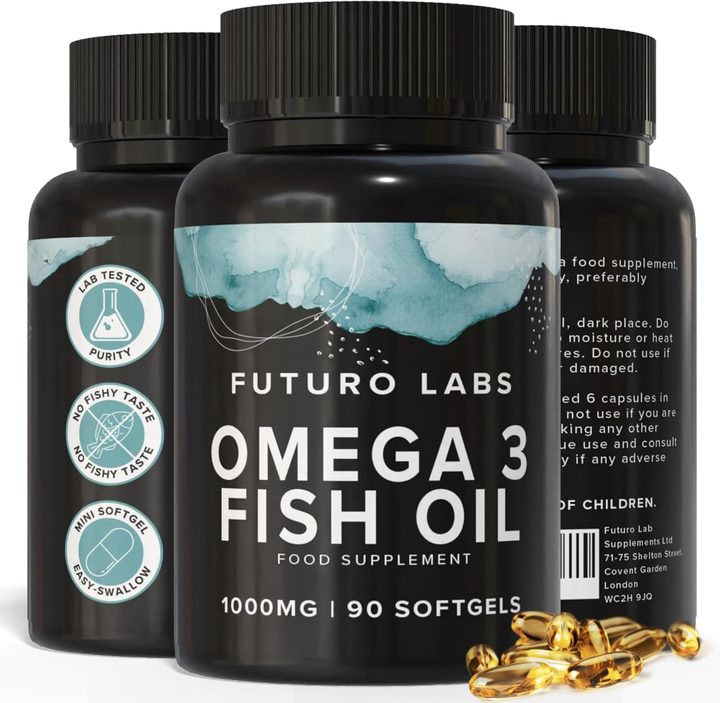
Our brand: the worked example on this page
Futuro Labs Omega 3 Fish Oil
- 17p a day
- 90 softgels, 1 softgel daily
- Lab tested
- Made in the UK
The standard natural-form lane, for comparison: Futuro Labs Omega 3 Fish Oil on Amazon UK, 300mg EPA+DHA per softgel, £14.99 for 90 days. Label breakdown. The prescription EE products are on the brand name page; the TG side on the triglyceride checklist.
The chemistry in one paragraph, and why the form exists at all
In a fish, omega-3 fatty acids ride a triglyceride: three fatty acids bonded to a glycerol backbone, the standard packaging of dietary fat. An ethyl ester is the same fatty acid re-bonded to a molecule of ethanol instead, one acid per ethanol, a smaller, simpler unit, and the reason it exists is industrial rather than nutritional: converting oil to ethyl esters is the gateway step of concentration, freeing individual fatty acids so molecular distillation can separate EPA and DHA from everything else, boiling off contaminants and saturated fractions along the way, which is how a 30% natural oil becomes a 60%, 80% or 96% concentrate. The finished concentrate then either ships as ethyl esters, the cheaper route, or pays for re-esterification back onto glycerol, the rTG products, and the pharmaceutical omega-3s, Omacor and its generics, are themselves ethyl esters, a detail worth holding whenever EE is described as an inferior form: it is the form medicine chose.
The benefits stated honestly, the drawback sized, and the label reading
Ethyl ester omega-3 benefits, asked straight: concentration, the entire point, more EPA and DHA per capsule than natural oil can hold, making gram targets a two-capsule job; purity, since the distillation that made the EE also stripped heavy metals, dioxins and oxidised fractions; and price, EE concentrates delivering the best pence-per-100mg figures on many shelves precisely because they skipped the re-esterification cost. The drawback, sized by the bioavailability work in Dyerberg's line: EE digests via a slower, more bile-dependent route, absorbing measurably less well on an empty stomach, with the gap narrowing substantially when the dose rides a fatty meal, dietary fat summoning the machinery EE needs, which converts the whole TG-versus-EE debate into a dinner instruction for anyone who was taking their capsules with food anyway. The label reading: concentrates that say nothing about form are EE by default, rTG is always announced because it cost money, and standard 30% oils are natural triglyceride by norm, the form question barely touching them.
| Question | The honest answer |
|---|---|
| What is it chemically? | A fatty acid bonded to ethanol instead of the glycerol backbone |
| Why does it exist? | It is the working form of concentration and purification |
| Its real benefits? | Strength per capsule, distillation-grade purity, the best per-gram prices |
| Its real drawback? | Weaker fasted absorption; a fatty meal closes most of the gap |
| Who uses EE deliberately? | Concentrate buyers on a budget, and the pharmaceutical products themselves |
| How to spot it? | Concentrates silent on form are EE; rTG is always declared; standard oils are natural TG |
The verdict, and where each buyer lands
What are ethyl esters in fish oils: the concentration industry's working chemistry, fatty acids on an ethanol backbone, honestly strong on purity, strength and price, honestly weaker fasted, and functionally settled by the with-dinner habit this entire section already recommends for other reasons. Where that leaves each buyer: the everyday 250mg shopper never meets the question, standard oils like the worked example, Futuro Labs Omega 3 Fish Oil at 300mg of EPA and DHA per natural-form softgel, £14.99 for 90 days at 17p, being triglyceride by norm; the gram-scale buyer chooses between a well-priced EE with a meal and a pricier rTG with a small edge, both legitimate; and nobody, having read the chemistry, needs to pay a fear premium to escape a form the prescription products themselves are made of.
What to check on the label
- EE = fatty acid on an ethanol backbone: the working form of concentration.
- Honest benefits: strength, purity, price: never absorption.
- Honest drawback: weaker fasted uptake: a fatty meal closes most of it.
- The prescription omega-3s are ethyl esters: the inferior-form story overreaches.
- Silence on a concentrate means EE: rTG always announces itself.
Our brand
The worked example: Futuro Labs Omega 3 Fish Oil
Futuro Labs Omega 3 Fish Oil: 1 softgel daily with food, 1000mg fish oil providing 180mg EPA and 120mg DHA (300mg combined), 90 softgels for £14.99, 17p a day, lab-tested purity, UK GMP made. Gelatin shell, so not vegetarian.
- Fish oil per softgel
- 1000mg
- EPA / DHA per softgel
- 180mg / 120mg (300mg combined)
- Serving
- 1 softgel a day
- Bottle
- 90 softgels, 90 days
- Price
- £14.99 (17p a day)
- Softgel
- mini softgel, no fishy taste
Questions people also ask
Are ethyl ester fish oils bad for you?
No: they are the form the prescription products use, made by the same distillation that purifies the oil. The only real cost is weaker fasted absorption, fixed at dinner.
Why are ethyl esters cheaper than triglyceride fish oil?
They skip the re-esterification step: same distilled oil, one less process, which is why EE concentrates often win the pence-per-100mg comparison.
Do ethyl esters absorb as well as triglycerides?
Not fasted: the bioavailability studies show a real gap on an empty stomach that narrows substantially with a fatty meal.
Is my standard 1000mg fish oil an ethyl ester?
Almost certainly not: standard-strength oils are natural triglyceride by manufacturing norm. The EE question lives in the concentrate aisle.
Should I pay extra to avoid ethyl esters?
Only at gram doses taken erratically: with a consistent dinner habit, a well-priced EE delivers nearly everything the rTG premium buys.
Sources
- Futuro Labs Omega 3 Fish Oil listing: 1000mg fish oil per softgel providing 180mg EPA and 120mg DHA, 90 softgels. Amazon UK, accessed 31 August 2026. https://www.amazon.co.uk/dp/B0CP9T3BTN
- Dyerberg J, Madsen P, Møller JM, Aardestrup I, Schmidt EB. Bioavailability of marine n-3 fatty acid formulations. Prostaglandins, Leukotrienes and Essential Fatty Acids 2010;83(3):137-141. PubMed record
- Electronic medicines compendium (emc): Summaries of Product Characteristics for omega-3-acid ethyl esters 1000mg capsules (Omacor and generics) and icosapent ethyl (Vazkepa). https://www.medicines.org.uk/emc/search?q=omega-3-acid+ethyl+esters
- EFSA Panel on Dietetic Products. Scientific opinion on the tolerable upper intake level of EPA, DHA and DPA: supplemental intakes of EPA and DHA combined up to about 5g/day do not raise safety concerns for adults. EFSA Journal 2012;10(7):2815. https://www.efsa.europa.eu/en/efsajournal/pub/2815
- EFSA Panel on Dietetic Products. Scientific opinion on the substantiation of health claims related to EPA and DHA and normal function of the heart (250mg daily condition of use). EFSA Journal 2010;8(10):1796. https://www.efsa.europa.eu/en/efsajournal/pub/1796