Ghost Fitness/Collagen/Can you take collagen with vitamin c side effects?
Can you take collagen with vitamin c side effects?
The short answer
The side effects belong to vitamin C's dose ladder, not the pairing. At 12mg, the claim threshold, none. Up to a few hundred milligrams, absorption saturates and the excess is excreted, nothing felt. At one to two grams, loose stools and gut upset begin. Above that, urinary oxalate rises in stone-formers and iron absorption increases. Collagen adds nothing to any rung, and the pairing is the design the research was built on.
- 12mg to 80mgthe claim threshold at 15% NRV and the reference value: no side effects
- A few hundred milligramsabsorption saturates; the excess is excreted; nothing felt
- One to two gramsloose stools and gut upset; the UK safe level for supplements sits around a gram
- Above thaturinary oxalate rises in stone-formers; iron absorption increases, a note for iron overload; collagen adds nothing at any rung
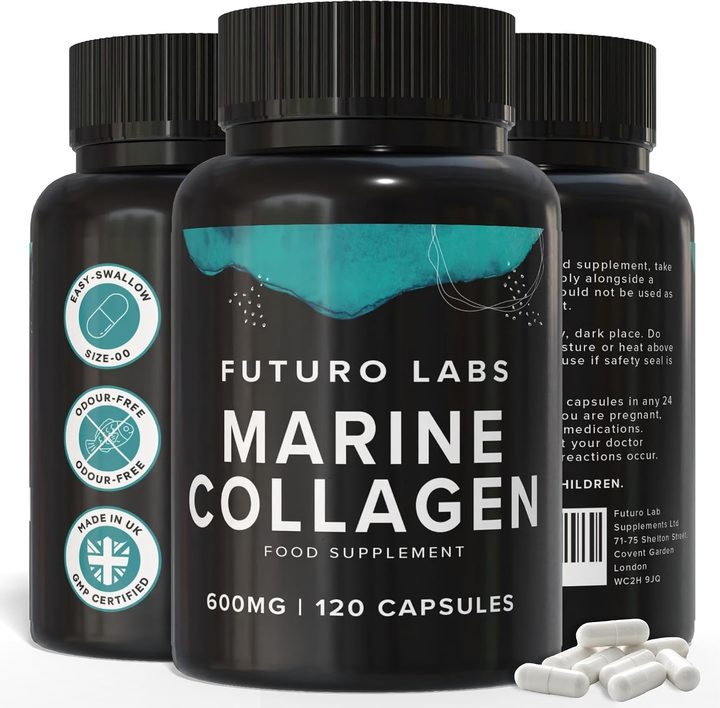
Our brand: the worked example on this page
Futuro Labs Marine Collagen
- 28p a day
- 120 capsules, 2 capsules daily
- Lab tested
- Made in the UK
The pairing at the bottom rung, 12mg of vitamin C built in beside the collagen: Futuro Labs Marine Collagen on Amazon UK, 2 capsules, 1200mg hydrolysed type 1 marine collagen with 12mg vitamin C at 15% NRV plus zinc, 120 for £16.99, 28p a day. Full label breakdown. Whether the pairing is beneficial is on the beneficial page; how much vitamin C to take with collagen on the vitamin C dose page.
Why the pairing has no side effects of its own, and the bottom rungs of vitamin C's ladder
Can you take collagen with vitamin C, and what are the side effects, is a question whose answer lives entirely on vitamin C's dose ladder, because the pairing has no side effects of its own and collagen brings almost nothing to the list, so the honest page climbs the ladder rung by rung. Why the pairing has none: vitamin C is the cofactor for the enzymes that hydroxylate proline and lysine and cross-link new collagen, the scurvy literature's lesson that without it collagen cannot be made properly, and it holds the register's sentence that it contributes to normal collagen formation for the normal function of skin, cartilage, bones, blood vessels, gums and teeth, the only authorised sentence that mentions collagen, so vitamin C beside collagen is not a risky combination but the design, the pre-loading research having paired around 15 grams of gelatin or collagen with roughly 50mg of vitamin C deliberately, the gelatin and vitamin C literature's protocol, and a capsule that builds the two together is following the research rather than stacking two risks. The bottom rungs: at 12mg of vitamin C, the 15 percent of the 80mg nutrient reference value that lets a product print the collagen formation sentence, there are no side effects of any kind, that being a fraction of an orange; at the 80mg reference value itself, the amount an adult needs daily, none; and up to a few hundred milligrams a day, the amount in a strong tablet or a fortified drink, none felt either, since absorption from the gut saturates around that level and the excess is excreted in the urine, the vitamin C safety assessment's account, a water-soluble vitamin that the body does not store passing through, so a reader on a collagen capsule with 12mg, a plain powder with an 80mg tablet or a fortified drink alongside is on rungs where the ladder has nothing to report.
The upper rungs, one to two grams and above, the people with a note, collagen's own short leaflet, and the ladder filed
The upper rungs are where side effects begin, and they are vitamin C's alone. At around one to two grams a day, the doses of the high-strength effervescent tablets and the immune-season habit, loose stools, gut upset and bloating begin in many people, the osmotic effect of unabsorbed vitamin C in the bowel, which is the reason the UK safe level for vitamin C supplements is set around a gram a day and the reason the ladder's practical ceiling for a reader pairing it with collagen is far below anything the pairing needs, the safety assessment's level. Above that, two notes for two kinds of reader: high vitamin C doses raise urinary oxalate, and a reader prone to calcium oxalate kidney stones keeps the dose modest and tells the urologist, and high doses increase the absorption of non-haem iron from food, which is a benefit to most and a note for a reader with haemochromatosis or another iron overload condition, who keeps vitamin C supplements low and mealtime vitamin C moderate on a clinician's advice. Collagen's own short leaflet, for completeness: fullness from a large powder dose, a taste, rare gut upset and a fish note for marine collagen in a fish-allergic reader, with no interaction with vitamin C or anything else and no claim, so collagen adds nothing to any rung of the ladder and the reader climbing it is climbing vitamin C's. The practical instruction follows the research and the ladder together: the pairing at the bottom rungs, 12mg built into a capsule for the claim or roughly 50mg with a powder for the protocol, up to a few hundred milligrams from a tablet or a drink with nothing felt, and no reason to go higher for the collagen's sake, a gram of vitamin C doing no more for collagen formation than 80mg does and bringing the bowel into it. The ladder filed: nothing at 12mg or 80mg, saturation and excretion at a few hundred milligrams, loose stools at one to two grams, oxalate and iron notes above that for stone-formers and iron overload, collagen adding nothing, and the pairing as the research's own design, with the worked example being the pairing at the bottom rung with 12mg built in beside the collagen, £16.99 for 120 at 28p a day.
| The rung | The side effect | The note |
|---|---|---|
| 12mg: the claim threshold at 15% NRV | None | A fraction of an orange; the register's collagen formation sentence printable |
| 80mg: the reference value | None | What an adult needs daily |
| A few hundred milligrams | None felt | Absorption saturates; the excess is excreted |
| One to two grams | Loose stools, gut upset, bloating | The UK safe level for supplements sits around a gram |
| Above that | Urinary oxalate up in stone-formers; iron absorption up | A urologist's note; an iron overload note |
| Collagen, at any rung | Fullness, a taste, rare gut upset, a fish note for marine | Adds nothing to vitamin C's ladder; the pairing is the research's design |
The verdict, a pairing the research designed, with side effects that begin only where vitamin C's dose leaves the collagen far behind
Can you take collagen with vitamin C, and what are the side effects: yes, and the side effects belong to vitamin C's dose ladder rather than to the pairing, none at the 12mg that prints the register's collagen formation sentence or at the 80mg reference value, nothing felt up to a few hundred milligrams where absorption saturates and the excess is excreted, loose stools and gut upset from around one to two grams where the UK safe level for supplements sits, and above that a rise in urinary oxalate for stone-formers and an increase in iron absorption for a reader with iron overload, with collagen adding fullness, a taste, rare gut upset and a fish note for marine and nothing to any rung, and the pairing being the design the research was built on, vitamin C as the cofactor for collagen formation paired with collagen at roughly 50mg in the pre-loading studies. The pairing at the bottom rung with 12mg built in: Futuro Labs Marine Collagen, 1200mg type 1 with 12mg vitamin C, 120 for £16.99 at 28p a day.
What to check on the label
- Read the pairing as the design: vitamin C is collagen's cofactor and the research's partner.
- Stay on the bottom rungs: 12mg for the claim, roughly 50mg for the protocol, a few hundred at most.
- Expect loose stools at a gram or two: vitamin C's, not collagen's.
- Keep it modest if you form stones or store iron: and tell the clinician.
- Read collagen's leaflet as short: fullness, a taste, a fish note.
Our brand
The worked example: Futuro Labs Marine Collagen
Futuro Labs Marine Collagen: 2 capsules daily, 1200mg hydrolysed type 1 marine collagen with 12mg vitamin C and 1.5mg zinc (15% NRV each), 120 capsules for £16.99, 60 days at 28p a day, lab-tested, UK GMP made. Slim veggie-shell capsules, odour free. Fish derived: pescatarian, not vegetarian or vegan.
- Collagen per serving
- 1200mg hydrolysed type 1 marine (fish)
- Co-factors
- vitamin C 12mg (15% NRV), zinc 1.5mg (15% NRV)
- Serving
- 2 capsules a day
- Bottle
- 120 capsules, 60 days
- Price
- £16.99 (28p a day)
- Capsule
- slim size 00, veggie shell, odour free
Questions people also ask
Is it safe to take vitamin C with collagen?
Yes, and it is the design: vitamin C is the cofactor for the enzymes that cross-link new collagen, holds the register's sentence for normal collagen formation for skin, cartilage and bones, and was paired with collagen at roughly 50mg in the pre-loading research, so the pairing has no side effects of its own and the only ones that exist are vitamin C's at high doses.
How much vitamin C should I take with collagen?
The bottom rungs of the ladder: 12mg, which is 15 percent of the 80mg reference value, lets a product print the collagen formation sentence, roughly 50mg is what the pre-loading research paired with collagen, and up to a few hundred milligrams from a tablet or a drink is absorbed with nothing felt, with no reason to go higher for the collagen's sake.
What are the side effects of too much vitamin C?
Loose stools, gut upset and bloating from around one to two grams a day, the osmotic effect of unabsorbed vitamin C in the bowel and the reason the UK safe level for supplements sits around a gram, and above that a rise in urinary oxalate in people prone to kidney stones and an increase in iron absorption, a note for a reader with an iron overload condition.
Can vitamin C and collagen upset your stomach?
Vitamin C can at a gram or two, collagen can as fullness from a large powder dose or rare gut upset in the sensitive, and the pairing cannot beyond the sum of the two, so a reader with an upset stomach drops the vitamin C to the bottom rungs, splits a large collagen dose, and reads a fish note if the collagen is marine and they are fish-allergic.
Does vitamin C help collagen absorb?
Not absorb, form: collagen peptides are absorbed as peptides and amino acids with or without vitamin C, and vitamin C's job is downstream, as the cofactor without which the body's own collagen cannot be hydroxylated and cross-linked, the scurvy lesson, which is why the register's sentence is for collagen formation and why the research paired the two.
Sources
- The vitamin C safety assessment: the nutrient reference value is 80mg a day, absorption saturates at a few hundred milligrams with the excess excreted, doses above around one to two grams a day cause loose stools and gastrointestinal upset, the safe level for supplements is set around a gram a day in UK guidance, and high doses raise urinary oxalate in people prone to kidney stones and increase iron absorption, a note for iron overload conditions. https://www.gov.uk/government/publications/vitamin-c-safe-upper-levels
- The scurvy literature: vitamin C deficiency impairs collagen synthesis through failed proline and lysine hydroxylation, producing the classic connective-tissue signs that resolve with vitamin C repletion. PubMed record
- The gelatin and vitamin C pre-exercise research (Shaw, Baar and colleagues): 15g gelatin with vitamin C taken about an hour before loading, studied for markers of collagen synthesis, the protocol behind the tendon-training conversation. PubMed record
- Retained Regulation (EC) No 1924/2006 on nutrition and health claims made on foods, and the Great Britain nutrition and health claims register. https://www.gov.uk/government/publications/great-britain-nutrition-and-health-claims-nhc-register