Ghost Fitness/Collagen/Can you use vitamin C and collagen serum together?
Can you use vitamin C and collagen serum together?
The short answer
Yes, layer them freely: no conflict exists. Know the doorman's rule, though: skin admits molecules around 500 daltons, so vitamin C gets in while collagen, thousands of times larger, sits on top as a decent surface moisturiser.
- The compatibility answeryes: no interaction, layer in any routine
- The doorman's rulemeaningful passive penetration ends around 500 daltons
- Vitamin C's passascorbic acid ~176 daltons: through the door, the evidenced one
- Collagen's sizepeptides run thousands; native collagen ~300,000: surface work only
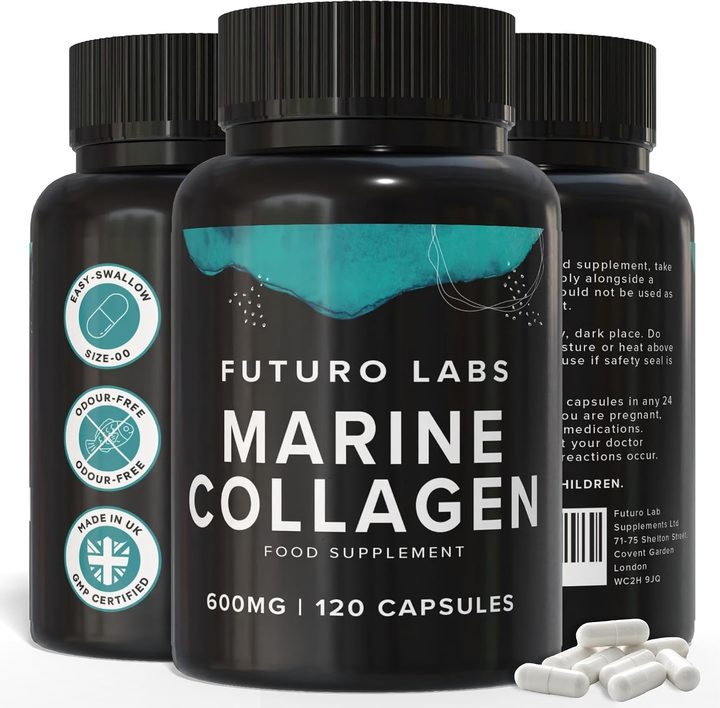
Our brand: the worked example on this page
Futuro Labs Marine Collagen
- 28p a day
- 120 capsules, 2 capsules daily
- Lab tested
- Made in the UK
The oral lane beside the shelf of serums: Futuro Labs Marine Collagen on Amazon UK, 1200mg hydrolysed type 1 with vitamin C at 15% NRV carrying the register's skin sentence, £16.99 for 60 days at 28p. Full label breakdown. The oral pairing's contract is on the C-for-skin page; the molecular-weight teach on the daltons page.
The doorman introduced, and both serums measured at the door
Layer them freely, no conflict existing between a vitamin C serum and a collagen serum in any order or routine, and spend the page on the rule that decides what each is actually doing on your face, because topical skincare has a doorman: the skin barrier, the stratum corneum, admits very little by passive diffusion, and the working rule of thumb the penetration literature uses is around 500 daltons, molecules under that weight having a chance of meaningful entry and molecules far above it staying outside, a rule that explains most of cosmetic chemistry in one number. Measure the two serums at the door. Vitamin C walks in: ascorbic acid weighs roughly 176 daltons, comfortably under the ceiling, and its derivatives are formulated precisely to cross and convert, which is why topical C owns a genuine dermatology literature, antioxidant activity in the skin it reaches, support against UV-generated damage alongside sunscreen, and a role in the brightening routines the cosmetics world builds, judged in that world's terms by concentration, stability and packaging, the famous fragility of L-ascorbic acid making the dark bottle and the use-by date real considerations. Collagen stays outside, politely: peptide fragments in serums run to thousands of daltons and native collagen weighs around 300,000, hundreds of times over the ceiling, so no collagen serum is delivering collagen into the dermis where yours lives, whatever the bottle's imagery, and the honest description of what it does is surface work, a film-forming humectant that binds water at the skin's top layer, smoothing appearance and easing tightness for as long as it sits there, which is a real, modest, washable benefit, the moisturiser's benefit, sold at serum prices.
The routine built honestly, the two lanes kept straight, and the shelf priced by the door
The layering routine, built with the doorman's knowledge: cleanse; apply the vitamin C serum first, thin, water-light textures going before heavier ones as the standard ordering rule, morning use being C's classic slot for the day's UV alongside its non-negotiable partner; let it settle a minute; apply the collagen serum over it as the comfort-and-surface layer, exactly where a film-former belongs; moisturiser if the routine uses one; and sunscreen last every morning, the step that outranks both bottles combined, the C serum's own literature positioning it as sunscreen's supporting act, never its substitute. No pH drama is needed at this page's depth, the practical version being simply that C goes on clean skin first and everything else follows. The two lanes then deserve their clean separation, because this query sits where they cross: the topical lane, governed by cosmetics rules, where C is the evidenced actor and collagen the pleasant surface player just described; and the oral lane, governed by the food register, where swallowed vitamin C at 15% NRV carries the authorised collagen-formation sentence for skin and swallowed peptides pool like any protein, the two lanes neither replacing nor requiring each other, a reader running both being coherent and a reader told the serum feeds the dermis being misled by a molecule that never fit the door. The shelf, priced by the doorman: pay for the C serum on its formulation, concentration stated, packaging opaque, date honest; pay for a collagen serum only at moisturiser prices for moisturiser work, the imagery discounted to zero; and spend the difference where every skin page on this site spends it first, the sunscreen that makes the whole routine's biggest difference standing at the end of it.
| The item | The size and verdict | The honest job |
|---|---|---|
| The 500-dalton rule | The barrier's approximate ceiling | Explains most of cosmetic chemistry |
| Vitamin C serum | ~176 daltons: through the door | Antioxidant support in-skin, beside sunscreen |
| Collagen serum | Thousands to ~300,000: stays outside | Film-forming surface moisturiser, washable |
| The layering order | Thin C first, collagen over, SPF last | Standard textures rule, no drama needed |
| The oral lane | A different rulebook entirely | C's sentence at 15% NRV; peptides pool |
| The pricing rule | Formulation for C; moisturiser rates for collagen | Imagery discounted at the door |
The verdict, stamped at the door
Can you use vitamin C and collagen serum together: yes, layer freely with the C first and sunscreen last, no conflict anywhere, and carry the doorman's rule out of the page, skin admitting molecules around 500 daltons, which lets ascorbic acid through to do its evidenced antioxidant work and leaves collagen, thousands of times too large, doing honest surface moisturising under premium imagery. The worked example serves the other lane entirely: Futuro Labs Marine Collagen, 1200mg hydrolysed type 1 with 12mg vitamin C at 15% NRV carrying the register's oral skin sentence, 1.5mg zinc alongside, lab tested, UK made, £16.99 for 60 days at 28p a day, a swallow rather than a layer, judged by its own rulebook while the serums are judged by theirs.
What to check on the label
- Layer freely, no conflict: C first, collagen over, SPF last.
- Know the 500-dalton rule: the barrier's approximate ceiling.
- C gets in: ~176 daltons, the evidenced topical actor.
- Collagen sits on top: honest surface moisturising, washable.
- Price by the door: formulation for C, moisturiser rates for collagen.
Our brand
The worked example: Futuro Labs Marine Collagen
Futuro Labs Marine Collagen: 2 capsules daily, 1200mg hydrolysed type 1 marine collagen with 12mg vitamin C and 1.5mg zinc (15% NRV each), 120 capsules for £16.99, 60 days at 28p a day, lab-tested, UK GMP made. Slim veggie-shell capsules, odour free. Fish derived: pescatarian, not vegetarian or vegan.
- Collagen per serving
- 1200mg hydrolysed type 1 marine (fish)
- Co-factors
- vitamin C 12mg (15% NRV), zinc 1.5mg (15% NRV)
- Serving
- 2 capsules a day
- Bottle
- 120 capsules, 60 days
- Price
- £16.99 (28p a day)
- Capsule
- slim size 00, veggie shell, odour free
Questions people also ask
Is it OK to layer collagen serum over vitamin C serum?
Yes, and that is the sensible order: the thin C serum on clean skin first, the film-forming collagen over it, moisturiser if used, and sunscreen last every morning.
Does collagen serum actually add collagen to skin?
No: the skin barrier admits molecules around 500 daltons and collagen runs from thousands to about 300,000, so serums do surface moisturising work, real and washable, never dermal delivery.
Why does vitamin C serum get through when collagen can't?
Size: ascorbic acid weighs roughly 176 daltons, under the barrier's ceiling, which is why topical C owns a genuine antioxidant literature while large proteins stay outside.
Do I still need oral vitamin C if I use the serum?
Different lanes: the serum works in-skin under cosmetics rules while dietary C at 15% NRV carries the register's collagen-formation sentence, neither replacing the other.
What should I pay for each serum?
C by its formulation, stated concentration, opaque packaging and honest dating; collagen at moisturiser rates for moisturiser work, with the savings spent on the sunscreen that outranks both.
Sources
- The skin penetration literature: the 500 dalton rule describes the approximate molecular weight ceiling for meaningful passive penetration of intact skin, excluding large proteins from transdermal delivery. PubMed record
- The peptide molecular weight literature: hydrolysed collagens run low molecular weight by definition, with di- and tripeptide absorption documented across ordinary hydrolysates rather than unique to ultra-low fractions. PubMed record
- The collagen and skin trial literature: randomised studies of oral collagen peptides on skin elasticity and hydration, mostly small, short and industry funded, with no authorised claim resulting. PubMed record
- Futuro Labs Marine Collagen listing and label: 1200mg hydrolysed type 1 marine collagen per 2-capsule serving with 12mg vitamin C and 1.5mg zinc at 15% NRV each, 120 capsules, independently lab tested, UK made. https://www.amazon.co.uk/dp/B0C2J7N364