Ghost Fitness/Collagen/Can you take creatine with collagen side effects?
Can you take creatine with collagen side effects?
The short answer
Two leaflets side by side, the pairing's line blank. Creatine: a water weight gain of around one to two kilograms in the first weeks, gut upset in some at loading doses, nothing else in healthy adults. Collagen: fullness from a large dose, a taste, rare gut upset, a fish note for marine. The pairing: no interaction in the body or in a glass, where creatine is stable for hours. The side effects of both are the side effects of each.
- Creatine's leafletone to two kilograms of water in the first weeks; gut upset in some at twenty-gram loading; nothing else in healthy adults
- Collagen's leafletfullness from a large powder dose; a taste; rare gut upset; a fish note for marine in the fish-allergic
- The pairing's lineblank: no interaction, no competition, no timing conflict; creatine stable in water for hours
- The instructionthree to five grams of creatine a day, no loading needed; collagen at its reason's dose; a shared glass fine
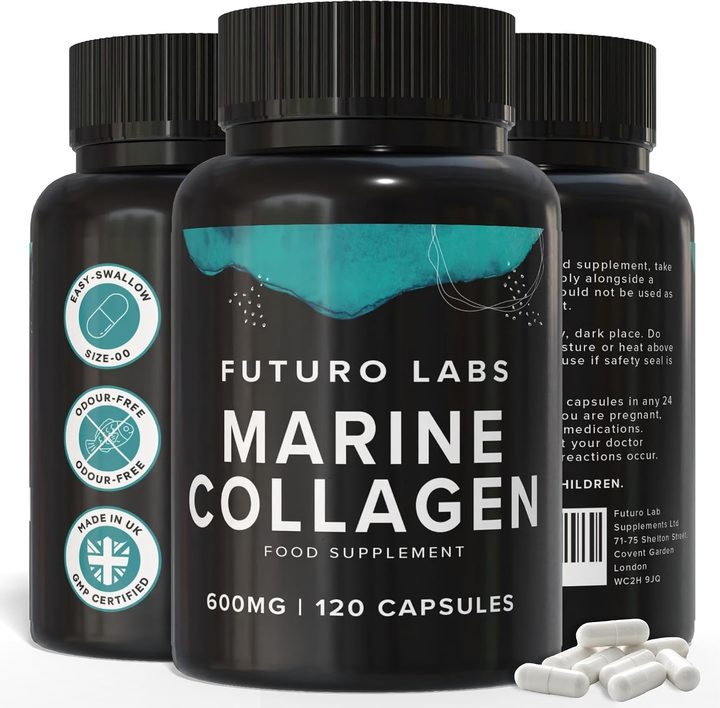
Our brand: the worked example on this page
Futuro Labs Marine Collagen
- 28p a day
- 120 capsules, 2 capsules daily
- Lab tested
- Made in the UK
The collagen half in capsules, which asks nothing of the creatine: Futuro Labs Marine Collagen on Amazon UK, 2 capsules, 1200mg hydrolysed type 1 marine collagen with 12mg vitamin C at 15% NRV plus zinc, 120 for £16.99, 28p a day. Full label breakdown. Mixing the two in one drink is on the mixing page; creatine against collagen for a lifter on the creatine versus collagen page.
Creatine's leaflet and collagen's leaflet, laid side by side
Can you take creatine with collagen, and what are the side effects, is a question best answered by laying the two supplements' leaflets side by side and reading the pairing's line, because the fear behind the question is that two things taken together make a third thing, and the honest page shows the third line blank. Creatine's leaflet: creatine monohydrate at three to five grams a day is among the most studied supplements there is, holding the register's sentence that it increases physical performance in successive bursts of short-term, high-intensity exercise at three grams a day and the sports nutrition position stand's grade as the best-evidenced ergogenic aid, the creatine literature's standing, and its side effects across the trials are a water weight gain of around one to two kilograms in the first weeks as muscle creatine rises and water follows it into the muscle, which is a change on the scale and not a harm, gut upset, bloating and loose stools in some users at loading doses of twenty grams a day, which the maintenance dose avoids and a loading week is not required to reach saturation in a month, and nothing else in healthy adults, no kidney or liver harm across the trials, the creatine safety literature's record, with the kidney note being for a reader who already has kidney disease and a clinician to ask. Collagen's leaflet: hydrolysed collagen is a protein, and its side effects are a protein's, fullness from a large powder dose of fifteen or twenty grams taken at once, a taste that some dislike and a flavoured product hides, rare gut upset in the sensitive, and a fish note, a marine collagen being fish-derived and a reader with a fish allergy reading the label and asking an allergist, with no claim of any kind and no drug interaction recorded. Two leaflets, both short, and neither mentioning the other.
The pairing's blank line, why a protein and an amino-acid derivative leave each other alone, the shared glass, what to do if something is felt, and the leaflets filed
The pairing's line is blank, and the reason is chemistry. Creatine is a small nitrogen-containing compound made from three amino acids, taken up by muscle through its own transporter and stored as phosphocreatine, and collagen is a large protein digested into peptides and amino acids and absorbed like any protein, so the two are handled by different routes, compete for nothing, neither blocks nor boosts the other's uptake, and neither has a timing window the other interferes with, creatine's timing being any time of day with saturation the goal and collagen's being its reason's, the creatine and collagen pages' shared finding, which is why no interaction is recorded anywhere and the line stays blank. The shared glass: a reader who wants one drink can stir creatine and collagen into the same water, juice or shake, since creatine monohydrate is stable in water for hours before it slowly converts to creatinine over a day or more, the creatine stability literature's finding, so a drink mixed and finished within the hour loses nothing, with the one practical note that a drink left overnight loses some creatine and should be mixed fresh. What to do if something is felt: a reader on both who notices a change reads the two leaflets rather than inventing a third, so a kilogram on the scale in week two is creatine's water and expected, loose stools on a loading week are creatine's loading and fixed by dropping to the maintenance dose, fullness after a large powder dose is collagen's and fixed by splitting it, and anything outside the two leaflets, a rash, persistent gut trouble or a symptom that worries, is a GP's with both tubs in hand. The register's lines are the two supplements' own: creatine's performance sentence at three grams, collagen's none and vitamin C's collagen formation sentence beside it, so a lifter takes the creatine for the performance file and the collagen for its own reason with a vitamin C line, together or apart. The leaflets filed: creatine's water weight, loading-dose gut upset and nothing else, collagen's fullness, taste, rare gut upset and fish note, a blank pairing line with different routes and no competition, a shared glass fine within the hour, and a felt change read off one of the two leaflets, with the worked example being the collagen half in capsules that asks nothing of the creatine, £16.99 for 120 at 28p a day.
| The leaflet | The side effect | The fix |
|---|---|---|
| Creatine | A water weight gain of around one to two kilograms in the first weeks | Expected; muscle water, not fat |
| Creatine | Gut upset in some at twenty-gram loading doses | Skip the load; three to five grams a day saturates in a month |
| Creatine | Nothing else in healthy adults; a kidney note for existing kidney disease | A clinician to ask if you have one |
| Collagen | Fullness from a large powder dose; a taste; rare gut upset | Split the dose; a flavoured product |
| Collagen | A fish note for marine collagen | A fish-allergic reader reads the label and asks an allergist |
| The pairing | None: different routes, no competition, no timing conflict; creatine stable in water for hours | A shared glass, finished within the hour |
The verdict, two short leaflets and no third one, so the side effects of both are the side effects of each
Can you take creatine with collagen, and what are the side effects: yes, and the side effects are each supplement's own, creatine's leaflet reading a water weight gain of around one to two kilograms in the first weeks as muscle creatine and water rise, gut upset in some at twenty-gram loading doses that the three-to-five-gram maintenance dose avoids, and nothing else in healthy adults across one of the most studied supplements there is, collagen's leaflet reading fullness from a large powder dose, a taste, rare gut upset and a fish note for marine in a fish-allergic reader, and the pairing's line reading blank, since an amino-acid derivative taken up by its own muscle transporter and a protein digested like any other take different routes, compete for nothing and conflict in no timing, with creatine stable in a shared glass for hours, so a reader who feels something new reads one of the two leaflets and not a third. The collagen half in capsules: Futuro Labs Marine Collagen, 1200mg type 1 with 12mg vitamin C, 120 for £16.99 at 28p a day.
What to check on the label
- Read creatine's leaflet: water weight, loading-dose gut upset, nothing else.
- Read collagen's leaflet: fullness, taste, rare gut upset, a fish note.
- Leave the pairing's line blank: different routes, no interaction.
- Share a glass if you like: mixed fresh, finished within the hour.
- Read a felt change off one leaflet: a GP for anything outside both.
Our brand
The worked example: Futuro Labs Marine Collagen
Futuro Labs Marine Collagen: 2 capsules daily, 1200mg hydrolysed type 1 marine collagen with 12mg vitamin C and 1.5mg zinc (15% NRV each), 120 capsules for £16.99, 60 days at 28p a day, lab-tested, UK GMP made. Slim veggie-shell capsules, odour free. Fish derived: pescatarian, not vegetarian or vegan.
- Collagen per serving
- 1200mg hydrolysed type 1 marine (fish)
- Co-factors
- vitamin C 12mg (15% NRV), zinc 1.5mg (15% NRV)
- Serving
- 2 capsules a day
- Bottle
- 120 capsules, 60 days
- Price
- £16.99 (28p a day)
- Capsule
- slim size 00, veggie shell, odour free
Questions people also ask
Do creatine and collagen interact?
No: creatine is a small compound taken up by muscle through its own transporter and stored as phosphocreatine, and collagen is a protein digested into peptides and amino acids and absorbed like any protein, so they take different routes, compete for nothing, block nothing and share no timing window, with no interaction recorded anywhere.
What are the side effects of creatine?
A water weight gain of around one to two kilograms in the first weeks as muscle creatine and water rise, which is a change on the scale and not a harm, gut upset in some at loading doses of twenty grams a day, which the three-to-five-gram maintenance dose avoids, and nothing else in healthy adults across the trials, with a note for a reader who already has kidney disease to ask a clinician.
What are the side effects of collagen supplements?
A protein's: fullness from a large powder dose taken at once, a taste that some dislike, rare gut upset in the sensitive, and a fish note for marine collagen in a reader with a fish allergy, who reads the label and asks an allergist, with no claim of any kind and no drug interaction recorded.
Can I put creatine and collagen in the same drink?
Yes: creatine monohydrate is stable in water for hours before slowly converting to creatinine over a day or more, so a drink mixed and finished within the hour loses nothing, and the collagen dissolves alongside it without any reaction, with the one note that a drink left overnight should be mixed fresh.
I feel bloated taking creatine and collagen together, which one is it?
Read the two leaflets: bloating and loose stools in a loading week are creatine's, fixed by dropping to three to five grams a day, fullness after a fifteen or twenty gram powder dose is collagen's, fixed by splitting it, a kilogram on the scale is creatine's water, and anything outside the two leaflets or persisting is a GP's with both tubs in hand.
Sources
- The creatine safety literature: creatine monohydrate at three to five grams a day is among the most studied supplements, with a water weight gain of around one to two kilograms in the first weeks as muscle creatine and water rise, gastrointestinal upset in some at loading doses of twenty grams a day, and no kidney, liver or other harm in healthy adults across the trials, with no interaction with dietary protein or collagen. PubMed record
- Kreider RB, et al. International Society of Sports Nutrition position stand: safety and efficacy of creatine supplementation in exercise, sport, and medicine. Journal of the International Society of Sports Nutrition 2017;14:18. PubMed record
- The creatine stability literature: creatine monohydrate is stable dry but slowly converts to creatinine in aqueous solution over hours to days, supporting mix-and-drink practice. PubMed record
- The collagen composition literature: amino acid analyses show glycine at roughly every third residue with high proline and hydroxyproline, low leucine and no tryptophan. PubMed record