Ghost Fitness/Collagen/Is creatine or collagen better?
Is creatine or collagen better?
The short answer
They sit at opposite ends of the aisle's evidence spectrum: creatine holds an authorised claim at 3g with decades of trials, collagen holds none. Different jobs, but on any evidence axis, and any budget order, creatine first.
- Creatine's dossieran authorised performance claim at 3g daily; decades of trials
- Collagen's dossierzero claims; modest surrogate trials; one protocol niche
- The gapthe aisle's widest: strongest and weakest-documented neighbours
- The budget ordercreatine, then protein, then collagen, cut from the bottom
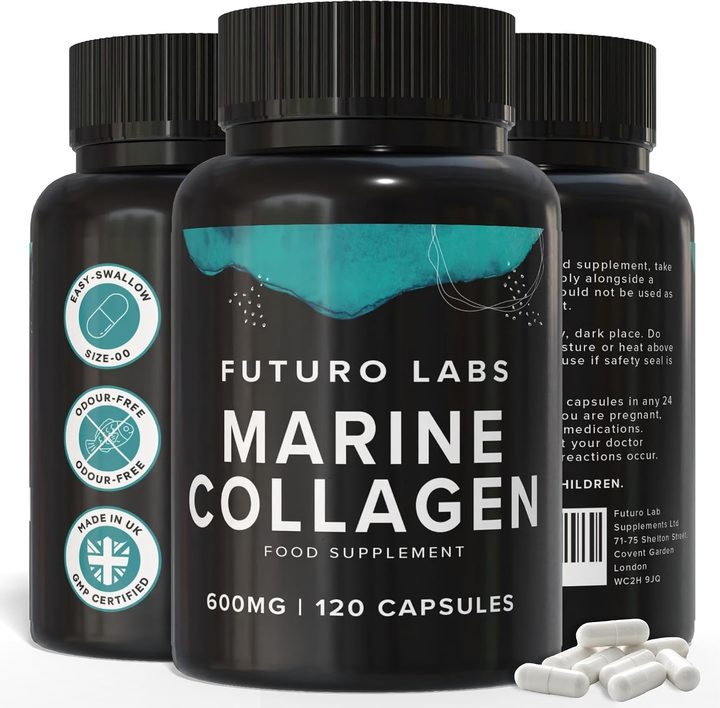
Our brand: the worked example on this page
Futuro Labs Marine Collagen
- 28p a day
- 120 capsules, 2 capsules daily
- Lab tested
- Made in the UK
The weaker dossier, priced with matching modesty: Futuro Labs Marine Collagen on Amazon UK, 1200mg hydrolysed type 1 with vitamin C and zinc at 15% NRV, £16.99 for 60 days at 28p. Full label breakdown. The three-way draft board is on the draft page; the combined-tub audit on the collagen-creatine page.
The two dossiers opened, and the spectrum they define between them
Put the two dossiers on the desk and the comparison becomes a measurement, because these products bookend the sports aisle's entire evidence spectrum. Creatine's dossier is the thickest in the building: hundreds of trials across decades, meta-analyses, position stands from the sports science establishment, a safety record long enough to bore, a mechanism understood to the enzyme, and, the line this site weighs heaviest, an authorised claim on the European register, creatine increases physical performance in successive bursts of short-term, high-intensity exercise, activated at a stated 3 grams daily, lawful words a tub may print because the evidence cleared the bar every other sports ingredient failed, the aisle's strongest case by the strictest available referee. Collagen's dossier is the one this whole section has audited page by page: zero authorised claims for any outcome at any dose from any source, a skin literature of small, short, sponsor-heavy trials moving instrument surrogates modestly, a joint story whose lawful vocabulary belongs entirely to its vitamin C passenger, and one genuinely interesting niche, the 15g pre-loading protocol, resting on lab tissue and blood markers rather than outcomes. Side by side, the gap between the folders is the widest two neighbouring shelves can show, the best-documented and among the least-documented popular supplements in the same basket, and measuring that gap honestly is most of the answer.
Different jobs conceded, the axes scored anyway, and the order that survives every framing
The fair concession first: the products apply for different jobs, creatine for power and performance in short intense efforts, repeated sprints, heavy sets, the extra rep, collagen for the daily habit carrying its cofactors' sentences or the connective-tissue protocol beside rehab loading, so a reader with exactly one of those goals has had the choice made by the goal. But the query says better, and better invites the axes, so score them plainly. Evidence quality: creatine, by the distance measured above. Regulatory standing: creatine, an authorised claim against none. Cost of the evidenced dose: creatine again, 3 grams of plain monohydrate costing pennies below even collagen's 28p benchmark. Certainty per pound: creatine, by multiplication of the above. Relevance to a lifter's core goals: creatine, performance sitting nearer the training block than any surrogate skin endpoint. Collagen's honest wins are narrower and real: it is the only candidate for its own protocol niche, the only one carrying skin-adjacent cofactor sentences, and the right pick for the reader whose entire interest is that lane. Which yields the order that survives every framing, the draft-board page's verdict restated: a training adult budgeting from scratch buys creatine first on the aisle's strongest case, protein second as the diet's foundation, and collagen last as the optional 28p rider or protocol experiment, cutting from the bottom when money tightens, and the both answer, for the reader who wants it, is untroubled, the two coexist without interaction concerns at their standard doses, provided each is bought as its own dossier priced it, one as the aisle's benchmark certainty, the other as its priced-for-modesty bet.
| The axis | Creatine | Collagen |
|---|---|---|
| Regulatory standing | An authorised performance claim at 3g | No claims: any outcome, any dose, any source |
| Trial base | Decades, hundreds of studies, position stands | Small sponsor-heavy surrogate trials; one marker-level niche |
| Cost of the evidenced dose | Pennies for 3g plain monohydrate | 28p benchmark for the habit; the protocol in pennies via gelatine |
| The job applied for | Power and short intense efforts | The cofactor habit or the pre-loading protocol |
| Certainty per pound | The aisle's best ratio | Priced honestly only with expectations flat |
| The budget order | First, always | Last: the optional rider, cut first when money tightens |
The verdict, filed with the gap on record
Is creatine or collagen better: they bookend the aisle, creatine holding the register's authorised performance claim at 3 grams atop decades of trials, collagen holding no claims and a marker-level niche, so on every evidence axis, and in every budget order, creatine first, with collagen defensible afterwards only in its own two lanes at its own modest price, and both together fine for the reader who wants both stories at their honest valuations. The worked example prices the weaker dossier the only way this site allows: Futuro Labs Marine Collagen, 1200mg hydrolysed type 1 with 12mg vitamin C and 1.5mg zinc at 15% NRV, lab tested, UK made, £16.99 for 60 days at 28p a day, a modest bet sitting, knowingly, at the far end of the spectrum from the aisle's one proven line.
What to check on the label
- The dossiers bookend the aisle: strongest case beside one of the weakest.
- Creatine holds the authorised claim: 3g daily, decades of trials behind it.
- Collagen holds its two lanes only: the cofactor habit and the protocol.
- Every axis scores creatine first: evidence, standing, cost, certainty.
- Both is fine, priced honestly: certainty at pennies, the bet at 28p.
Our brand
The worked example: Futuro Labs Marine Collagen
Futuro Labs Marine Collagen: 2 capsules daily, 1200mg hydrolysed type 1 marine collagen with 12mg vitamin C and 1.5mg zinc (15% NRV each), 120 capsules for £16.99, 60 days at 28p a day, lab-tested, UK GMP made. Slim veggie-shell capsules, odour free. Fish derived: pescatarian, not vegetarian or vegan.
- Collagen per serving
- 1200mg hydrolysed type 1 marine (fish)
- Co-factors
- vitamin C 12mg (15% NRV), zinc 1.5mg (15% NRV)
- Serving
- 2 capsules a day
- Bottle
- 120 capsules, 60 days
- Price
- £16.99 (28p a day)
- Capsule
- slim size 00, veggie shell, odour free
Questions people also ask
Is collagen better than creatine?
On no axis: creatine holds an authorised performance claim at 3g with decades of trials, while collagen holds no claims and a marker-level protocol niche, so evidence, cost and budget order all read creatine first.
Do creatine and collagen do the same thing?
No: creatine serves power and repeated short intense efforts, collagen serves the daily cofactor habit or the 15g pre-loading protocol, so a single clear goal picks for you.
Can I take creatine and collagen together?
Yes, untroubled at standard doses: 3g creatine and the collagen habit or protocol coexist, provided each is bought at its dossier's honest valuation.
Which should I buy first on a budget?
The draft order: creatine first on the aisle's strongest case, protein second as the diet's foundation, collagen last as the optional rider, and cut from the bottom.
Why does an authorised claim matter so much?
It is the strictest available referee: the register cleared creatine's performance wording on evidence and cleared nothing for collagen, the cleanest one-line summary of the gap between the dossiers.
Sources
- EFSA Panel on Dietetic Products, Nutrition and Allergies. Scientific Opinion on the substantiation of health claims related to creatine and increase in physical performance during short-term, high intensity, repeated exercise bouts. EFSA Journal 2011;9(7):2303. https://efsa.onlinelibrary.wiley.com/doi/10.2903/j.efsa.2011.2303
- Kreider RB, et al. International Society of Sports Nutrition position stand: safety and efficacy of creatine supplementation in exercise, sport, and medicine. Journal of the International Society of Sports Nutrition 2017;14:18. PubMed record
- The gelatin and vitamin C pre-exercise research (Shaw, Baar and colleagues): 15g gelatin with vitamin C taken about an hour before loading, studied for markers of collagen synthesis, the protocol behind the tendon-training conversation. PubMed record
- Futuro Labs Marine Collagen listing and label: 1200mg hydrolysed type 1 marine collagen per 2-capsule serving with 12mg vitamin C and 1.5mg zinc at 15% NRV each, 120 capsules, independently lab tested, UK made. https://www.amazon.co.uk/dp/B0C2J7N364