Ghost Fitness/Collagen/Collagen before and after one month: what has actually happened?
Collagen before and after one month: what has actually happened?
The short answer
Day 30: epidermis turned over once, fed by an unchanged dermis; dermis months from changing; joints a third of the way to a reading; bone nothing; gut adapted; habit formed or lapsed, the one real result.
- Skin at day 30epidermis turned over once; dermis a fraction into a clock of months; first trial reading 4 to 8 weeks away
- Joints and tendons at day 30a third of the way to the 12-week questionnaire; ~12 timed protocol sessions done
- Bone and gut at day 30bone nothing, measured at 12 months; gut adapted, fullness faded
- The habit at day 30formed if anchored, lapsed if floating: the one result the month can report
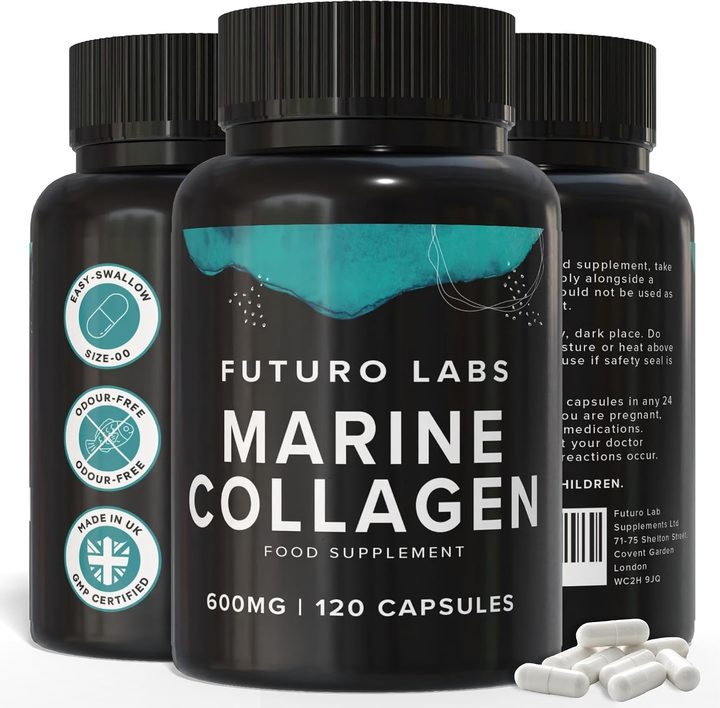
Our brand: the worked example on this page
Futuro Labs Marine Collagen
- 28p a day
- 120 capsules, 2 capsules daily
- Lab tested
- Made in the UK
The habit-sized dose for month two: Futuro Labs Marine Collagen on Amazon UK, 2 capsules, 1200mg hydrolysed type 1 marine collagen with 12mg vitamin C at 15% NRV plus zinc, 120 for £16.99, 28p a day, sixty days a tub, lab tested and UK made, below the trial doses and taken daily at an anchor for vitamin C's collagen formation sentence. Full label breakdown. The photograph as a calendar is on the before-and-after page; the three skin clocks on the collagen and skin page; the twelve-month ledger on the year of collagen page.
The day-30 report card: skin, joints, tendons and bone
Collagen before and after one month is the photograph pair the shelf most likes to show and the honest page replaces it with a report card, because day 30 is a date on which something can be said about every tissue collagen is sold for and almost none of it is what the photograph implies. Skin first, in its two layers. The epidermis, the outer living layer, turns over in around four weeks, so on day 30 the skin a reader sees is, for the first time, skin grown entirely since the tub was opened, which sounds like the moment to judge and is the reverse: the epidermis is fed from the dermis beneath it, and the dermis, where the skin's own collagen sits and where the trials' instruments measured, turns over on a clock of months and is a fraction of the way through it, so the new epidermis is more of the same, made by an unchanged dermis, and a reader inspecting it at day 30 is inspecting a control sample. The skin trials took their first reading at eight to twelve weeks, so on day 30 the first honest measurement is still four to eight weeks off, and the few percent in elasticity and hydration the trials found by cutometer and corneometer at that reading would not be visible in a mirror even then; a one-month before-and-after photograph, unless taken in fixed light at a fixed hour with a fixed face, shows the lighting, the hydration and the expression and nothing the collagen did. Joints second: the comfort trials at around ten grams a day took their first questionnaire reading at twelve weeks and their clearer one at twenty-four, so on day 30 a reader on the joint dose is a third of the way to the first reading with no score change expected, and a reader scoring one provoking movement weekly has four data points and a baseline, which is the right amount to have and not enough to read. Tendons third: a reader running the pre-loading protocol, around fifteen grams with vitamin C an hour before each loading session, has done around twelve sessions in a month, the collagen synthesis marker rising in the hour after each as the trial showed, while the tendon itself remodels under the loading on a clock of months and reports nothing at day 30 beyond how the programme is going. Bone fourth: nothing, and nothing expected, since the one collagen bone trial measured density at twelve months.
The report card's other lines: the gut, the habit, and the honest day-30 verdict
Two lines on the report card are about the reader rather than the tissue, and they are the two with results. The gut: a reader who started on a full scoop had fullness, mild bloating and perhaps a looser stool in the first days, twenty grams of protein in a glass being a new load, and by day 30 the gut has adapted, the gastrointestinal adaptation literature's one to two weeks having passed, so the fortnight's discomfort is gone and a reader who still has it is on too large a dose and drops to a dessertspoon; a reader on capsules had nothing to adapt to. The habit: the habit literature places the cliff at around week three, the point at which a behaviour floating on memory lapses and a behaviour anchored to a fixed daily point survives, so by day 30 the reader has passed it one way or the other and knows which, the anchored dose still being taken with the morning coffee or the last glass of water and the floating dose already missed more days than taken, and this is the one line on the report card that can honestly be marked as a result, because every collagen trial's controlled variable was consistency and a reader who reaches day 30 with the habit intact has done the thing the trials required and can now reach their readings. The honest day-30 verdict follows from the card: there is nothing to judge yet in any tissue, so the choice is not whether it worked but whether to continue, and the continuation has two honest forms, at the trial dose to the trial reading, ten grams to week twelve for joints or 2.5 to 10 grams to week twelve for skin with a fixed-light photograph or a scored sheet to read at the end, or at a habit-sized dose for the vitamin C line and the routine, knowing that is what it is; and the stop has one honest form, knowingly, because the month was never going to show anything and the reader has decided the reasons were not theirs, rather than because the mirror at day 30 was disappointing, which it was always going to be. The worked example is the habit-sized dose for month two: two capsules, 1200mg hydrolysed type 1 marine collagen with 12mg vitamin C plus zinc, 120 for £16.99 at 28p a day, sixty days a tub, lab tested and UK made, below the trial doses, taken daily at the anchor that survived the month for vitamin C's collagen formation sentence. Collagen before and after one month: an epidermis renewed by an unchanged dermis, joints a third of the way to a reading, a tendon protocol twelve sessions in, a bone untouched, a gut settled, and a habit that either exists or does not, which is the only before-and-after the month can show.
| The line | What has happened by day 30 | When the trials read it | The honest mark |
|---|---|---|---|
| Epidermis | Turned over once; skin grown since the tub opened, fed by an unchanged dermis | Not measured; the surface | More of the same |
| Dermis | A fraction into a clock of months | 8 to 12 weeks by cutometer and corneometer | Nothing yet, and nothing a mirror would see then |
| Joints | A third of the way to the first reading; four weekly scores and a baseline | 12 and 24 weeks by questionnaire | Too early to read |
| Tendon protocol | ~12 timed sessions; the marker rising after each | A marker within the hour; the tendon over months | The programme's progress, not the collagen's |
| Bone | Nothing | 12 months in one trial | Not applicable |
| Gut | Adapted; scoop-dose fullness faded | The first fortnight | Settled, or the dose is too large |
| Habit | Formed if anchored, lapsed if floating | Every trial's controlled variable | The one result |
| The photograph | Lighting, hydration, expression | Standardised in trials | Shows the light |
| The worked exampleOurs | Two capsules, 1200mg marine collagen with 12mg vitamin C, 28p a day | Below the trial doses | Month two's habit-sized dose |
What to check on the label
- Do not judge the mirror at day 30: the dermis has not changed.
- Mark the habit: it is the month's only result.
- Check the gut has settled: or drop to a dessertspoon.
- Continue to the trial reading or stop knowingly: not because of the month.
- Keep the sheet or the fixed-light photo going: read it at twelve weeks.
Our brand
The worked example: Futuro Labs Marine Collagen
Futuro Labs Marine Collagen: 2 capsules daily, 1200mg hydrolysed type 1 marine collagen with 12mg vitamin C and 1.5mg zinc (15% NRV each), 120 capsules for £16.99, 60 days at 28p a day, lab-tested, UK GMP made. Slim veggie-shell capsules, odour free. Fish derived: pescatarian, not vegetarian or vegan.
- Collagen per serving
- 1200mg hydrolysed type 1 marine (fish)
- Co-factors
- vitamin C 12mg (15% NRV), zinc 1.5mg (15% NRV)
- Serving
- 2 capsules a day
- Bottle
- 120 capsules, 60 days
- Price
- £16.99 (28p a day)
- Capsule
- slim size 00, veggie shell, odour free
Questions people also ask
What should I see after one month of collagen?
Nothing in any tissue: the epidermis has turned over once but is fed by a dermis that has not yet changed, the skin trials took their first reading at eight to twelve weeks by instrument, the joint trials at twelve weeks by questionnaire, and the one thing a month can honestly show is whether the daily habit has anchored or lapsed.
Why has my skin not changed after a month of collagen?
Because it could not have: the dermis, where the trials' instruments measured, turns over on a clock of months and is a fraction of the way through it at day 30, and even at the trials' eight-to-twelve-week reading the few percent found by cutometer and corneometer is generally below what a mirror shows.
Should I keep taking collagen if I see nothing at one month?
Decide by the reason rather than the mirror: continue at the trial dose to the trial reading, ten grams to week twelve for joints or 2.5 to 10 grams to week twelve for skin with a fixed-light photograph or a scored sheet, or continue at a habit-sized dose for the vitamin C line knowing that is what it is, or stop knowingly, since the month was never going to show anything.
Is one month enough for collagen to work on joints?
No: the joint comfort trials at around ten grams a day took their first questionnaire reading at twelve weeks and their clearer one at twenty-four, so at one month a reader is a third of the way to the first reading with no score change expected, and a weekly scored sheet on one movement has a baseline and four points, the right amount to have and too few to read.
What does collagen do in the first month?
It digests, feeds the amino acid pool and the slow tissues at their own pace, produces fullness at scoop doses that fades over a fortnight as the gut adapts, raises a collagen synthesis marker for an hour after each timed protocol dose, and either becomes a habit at an anchor or lapses by week three, which is the month's only measurable outcome.
Sources
- The skin biology literature: the epidermis turns over in around four weeks while dermal collagen, the layer supplements target, turns over far more slowly, so the oral collagen skin trials measured elasticity and hydration after eight to twelve weeks of daily intake with no timing of day specified, consistency across weeks rather than time of day being the variable the trials controlled. PubMed record
- The collagen peptide trial literature: randomised controlled studies of hydrolysed collagen supplementation across skin, joint and connective-tissue outcomes, typically at 2.5g to 15g daily, with small effects and frequent industry funding. PubMed record
- The gastrointestinal adaptation literature: fullness, bloating and stool changes after a new protein or fibre load are commonest in the first days and diminish over one to two weeks as gut motility, enzyme output and the microbiome adjust, and settle fastest when the dose is introduced gradually and taken with food. PubMed record
- The habit formation literature: anchoring a new behaviour to an existing daily routine is the best-documented adherence strategy, with consistency outperforming timing choices. PubMed record