Ghost Fitness/Collagen/Does collagen count towards protein intake?
Does collagen count towards protein intake?
The short answer
A two-column tracker. Column one, complete protein: whey, meat, fish, eggs, dairy, pulses, carrying leucine and all nine essential amino acids, where the 1.6 grams per kilogram target lives. Column two, collagen: every gram counts on the label, none toward the target, for want of leucine and tryptophan. Meet the target in column one first, add collagen in column two for its own reason, and never let column two fill a gap in column one.
- Column onecomplete protein: the 1.6 grams per kilogram target; twenty-five to thirty grams per main meal
- Column twocollagen: every gram on the label; none toward the target; almost no leucine, no tryptophan, a quality score near zero
- The rulemeet column one first; add column two for its own reason; never fill a column-one gap with column two
- The appreads nitrogen and adds both columns into one number; the reader keeps the columns apart
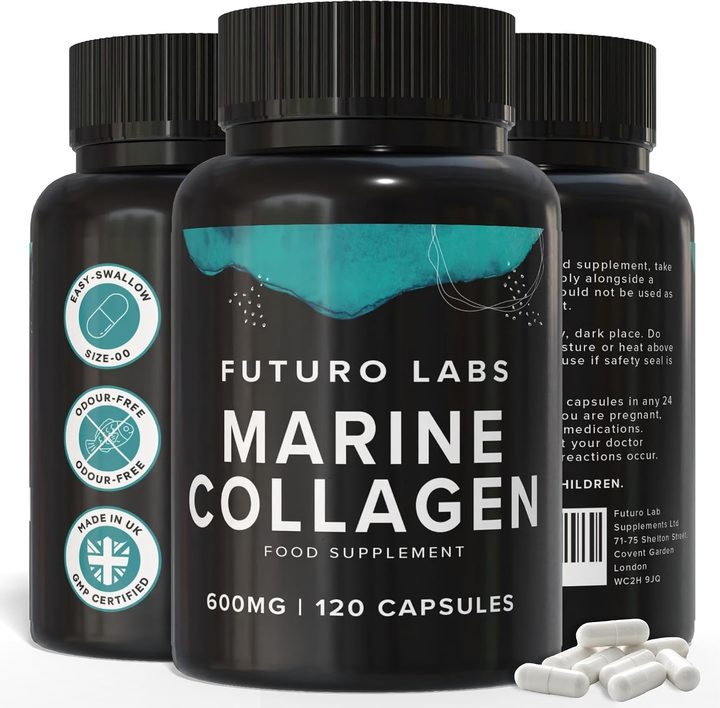
Our brand: the worked example on this page
Futuro Labs Marine Collagen
- 28p a day
- 120 capsules, 2 capsules daily
- Lab tested
- Made in the UK
A column-two dose taken for the vitamin C line, never mistaken for column one: Futuro Labs Marine Collagen on Amazon UK, 2 capsules, 1200mg hydrolysed type 1 marine collagen with 12mg vitamin C at 15% NRV plus zinc, 120 for £16.99, 28p a day. Full label breakdown. The three ledgers are on the counting page; whether collagen is a good source of protein on the protein source page.
The two columns, what goes in each and why the target lives in the first
Does collagen count towards protein intake, and does collagen protein count towards daily protein intake, are questions a tracking app answers with one number and a lifter should answer with two columns, because the app counts nitrogen and a lifter counts what protein does, and the honest page builds the tracker. Column one, complete protein: whey and casein, meat, poultry, fish, eggs, dairy, soya and, combined across a day, pulses and grains, the proteins that carry leucine at a useful proportion and all nine essential amino acids in the ratios muscle uses, and this is the column in which the protein target lives, around 1.6 grams per kilogram of body weight a day for a lifter building or keeping muscle, the protein intake literature's range, split so that each main meal carries twenty-five to thirty grams, the protein distribution research's per-meal dose that switches synthesis on and counters anabolic resistance, and the register's muscle sentences, protein contributes to a growth in muscle mass and to the maintenance of muscle mass, are written for this column. Column two, collagen: hydrolysed collagen from a powder or a capsule, glycine at every third residue with proline and hydroxyproline, almost no leucine, a fraction of whey's ten percent, and no tryptophan at all, the collagen composition literature's profile, scoring at or near zero on the PDCAAS and DIAAS scales that rate essential amino acid completeness and digestibility, the protein quality literature's verdict, and this column counts every gram on the label, since a label measures nitrogen and collagen is nitrogen, and counts none of them toward the target, since the target exists to supply what collagen does not carry, the direct comparison trials finding whey producing the greater anabolic response for exactly that reason.
The rule for keeping the columns, the app's one number and how to read it, the reason column two exists, and the tracker filed
The rule for keeping the columns is three lines. Meet column one first: a lifter at 80 kilograms needs around 130 grams of complete protein a day, and reaches it with the plate and a shake before column two is opened, since every gram of the target has to carry leucine and the essential amino acids to do its job. Add column two for its own reason: a physiotherapist's tendon protocol at around 15 grams of collagen with vitamin C an hour before loading, the gelatin and vitamin C literature's research adjunct, or the skin trials' 2.5 to 10 grams with modest expectation, recorded as grams in the app and taken as a supplement on top of a complete diet, with a vitamin C line beside it for the register's only collagen sentence. Never fill a column-one gap with column two: a lifter who is 20 grams short of the target at the end of the day and reaches for a collagen shake because it says 20 grams of protein has filled the gap on the app and not in the muscle, a swap that costs the leucine dose the gap needed, so the gap is filled with a whey shake, a tin of fish or a bowl of yoghurt and the collagen is left in its own column. The app's one number and how to read it: an app adds both columns into one protein total because it reads labels, so a lifter who logs 130 grams with 20 of collagen in it reads the total as 110 in column one and 20 in column two and judges the day by the 110, a mental subtraction that takes a second and that the app cannot do for them, with a reader who wants the app to do it logging collagen as a separate food group or under a name that flags it. The reason column two exists at all is worth saying: collagen is not a worse protein for a lifter to eat, it is a different ingredient with a different purpose, a source of glycine, proline and hydroxyproline for the research that studies connective tissue, and it counts perfectly well toward that purpose while counting for nothing toward muscle, the two-column tracker being the honest way to hold both facts. The tracker filed: complete protein in column one where the 1.6 target and the per-meal dose live, collagen in column two counted on the label and not toward the target, the target met first, column two added for its own reason and never used to fill a gap, and the app's one number read as two, with the worked example being a column-two dose taken for the vitamin C line, £16.99 for 120 at 28p a day.
| The column | What goes in it | What it counts toward |
|---|---|---|
| Column one: complete protein | Whey, casein, meat, fish, eggs, dairy, soya, pulses combined | The 1.6 grams per kilogram target; twenty-five to thirty grams per main meal; the register's muscle sentences |
| Column two: collagen | Powder or capsules; glycine, proline, hydroxyproline; almost no leucine; no tryptophan | Every gram on the label; none toward the target; its own reason |
| The rule | Meet column one first; add column two for its reason | Never fill a column-one gap from column two |
| The app | Adds both into one number by nitrogen | Read 130 with 20 of collagen as 110 and 20 |
| Column two's reason | A tendon protocol at around 15 grams with vitamin C; the skin trials' 2.5 to 10 grams | A supplement on top of a complete diet |
| The capsule benchmarkOurs | 1200mg type 1 with 12mg vitamin C, a column-two dose | Taken for the vitamin C line, never mistaken for column one |
The verdict, two columns kept apart, with the target met in the first and collagen added in the second for a reason of its own
Does collagen count towards protein intake: on a two-column tracker, complete protein in column one, whey, meat, fish, eggs, dairy and pulses, which carry leucine and all nine essential amino acids and in which the 1.6 grams per kilogram target and the twenty-five to thirty grams per main meal live, and collagen in column two, which counts every gram on the label because labels count nitrogen and none toward the target because collagen carries almost no leucine and no tryptophan and scores at or near zero on protein quality scales, so that a lifter meets the target in column one first, adds collagen in column two for a tendon protocol or the skin trials' dose, never fills a column-one gap with a collagen shake, and reads the app's single number as two. A column-two dose for the vitamin C line: Futuro Labs Marine Collagen, 1200mg type 1 with 12mg vitamin C, 120 for £16.99 at 28p a day.
What to check on the label
- Keep two columns: complete protein and collagen.
- Put the target in column one: 1.6 grams per kilogram, twenty-five to thirty a meal.
- Count collagen on the label only: nitrogen, not leucine.
- Never fill a gap with collagen: a whey shake, a tin of fish, a yoghurt.
- Read the app's number as two: subtract the collagen before judging the day.
Our brand
The worked example: Futuro Labs Marine Collagen
Futuro Labs Marine Collagen: 2 capsules daily, 1200mg hydrolysed type 1 marine collagen with 12mg vitamin C and 1.5mg zinc (15% NRV each), 120 capsules for £16.99, 60 days at 28p a day, lab-tested, UK GMP made. Slim veggie-shell capsules, odour free. Fish derived: pescatarian, not vegetarian or vegan.
- Collagen per serving
- 1200mg hydrolysed type 1 marine (fish)
- Co-factors
- vitamin C 12mg (15% NRV), zinc 1.5mg (15% NRV)
- Serving
- 2 capsules a day
- Bottle
- 120 capsules, 60 days
- Price
- £16.99 (28p a day)
- Capsule
- slim size 00, veggie shell, odour free
Questions people also ask
Does collagen protein count towards daily protein intake?
On the label and in the app, yes, since labels count nitrogen and collagen is nitrogen; toward the 1.6 grams per kilogram target a lifter eats for muscle, no, since that target supplies leucine and the essential amino acids that collagen barely carries, so it is tracked in a second column and the target is met in the first.
How should I log collagen in my tracking app?
As a separate food group or under a name that flags it, so the day's total can be read as two numbers, the complete protein that meets the target and the collagen that sits beside it, since the app adds both by nitrogen into one figure and cannot tell them apart for you.
What is complete protein?
A protein that carries all nine essential amino acids in the proportions muscle uses, with leucine at a useful share: whey, casein, meat, poultry, fish, eggs, dairy and soya, and pulses combined with grains across a day, against collagen, which lacks tryptophan entirely and carries almost no leucine, scoring at or near zero on the quality scales.
I am short on protein for the day, can I make it up with collagen?
Not for the muscle target: a collagen shake fills the gap on the app and not in the muscle, since the gap needed a leucine dose and collagen carries almost none, so the gap is filled with a whey shake, a tin of fish, eggs or a bowl of yoghurt and the collagen stays in its own column for its own reason.
Is collagen useless as protein, then?
It is a different ingredient with a different purpose: a source of glycine, proline and hydroxyproline for the connective tissue research, counting perfectly well toward a tendon protocol at around 15 grams with vitamin C or the skin trials' dose, and counting for nothing toward muscle, which the two-column tracker holds as two true facts.
Sources
- The protein intake and resistance training literature: meta-analyses support intakes around 1.6g per kilogram of body weight daily for maximising resistance-training gains, with diminishing returns above. PubMed record
- The protein distribution literature: studies in older adults support spreading intake so each main meal reaches roughly 25-30g of complete protein, countering anabolic resistance better than skewed patterns. PubMed record
- The protein quality literature: scoring systems such as PDCAAS and DIAAS rate proteins by essential amino acid completeness and digestibility, with collagen scoring at or near zero for lacking tryptophan. PubMed record
- Comparative protein research: the leucine content of a protein drives its muscle protein synthesis response, with whey outperforming collagen in direct comparisons. PubMed record