Ghost Fitness/Collagen/Does collagen count as protein intake for muscle growth?
Does collagen count as protein intake for muscle growth?
The short answer
Two ledgers, two answers: on a food label collagen counts as protein by energy, and in a training log it counts as zero, the 1.2 to 2.2g targets assuming complete protein. Log its calories; give the protein line nothing.
- The labelling ledgercounts: by energy percentage, collagen is protein on any panel
- The training ledgerzero: the targets assume complete, leucine-carrying grams
- The reason for the splitquality scores near zero: no tryptophan, a third of whey's leucine
- The logging rulecount the calories, discount the protein line to nothing
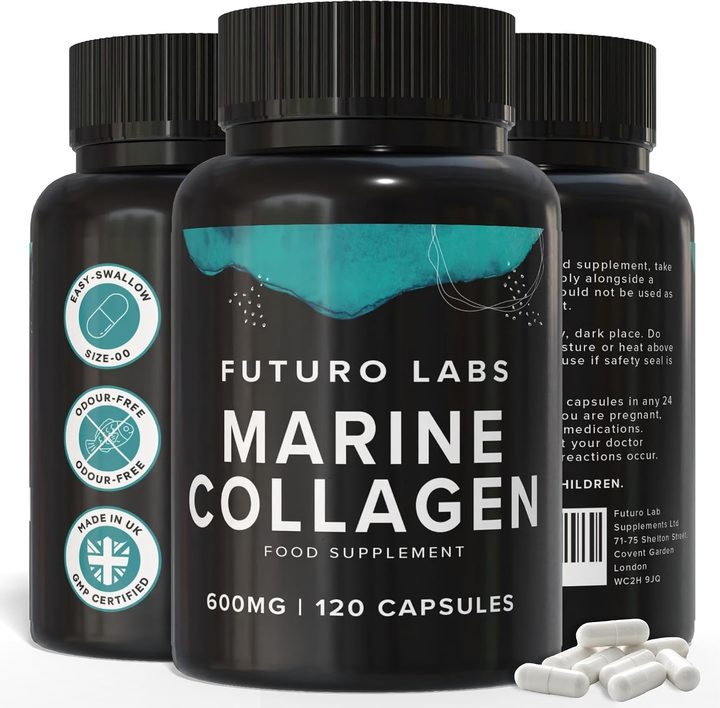
Our brand: the worked example on this page
Futuro Labs Marine Collagen
- 28p a day
- 120 capsules, 2 capsules daily
- Lab tested
- Made in the UK
Aboard for its own ledger entirely: Futuro Labs Marine Collagen on Amazon UK, 1200mg hydrolysed type 1 with vitamin C and zinc at 15% NRV, £16.99 for 60 days at 28p, never logged as protein. Full label breakdown. The two-rulers paradox is on the source-of-protein page; the bystander verdict on the still-build page.
The two ledgers named, and why the same grams read differently in each
The question has two honest answers because two different ledgers exist, and naming them dissolves the confusion this whole corner of the aisle trades on. Ledger one, the food label's: on a nutrition panel, collagen counts as protein, fully, the labelling ruler measuring energy contribution, and collagen being essentially pure protein by that measure, 10g of peptides declaring roughly 9g of protein on the back of the tub, no trick, no error, the panel doing exactly its job of describing what the food is made of, which is the two-rulers paradox this site maps on its own page, a substance that is protein for labelling purposes while failing every measure of protein usefulness. Ledger two, the training log's: here the same grams count as zero, because the 1.2-to-2.2g-per-kilogram targets that muscle-growth planning runs on were built by research feeding complete proteins, the numbers assuming every essential amino acid arrives, leucine at trigger strength included, and collagen defaults on those assumptions comprehensively, tryptophan absent outright, making it incomplete by definition, leucine at roughly a third of whey's per gram, and the quality scores that formalise usefulness, PDCAAS and DIAAS, sitting near zero, so counting collagen's grams toward a target quietly redefines the target, 150g on paper becoming perhaps 130g of grams that do what the research meant, the deficit invisible in the app and real in the tissue.
The logging rule written for real trackers, the edge cases, and the accounting closed
Make the split operational, because most askers are holding a tracking app: log collagen's calories, honestly and fully, roughly 4kcal per gram like any protein, since energy is energy and the labelling ledger is correct about it; and give the protein line nothing, either by logging the serving as a custom entry with its protein field set to zero, the cleanest method, or by mentally discounting it from the day's protein total, the same arithmetic done in your head, so that the target the app polices remains a target of grams that actually build, whey, meat, dairy, eggs, soy and well-paired plants doing the counting they were always meant to do. The edge cases close quickly: the collagen-whey blend logs by its parts, the whey fraction counting and the collagen fraction not, which is one more reason the blend pages send readers to separate tubs; the protocol lifter's 15g scoop logs the same way, sixty-odd calories and zero toward the protein line, its purpose living in the tendon diary rather than the macro summary; small habit doses of 1-to-2g are a rounding error either way, logged or ignored without consequence; and the reader whose tracker shows protein consistently short once collagen stops counting has found the page's real gift, an honest number to fix with food or a complete scoop rather than a flattering one that fixed nothing. The accounting closed: yes on the panel, zero in the programme, calories always, protein never, and the muscle maths finally telling the truth the tissue already knew.
| The ledger | Collagen's entry | Why |
|---|---|---|
| The food label | Counts fully as protein | The labelling ruler measures energy contribution |
| The training log | Counts as zero | Targets assume complete, leucine-carrying grams |
| The calories | Always logged: ~4kcal per gram | Energy is energy on every ledger |
| The blend | Logs by its parts: whey counts, collagen doesn't | One more case for separate tubs |
| The protocol scoop | Sixty-odd calories, zero protein | Its purpose lives in the tendon diary |
| The shortfall revealed | Fix with food or a complete scoop | An honest number beats a flattering one |
The verdict, balanced across both books
Does collagen count as protein intake for muscle growth: it counts on the food label, where the energy ruler honestly calls it protein, and it counts as zero in the training log, where the 1.2-to-2.2g targets assume complete, leucine-carrying grams that collagen's tryptophan-free, third-strength profile cannot supply, the logging rule following in one line, count the calories, give the protein line nothing. The worked example keeps its books straight by design: Futuro Labs Marine Collagen, 1200mg hydrolysed type 1 with 12mg vitamin C and 1.5mg zinc at 15% NRV, lab tested, UK made, £16.99 for 60 days at 28p a day, aboard for its cofactor sentences and its protocol lane, and entered in any honest tracker as exactly what it is, a few calories, no protein that counts, and no confusion carried forward.
What to check on the label
- Two ledgers, two answers: the panel says yes, the programme says zero.
- The targets assume completeness: leucine-carrying grams built the numbers.
- Log the calories always: ~4kcal per gram, on every ledger.
- Zero the protein field: custom entry or mental discount, either works.
- Blends log by their parts: the whey counts, the collagen never does.
Our brand
The worked example: Futuro Labs Marine Collagen
Futuro Labs Marine Collagen: 2 capsules daily, 1200mg hydrolysed type 1 marine collagen with 12mg vitamin C and 1.5mg zinc (15% NRV each), 120 capsules for £16.99, 60 days at 28p a day, lab-tested, UK GMP made. Slim veggie-shell capsules, odour free. Fish derived: pescatarian, not vegetarian or vegan.
- Collagen per serving
- 1200mg hydrolysed type 1 marine (fish)
- Co-factors
- vitamin C 12mg (15% NRV), zinc 1.5mg (15% NRV)
- Serving
- 2 capsules a day
- Bottle
- 120 capsules, 60 days
- Price
- £16.99 (28p a day)
- Capsule
- slim size 00, veggie shell, odour free
Questions people also ask
Should I count collagen toward my daily protein goal?
No: the 1.2 to 2.2g per kilogram targets assume complete protein, and collagen's missing tryptophan and third-strength leucine mean its grams do not do what the target's research meant.
Why does the label call collagen protein if it doesn't count?
Two rulers: labelling measures energy contribution, by which collagen is essentially pure protein, while training targets measure usefulness, by which its quality scores sit near zero.
How do I log collagen in a tracking app?
Count its calories fully, roughly 4kcal per gram, and set its protein field to zero with a custom entry, or discount the grams from your total by hand.
Does a collagen-whey blend count as protein?
By its parts: the whey fraction counts toward the target and the collagen fraction does not, which is one more reason to buy the two separately.
What if my protein comes up short once collagen stops counting?
That shortfall was always real: close it with food or a complete scoop, the honest number finally showing what the tissue experienced all along.
Sources
- Comparative protein research: the leucine content of a protein drives its muscle protein synthesis response, with whey outperforming collagen in direct comparisons. PubMed record
- The tryptophan literature: an essential amino acid the body cannot synthesise, precursor to serotonin and niacin, absent from collagen and required from complete dietary protein. PubMed record
- Futuro Labs Marine Collagen listing and label: 1200mg hydrolysed type 1 marine collagen per 2-capsule serving with 12mg vitamin C and 1.5mg zinc at 15% NRV each, 120 capsules, independently lab tested, UK made. https://www.amazon.co.uk/dp/B0C2J7N364
- EFSA Panel on Dietetic Products. Scientific opinion on Dietary Reference Values for fats: Adequate Intake of 250mg combined EPA and DHA per day for adults. EFSA Journal 2010;8(3):1461. https://www.efsa.europa.eu/en/efsajournal/pub/1461