Ghost Fitness/Collagen/Does collagen protein help build muscle?
Does collagen protein help build muscle?
The short answer
Parse the tub. Protein's muscle-mass sentence is lawful on collagen powder, a source of protein by energy, and hollow, because the evidence is complete protein: collagen lacks tryptophan and most of whey's leucine and does not drive muscle protein synthesis.
- The lawful partprotein contributes to a growth in muscle mass: authorised for any food that is a source of protein, which collagen powder is by energy
- The hollow partthe evidence behind the sentence is complete protein; collagen lacks tryptophan, carries a third of whey's leucine
- Does it counton the label yes; in the training log no; 1.6g per kilo is written in complete protein
- The honest purchaseconnective tissue research and vitamin C's sentence, booked beside the muscle protein
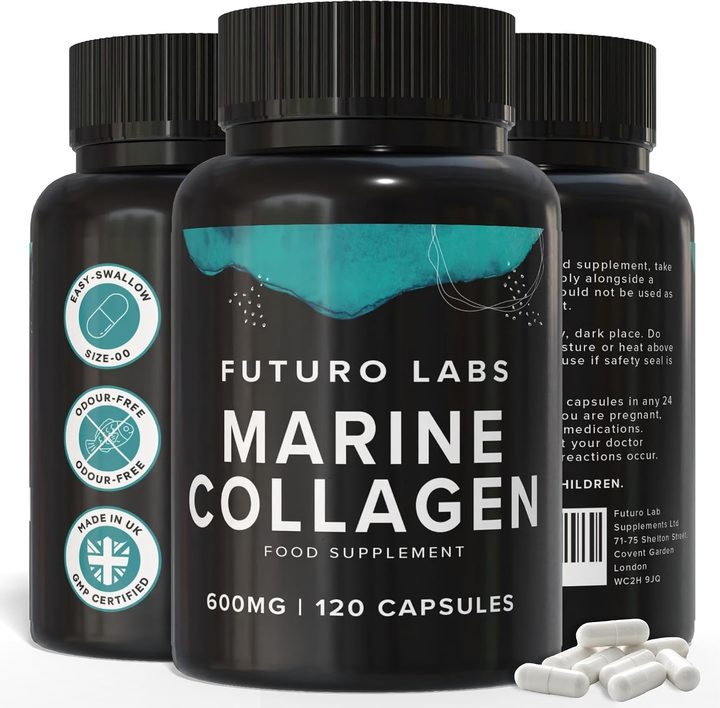
Our brand: the worked example on this page
Futuro Labs Marine Collagen
- 28p a day
- 120 capsules, 2 capsules daily
- Lab tested
- Made in the UK
No muscle sentence borrowed: Futuro Labs Marine Collagen on Amazon UK, 2 capsules, 1200mg hydrolysed type 1 marine collagen with 12mg vitamin C at 15% NRV plus zinc, 120 for £16.99, 28p a day, lab tested and UK made, stated as the connective tissue protein it is and taken for vitamin C's collagen formation sentence beside a day of complete protein. Full label breakdown. The trials that tried are on the does collagen help build muscle page; the two ledgers on the does collagen count page; the noun and the verb on the what does collagen protein do page.
The lawful part: how a collagen tub comes to carry protein's muscle sentence
Does collagen protein help build muscle is a question best answered by parsing the phrase on the tub, because collagen protein is two words doing two different jobs and the second word is doing work the first cannot, lawfully, which is the most useful thing a reader can understand about the muscle line on a collagen label. Start with the register. The UK nutrition and health claims register authorises two sentences for protein that every lifter has seen on a whey tub: protein contributes to a growth in muscle mass, and protein contributes to the maintenance of muscle mass, alongside a third, that protein contributes to the maintenance of normal bones. The condition of use for those sentences is not that the protein be complete, high in leucine or shown to build muscle in a trial; it is that the food carrying the sentence be at least a source of protein, defined as twelve percent of its energy value coming from protein, with high in protein at twenty percent, thresholds written for foods and drinks in general and not for the supplement aisle. Collagen powder is essentially all protein by energy, so it clears the source-of-protein threshold by a wide margin and clears high in protein too, which means a collagen tub may lawfully print protein contributes to a growth in muscle mass on its label, in the register's exact words, and many do. That is the lawful part, and it is worth stating plainly because a reader who sees the sentence and assumes it must have been earned by collagen has misread the mechanism: the sentence was earned by the category protein, on the evidence for protein as it is normally eaten, and the condition of use is a nutrition threshold that an incomplete protein meets as easily as a complete one, so the register's grammar allows the word protein on the tub to carry a muscle claim regardless of what the word collagen in front of it is. The regulator did not intend to endorse collagen for muscle; the regulator wrote a rule for protein content and collagen has protein content.
The hollow part: why the sentence is true of the category and false of the molecule, and what a lifter does with the parse
The hollow part is why the lawful sentence tells a lifter nothing about collagen. The evidence behind protein's muscle sentences is the evidence for complete dietary protein, the meat, dairy, eggs, fish, soya and whey that supplied the trials in which protein intake and resistance training built and kept muscle, and the mechanism that evidence rests on is specific: muscle protein synthesis after a meal or a session is triggered mainly by leucine, and sustained only when every essential amino acid is present to be built into new muscle protein. Collagen fails both conditions. It carries around a third of whey's leucine per gram, so the trigger is weak; it lacks tryptophan entirely, so the build cannot be completed from it alone; it scores near zero on the completeness scales the food regulators themselves use; and in the direct comparison, older women in energy restriction given whey or an equal dose of collagen peptides, whey supported muscle protein synthesis and collagen did not. So the sentence on the tub is true of protein as a category and false of the molecule in the tub, lawful and hollow at once, and a reader who buys collagen for the muscle line has bought a category's claim attached to the one common protein that does not deliver it. The secondary questions parse the same way. Does collagen have protein to build muscle: it has protein by weight and by the nitrogen test, and not the amino acids that build muscle, which is a different thing the label's grammar cannot express. Does collagen count as protein for muscle growth: on the label, yes, by energy; in the training log, no, because the 1.6 grams per kilo a lifter eats for muscle is a target written in complete protein, and a collagen scoop counted toward it is a scoop of muscle protein not eaten, the arithmetic error that is the only way collagen harms a lifter's muscle. What a lifter does with the parse is short: read the muscle sentence on a collagen tub as the category's, not the molecule's; eat complete protein to target and count only that; and buy collagen, if at all, for the connective tissue research at trial doses, the tendon protocol, the joint and skin trials, and for vitamin C's collagen formation sentence, which is the one claim on a collagen label that describes something collagen is actually involved in, booked beside the muscle protein and never within it. The worked example borrows no muscle sentence and says what it is: two capsules, 1200mg hydrolysed type 1 marine collagen with 12mg vitamin C plus zinc, 120 for £16.99 at 28p a day, lab tested and UK made, the connective tissue protein stated as such, taken for vitamin C's sentence beside a day of whey, dairy, meat, fish, eggs or soya at 1.6 grams per kilo. Does collagen protein help build muscle: the word protein on the tub may lawfully say so, and the collagen in the tub cannot do it.
| The item | What the register says | What the molecule does | The reading |
|---|---|---|---|
| The sentence | Protein contributes to a growth in muscle mass; authorised | Not applicable | Lawful on any source of protein |
| The condition of use | At least 12% of energy from protein; high at 20% | Collagen powder is essentially all protein by energy | Collagen clears it easily |
| The evidence behind it | Complete dietary protein with training | Collagen lacks tryptophan, carries a third of whey's leucine | The sentence is the category's, not the molecule's |
| The direct test | Not part of the claim | Whey supported muscle protein synthesis; an equal collagen dose did not | Hollow |
| Does it have protein to build muscle | Protein by weight and nitrogen | Not the amino acids that build muscle | Two different things the label's grammar cannot separate |
| Does it count toward 1.6g per kilo | On the label, yes | In the training log, no | Book it separately; count only complete protein |
| The honest purchase | Vitamin C's collagen formation sentence | Connective tissue research at trial doses | Beside the muscle protein, never within it |
| The worked exampleOurs | No muscle sentence borrowed | Two capsules, 1200mg marine collagen with 12mg vitamin C, 28p a day | The connective tissue protein, stated as such |
What to check on the label
- Read the muscle line as the category's: protein earned it, collagen printed it.
- Check the leucine and the tryptophan: a third, and none.
- Count only complete protein toward 1.6g per kilo: book collagen separately.
- Buy collagen for connective tissue: the tendon protocol, the skin and joint trials.
- Trust the vitamin C sentence: the one line that describes collagen's biology.
Our brand
The worked example: Futuro Labs Marine Collagen
Futuro Labs Marine Collagen: 2 capsules daily, 1200mg hydrolysed type 1 marine collagen with 12mg vitamin C and 1.5mg zinc (15% NRV each), 120 capsules for £16.99, 60 days at 28p a day, lab-tested, UK GMP made. Slim veggie-shell capsules, odour free. Fish derived: pescatarian, not vegetarian or vegan.
- Collagen per serving
- 1200mg hydrolysed type 1 marine (fish)
- Co-factors
- vitamin C 12mg (15% NRV), zinc 1.5mg (15% NRV)
- Serving
- 2 capsules a day
- Bottle
- 120 capsules, 60 days
- Price
- £16.99 (28p a day)
- Capsule
- slim size 00, veggie shell, odour free
Questions people also ask
Why does my collagen tub say it builds muscle if it does not?
Because the register's protein sentences attach to any food that is a source of protein, twelve percent of energy from protein, which collagen powder clears easily, so the tub may lawfully print protein contributes to a growth in muscle mass in the register's words, a sentence earned by complete protein as a category and hollow for a molecule that lacks tryptophan and most of whey's leucine.
Does collagen have protein to build muscle?
It has protein by weight and by the nitrogen test, and not the amino acids that build muscle: collagen carries around a third of whey's leucine, the trigger for muscle protein synthesis, and no tryptophan, one of the nine essential amino acids, so it fails both conditions the muscle-building evidence rests on.
Does collagen count as protein for muscle growth?
On the label yes and in the training log no: collagen is protein by energy, so it counts toward a nutrition declaration, while the 1.6 grams per kilo a lifter eats for muscle is a target written in complete protein, and a collagen scoop counted toward it is a scoop of muscle protein not eaten.
Is collagen protein powder the same as whey protein powder?
Same word, different molecule: whey is a complete, leucine-rich protein that drives muscle protein synthesis and earned the register's muscle sentences, while collagen is an incomplete connective tissue protein that may print the same sentences by meeting the protein threshold and does not deliver them, so a lifter buys whey for muscle and collagen for connective tissue reasons.
Should I take collagen protein as well as whey for muscle?
As well as, never instead of: whey or another complete protein at around 1.6 grams per kilo does the muscle job, and collagen is added on top for the connective tissue research, the tendon protocol and the skin and joint trials, or for vitamin C's collagen formation sentence, booked on its own line so the muscle total stays honest.
Sources
- The GB claims register, protein entries: protein contributes to a growth in muscle mass and to the maintenance of muscle mass and of normal bones, authorised for foods that are at least a source of protein. https://www.gov.uk/government/publications/great-britain-nutrition-and-health-claims-nhc-register
- Comparative protein research: the leucine content of a protein drives its muscle protein synthesis response, with whey outperforming collagen in direct comparisons. PubMed record
- The tryptophan literature: an essential amino acid the body cannot synthesise, precursor to serotonin and niacin, absent from collagen and required from complete dietary protein. PubMed record
- The collagen versus whey muscle protein synthesis comparison: a randomised trial in older women during energy restriction and step reduction found whey protein supplementation supported muscle protein synthesis where an equal dose of collagen peptides did not, consistent with collagen's near-absence of leucine and lack of tryptophan, the direct test the training trials lacked. PubMed record