Ghost Fitness/Collagen/Can collagen cause anxiety?
Can collagen cause anxiety?
The short answer
The mechanism is real; the dose defeats it. Collagen lacks tryptophan, the serotonin precursor, and a tryptophan-free amino acid load as sole protein lowers brain tryptophan in labs. A dose within a complete-protein diet does not. Trials show no anxiety.
- The kernel of truthno tryptophan in collagen; brain tryptophan tracks its ratio to competing amino acids; depletion drinks lower it for hours
- Why the dose defeats it10 to 20g within a diet containing complete protein does not reproduce the depletion ratio; tryptophan arrives from every meal
- The trialsup to 15g a day for months: no anxiety, mood or sleep signal above placebo
- The glycinea third of collagen; ~3g in 10g; small trials report calmer sleep, not anxiety
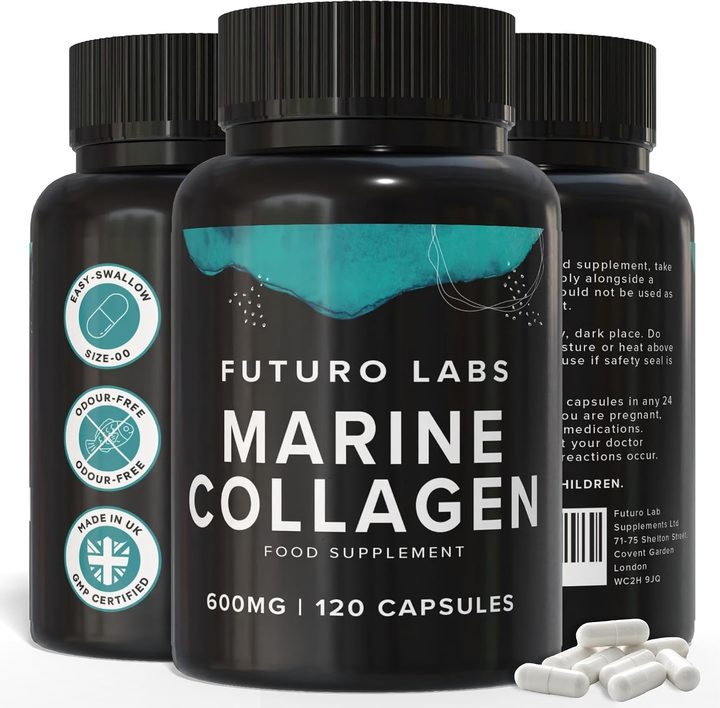
Our brand: the worked example on this page
Futuro Labs Marine Collagen
- 28p a day
- 120 capsules, 2 capsules daily
- Lab tested
- Made in the UK
A gram of protein beside a day of complete protein: Futuro Labs Marine Collagen on Amazon UK, 2 capsules, 1200mg hydrolysed type 1 marine collagen with 12mg vitamin C at 15% NRV plus zinc, 120 for £16.99, 28p a day, lab tested and UK made, a dose too small to shift any amino acid ratio, taken for vitamin C's collagen formation sentence. Full label breakdown. Why collagen lacks tryptophan is on the collagen versus regular protein page; the glycine footnote on the before bed page; the symptom audit on the symptoms of too much collagen page.
The mechanism examined: tryptophan, the shared transporter, and what the depletion studies actually did
Can collagen cause anxiety is a question with a real mechanism behind it, which is why it deserves examination rather than a wave of the hand, and the honest page follows the mechanism to the point where the dose defeats it, because that is where the answer lives. The mechanism runs in three steps and each is true. First, collagen contains no tryptophan: it is a third glycine with proline and hydroxyproline, and tryptophan, one of the nine essential amino acids, is absent, which is why collagen scores near zero on the protein completeness scales and why this site never counts it toward muscle. Second, tryptophan is the amino acid from which the brain synthesises serotonin, and the rate of that synthesis depends partly on how much tryptophan reaches the brain. Third, tryptophan crosses from blood into brain on a transporter it shares with the other large neutral amino acids, leucine, isoleucine, valine, phenylalanine and tyrosine, so the amount that gets in depends not on tryptophan alone but on its ratio to those competitors in the blood, a high load of competitors crowding tryptophan out. Laboratory research exploits exactly this. The acute tryptophan depletion method gives volunteers, usually after a day of low-protein food, an amino acid drink containing large amounts of every large neutral amino acid except tryptophan, as their sole protein, which floods the transporter with competitors and drives the ratio down, and within hours brain tryptophan and serotonin synthesis fall sharply, with lowered mood in some susceptible people, particularly those with a history of depression, the effect reversing as the drink clears. That is the kernel of truth in the claim, and it is a substantial one: a tryptophan-free amino acid load, given as the only protein, does lower brain serotonin for a few hours in a laboratory, and collagen is a tryptophan-free amino acid source. The question is whether a collagen dose as people take it reproduces the conditions of the depletion drink, and it does not, for reasons of dose and diet the next paragraph sets out.
Why the dose defeats the mechanism, what the trials and the glycine say, and the honest note about anxiety itself
The depletion drink works because it is the sole protein after a low-protein day, delivering fifty to a hundred grams of competing amino acids into a bloodstream carrying little tryptophan, and a collagen dose is neither. A reader taking ten or twenty grams of collagen in a morning coffee has eaten, or will eat within hours, breakfast, lunch and dinner containing complete protein, eggs, dairy, meat, fish, beans or whey, every one of which carries tryptophan, so the bloodstream the collagen enters already holds tryptophan from the last meal and will receive more from the next, and the collagen's competing amino acids are diluted by the day's rather than concentrated as the drink's are. The ratio does move a little after any protein serving, complete or not, since every protein delivers competitors, but a collagen scoop within an ordinary diet does not produce the depletion drink's ratio or anything near it, and the amino acid pharmacokinetics of a ten-gram dose, peaking and clearing over a few hours against the background of a fed day, are not those of a hundred-gram depletion load on a fasting one. The trials agree by their silence: hydrolysed collagen at 2.5 to 15 grams a day for eight weeks to a year, in thousands of participants across the skin, joint, bone and training trials, has produced no signal of anxiety, low mood or sleep disturbance above placebo in any adverse event table, and if the mechanism operated at those doses it would have. The glycine points the other way: a third of collagen by weight, so around three grams in a ten-gram dose, glycine is an inhibitory neurotransmitter as well as an amino acid, and small trials of three grams before bed report calmer, better-quality sleep on questionnaires rather than agitation, a footnote with no claim and in the opposite direction from anxiety. So the honest verdict is that collagen at normal use does not cause anxiety by the mechanism claimed, that the theoretical case exists only for a very large collagen dose replacing complete protein in a diet already low in it, which is not how anyone takes it and is in any case an argument for eating complete protein rather than against collagen, and that a reader who wants to remove even the theoretical case takes collagen with a meal containing complete protein, which is where the morning coffee already puts it. The honest note that finishes the page is about anxiety rather than collagen: new, worsening or persistent anxiety has many causes and a tub is rarely one of them, so a reader experiencing it talks to a doctor rather than auditing the cupboard, and if the anxiety began with a new supplement of any kind, stopping it for a fortnight and telling the doctor what it was is the sensible experiment, since this site cannot see the reader and the doctor can. The worked example is a gram of protein beside a day of complete protein: two capsules, 1200mg hydrolysed type 1 marine collagen with 12mg vitamin C plus zinc, 120 for £16.99 at 28p a day, lab tested and UK made, a dose too small to shift any amino acid ratio in anyone, taken for vitamin C's collagen formation sentence. Can collagen cause anxiety: the mechanism is real in a laboratory drink and absent at a collagen dose eaten within an ordinary diet, the trials show nothing, and anxiety itself is a doctor's question.
| The step | The claim | In the depletion studies | At a collagen dose within a diet |
|---|---|---|---|
| No tryptophan | Collagen lacks the serotonin precursor | True: the drink omits it deliberately | True: collagen has none |
| The shared transporter | Competitors crowd tryptophan out of the brain | 50 to 100g of competitors as the sole protein after a low-protein day | 10 to 20g of collagen amid a day's complete protein |
| The ratio | Brain tryptophan falls | Sharply, for hours; lowered mood in susceptible people | Moves a little after any protein serving; nowhere near the drink's |
| The trials | Anxiety as a side effect | Not tested | Up to 15g a day for months: no anxiety, mood or sleep signal above placebo |
| The glycine | A third of collagen | Not relevant | ~3g in 10g; small trials report calmer sleep |
| The theoretical case | Very large collagen doses replacing complete protein in a low-protein diet | Approaches the drink's conditions | Not how anyone takes it; an argument for complete protein |
| Anxiety itself | Many causes | Not a supplement question | A doctor; stop a new supplement for a fortnight and say so |
| The worked exampleOurs | Two capsules, 1200mg marine collagen with 12mg vitamin C, 28p a day | A gram of protein | Too small to shift any ratio in anyone |
What to check on the label
- Grant the mechanism its kernel: no tryptophan, a shared transporter.
- Check the dose against the drink: a scoop is not a depletion load.
- Eat complete protein in the same day: the ratio takes care of itself.
- Read the trials' silence: no anxiety signal at 15g for months.
- Take anxiety to a doctor: not to the cupboard.
Our brand
The worked example: Futuro Labs Marine Collagen
Futuro Labs Marine Collagen: 2 capsules daily, 1200mg hydrolysed type 1 marine collagen with 12mg vitamin C and 1.5mg zinc (15% NRV each), 120 capsules for £16.99, 60 days at 28p a day, lab-tested, UK GMP made. Slim veggie-shell capsules, odour free. Fish derived: pescatarian, not vegetarian or vegan.
- Collagen per serving
- 1200mg hydrolysed type 1 marine (fish)
- Co-factors
- vitamin C 12mg (15% NRV), zinc 1.5mg (15% NRV)
- Serving
- 2 capsules a day
- Bottle
- 120 capsules, 60 days
- Price
- £16.99 (28p a day)
- Capsule
- slim size 00, veggie shell, odour free
Questions people also ask
Does collagen lower serotonin?
Not at a normal dose within an ordinary diet: the laboratory method that lowers brain serotonin gives a tryptophan-free amino acid load of fifty to a hundred grams as the sole protein after a low-protein day, and a ten or twenty gram collagen dose eaten among meals containing complete protein does not reproduce that ratio, tryptophan arriving from every other meal in the day.
Why do some people say collagen gave them anxiety?
The mechanism is plausible enough to be believed, since collagen lacks tryptophan and tryptophan competes with other amino acids to enter the brain, but no collagen trial at up to fifteen grams a day for months reports anxiety above placebo, and a symptom that began with a new supplement of any kind is tested by stopping it for a fortnight and telling a doctor, who can see what a tub cannot.
Should I take collagen with tryptophan or complete protein?
Taking collagen within a day that contains complete protein, which is what nearly everyone does, removes even the theoretical case, since tryptophan from eggs, dairy, meat, fish, beans or whey keeps the amino acid ratio ordinary, and a collagen product fortified with tryptophan is a way of lifting its protein score rather than a necessity for mood.
Does the glycine in collagen affect anxiety?
If anything the other way: glycine is a third of collagen and an inhibitory neurotransmitter as well as an amino acid, and small trials of around three grams before bed, the amount in ten grams of collagen, report calmer and better-quality sleep on questionnaires rather than agitation, a footnote with no claim.
I have anxiety, is collagen safe for me to take?
Collagen at normal doses within an ordinary diet has no anxiety signal in any trial and no mechanism that operates at those doses, so it is not a supplement anxiety rules out, but anxiety itself is a conversation with a doctor rather than a supplement page, and telling the doctor every supplement taken is the sensible habit whatever the answer.
Sources
- The tryptophan and brain uptake literature: tryptophan enters the brain by a transporter it shares with the other large neutral amino acids, so brain tryptophan and serotonin synthesis track the ratio of tryptophan to those competitors in blood, a ratio lowered experimentally by tryptophan-free amino acid mixtures given as the sole protein and unaffected by a protein serving eaten within an ordinary diet containing complete protein. PubMed record
- The tryptophan literature: an essential amino acid the body cannot synthesise, precursor to serotonin and niacin, absent from collagen and required from complete dietary protein. PubMed record
- The collagen peptide trial literature: randomised controlled studies of hydrolysed collagen supplementation across skin, joint and connective-tissue outcomes, typically at 2.5g to 15g daily, with small effects and frequent industry funding. PubMed record
- The amino acid kinetics literature: plasma amino acid and peptide levels rise within about 30 minutes of ingesting hydrolysed collagen or gelatine and peak around the hour, the pharmacokinetic basis for pre-loading timing. PubMed record