Ghost Fitness/Collagen/Can vegans take collagen?
Can vegans take collagen?
The short answer
No: all collagen is animal tissue, and vegan collagen products contain none, being amino and vitamin blends. A vegan's honest routes are a protein-adequate diet with vitamin C foods, and the claims tier, checked down to the capsule shell.
- The definitional nocollagen is animal structural tissue: no plant makes the molecule
- Route one decodedvegan collagen products: amino-and-vitamin blends, zero collagen
- Route twosynthesis support: protein-adequate diet plus vitamin C foods, mostly free
- Route threethe claims tier, vegan-checked down to shells and D3 source
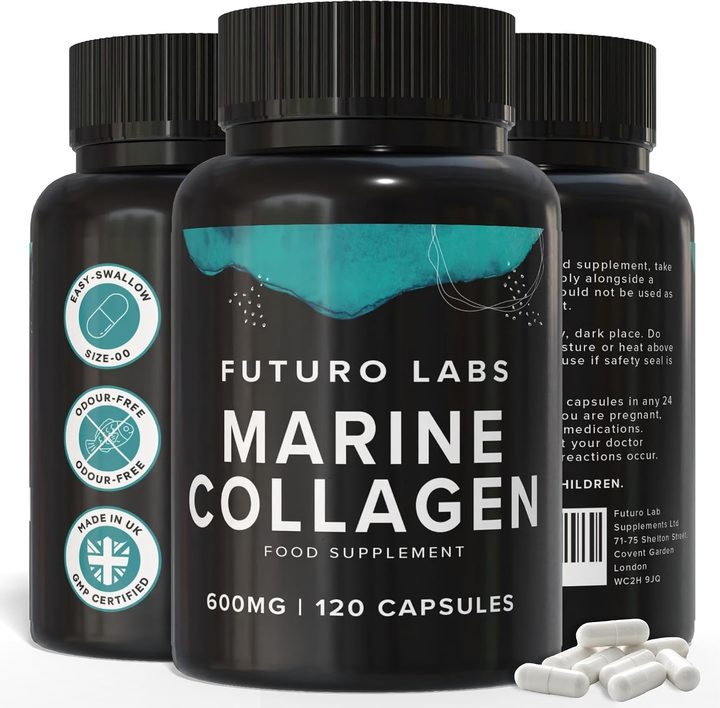
Our brand: the worked example on this page
Futuro Labs Marine Collagen
- 28p a day
- 120 capsules, 2 capsules daily
- Lab tested
- Made in the UK
This site's worked example self-excludes here and says so: Futuro Labs Marine Collagen on Amazon UK is fish-derived, suitable for pescatarians and not for vegans or vegetarians, stated plainly at £16.99 for 60 days. Full label breakdown. The vegetarian claims-tier route is on the vegetarians page; the animal question in full on the made-from-animals page.
The no given cleanly, route one decoded, and the blend priced at its honest value
The definitional answer takes one sentence and this site gives it without softening: no, vegans cannot take collagen, because collagen is animal structural tissue by definition, extracted from fish skin, hide or cartilage, no plant, fungus or bacterium on a shelf making the molecule, so every genuine collagen product is off the table and the interesting page begins with what a vegan reader actually meets when they search anyway. Route one, the vegan collagen shelf, decoded with the vegetarian page's plain finding: those products contain no collagen at all, the phrase being a contradiction the small print resolves, their contents being bundles of the amino acids collagen is rich in, glycine and proline typically, plus vitamin C and a rotation of botanicals, sold on a synthesis-support theory, give the body collagen's ingredients and it will build its own, which is true in the trivial sense that bodies always do exactly that from any adequate protein supply, and priced, too often, as if the theory were a technology. The honest valuation: judged as an amino-and-C blend, such a product can be harmless and occasionally convenient, and judged against its usual price it is groceries in a serum bottle, the glycine pennies-per-10g and the C threshold reachable from a single orange, so route one survives only for the reader who reads the label, prices the contents, and buys the blend as the blend it is.
Routes two and three walked properly, the biotech footnote, and the map handed over
Route two, and the one this site ranks first because it is mostly free: synthesis support done directly, since the body's own collagen production runs on a supply any well-planned vegan diet already carries, protein adequacy from legumes, soy, seitan, grains and nuts at the same 1.2-to-2.2g-per-kilogram targets every training page sets, complete coverage engineered by the plant pairings the protein-powder family tree maps, pea-rice blends and soy holding the essential aminos, plus vitamin C from the diet's easiest sources, citrus, peppers, berries, the cofactor whose collagen-formation role is the one lawful sentence in this whole territory, all of it purchasable in a supermarket vegetable aisle at grocery prices. Route three, the supplement route that genuinely exists for vegans, the claims tier, taken with the two checks the animal pages teach: vitamin C and zinc products carrying the skin, hair, nail and collagen-formation sentences are widely vegan-compatible, manganese likewise for the connective-tissue phrase, and vitamin D per UK winter guidance splits by source, D3 classically lanolin-derived from wool and excluded, lichen-derived D3 and D2 the vegan-compatible forms, with the capsule-shell gotcha inverted into a standing habit, every supplement a vegan buys getting its shell line read, gelatine wrappers disqualifying otherwise compatible products from the inside. The biotech footnote, for completeness and honesty: precision-fermentation collagen, microbes engineered to express the protein, is real technology appearing in cosmetics and lab contexts, and is not, at the time of writing, a meaningful presence on UK supplement shelves, so a vegan-collagen supplement claim today still decodes as route one until its label proves otherwise. The map handed over, then: no to collagen itself, groceries-priced blends if bought knowingly, a protein-and-C diet as the free foundation, and a shell-checked claims tier above it, which is everything the search was ever going to honestly find.
| The route | What it actually is | The honest valuation |
|---|---|---|
| Collagen itself | Animal tissue, always | The definitional no: excluded entirely |
| The vegan collagen shelf | Amino-and-C blends, zero collagen | Fine at grocery prices, not at serum prices |
| Diet-led synthesis support | Protein-adequate vegan eating plus C foods | The free foundation: ranked first |
| The claims tier | C, zinc, manganese; D by source | Vegan-compatible with the D3 and shell checks |
| The shell habit | Read every capsule's wrapper line | Gelatine shells disqualify from the inside |
| The biotech footnote | Fermented collagen: cosmetics and labs | Not yet a UK supplement-shelf reality |
The verdict, mapped and honest
Can vegans take collagen: no, by definition, every real collagen being animal tissue, and the useful answer is the map, the vegan-collagen shelf decoded as collagen-free amino blends worth grocery prices at most, the free route ranked first, a protein-adequate diet with vitamin C foods supplying everything the synthesis-support theory ever promised, and the claims tier open above it, C, zinc and manganese vegan-compatible with vitamin D checked to lichen or D2 and every capsule shell read before trust. This site's worked example belongs to the excluded category and labels itself accordingly: Futuro Labs Marine Collagen is fish-derived, suitable for pescatarians and plainly not for vegans or vegetarians, a self-exclusion stated on its own panel, which, on a page like this, is the only recommendation an animal product can honestly make.
What to check on the label
- The no is definitional: collagen is animal tissue, always.
- Vegan collagen contains none: amino-and-C blends at blend prices only.
- The free route ranks first: protein-adequate diet plus C foods.
- The claims tier is open: C, zinc, manganese; D checked to lichen or D2.
- Read every shell: gelatine wrappers disqualify from the inside.
Our brand
The worked example: Futuro Labs Marine Collagen
Futuro Labs Marine Collagen: 2 capsules daily, 1200mg hydrolysed type 1 marine collagen with 12mg vitamin C and 1.5mg zinc (15% NRV each), 120 capsules for £16.99, 60 days at 28p a day, lab-tested, UK GMP made. Slim veggie-shell capsules, odour free. Fish derived: pescatarian, not vegetarian or vegan.
- Collagen per serving
- 1200mg hydrolysed type 1 marine (fish)
- Co-factors
- vitamin C 12mg (15% NRV), zinc 1.5mg (15% NRV)
- Serving
- 2 capsules a day
- Bottle
- 120 capsules, 60 days
- Price
- £16.99 (28p a day)
- Capsule
- slim size 00, veggie shell, odour free
Questions people also ask
Is there any vegan collagen supplement?
No genuine one: collagen is animal tissue and products labelled vegan collagen contain none, being amino acid and vitamin C blends sold on a synthesis-support theory.
Are those vegan collagen blends worth buying?
Only at their honest value: glycine costs pennies and the C threshold is an orange, so judge them as grocery-grade blends, never as a technology worth serum prices.
How does a vegan support their own collagen production?
The free route: protein adequacy from legumes, soy and smart plant pairings at normal training targets, plus vitamin C foods, which together supply everything the blends bottle.
Which supplements can a vegan take from this territory?
The claims tier: vitamin C, zinc and manganese carry the lawful sentences and are widely vegan-compatible, with vitamin D checked to lichen-derived D3 or D2 and every capsule shell line read.
Will lab-grown collagen change this answer?
Eventually perhaps: precision-fermentation collagen exists in cosmetics and research, but it is not a meaningful UK supplement-shelf presence yet, so today's vegan-collagen labels still decode as blends.
Sources
- The tryptophan literature: an essential amino acid the body cannot synthesise, precursor to serotonin and niacin, absent from collagen and required from complete dietary protein. PubMed record
- Futuro Labs Marine Collagen listing and label: 1200mg hydrolysed type 1 marine collagen per 2-capsule serving with 12mg vitamin C and 1.5mg zinc at 15% NRV each, 120 capsules, independently lab tested, UK made. https://www.amazon.co.uk/dp/B0C2J7N364
- EFSA Panel on Dietetic Products, Nutrition and Allergies. Scientific Opinion on the substantiation of health claims related to magnesium. EFSA Journal 2010;8(10):1807. https://efsa.onlinelibrary.wiley.com/doi/10.2903/j.efsa.2010.1807
- EFSA Panel on Dietetic Products. Scientific opinion on Dietary Reference Values for fats: Adequate Intake of 250mg combined EPA and DHA per day for adults. EFSA Journal 2010;8(3):1461. https://www.efsa.europa.eu/en/efsajournal/pub/1461