Ghost Fitness/Omega-3/What does fish oil do for muscle recovery?
What does fish oil do for muscle recovery?
The short answer
Along the timeline. The first hours: nothing, a softgel taken that day has reached no membrane. Twenty-four to seventy-two hours: perceived soreness a point or so lower on a ten-point scale if two to three grams a day have been taken for weeks or months before, a curve shifted down not left. Strength and function: back on the same day with or without it. The week: nothing. The season: an index. One small shift in how sore, none in how soon.
- The first hoursnothing: a months-long membrane pool; protein, carbohydrate, fluid and sleep own this window
- Twenty-four to seventy-two hoursa point or so less perceived soreness, if two to three grams a day for weeks or months before; shifted down, not left
- Strength and functionunchanged at every point: full strength back on the same day either way
- The week and the seasonno faster readiness; an index built over months, which is not recovery
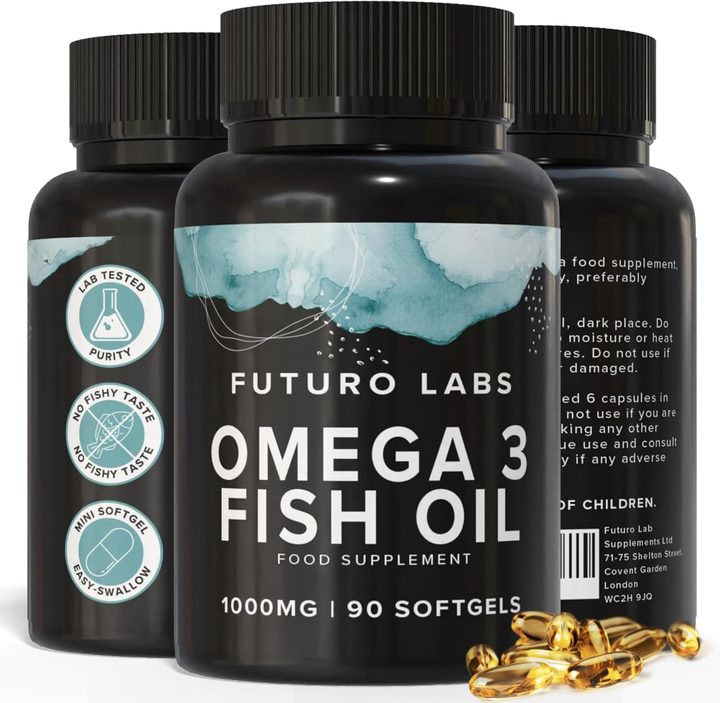
Our brand: the worked example on this page
Futuro Labs Omega 3 Fish Oil
- 17p a day
- 90 softgels, 1 softgel daily
- Lab tested
- Made in the UK
A softgel for the plate, with the soreness footnote at nine of them: Futuro Labs Omega 3 Fish Oil on Amazon UK, 1 softgel with the post-session meal, 180mg EPA and 120mg DHA, 90 for £14.99 at 17p. Full label breakdown. Recovery on its two axes is on the muscle recovery page; the soreness curve on the sore-muscles page.
The first hours and the soreness peak, where the timeline has one entry and it is small
What does fish oil do for muscle recovery is a question the honest page answers along the timeline after a session, because recovery is a sequence of events with a clock, and fish oil's file can be placed on it precisely, at one point and nowhere else. The first hours after a session: nothing. The acute recovery window, the hours in which glycogen is restored, fluid replaced and muscle protein synthesis switched on, belongs to carbohydrate, protein, water and the first night's sleep, the recovery pages' standing list, and a fish oil softgel taken with the post-session meal does nothing in that window, its EPA and DHA being absorbed over hours into a membrane pool that changes over three to four months, the incorporation literature's clock, so a softgel taken on the day of a session has reached no membrane by the time the session's recovery has begun and ended. Twenty-four to seventy-two hours, the soreness peak: this is the one point on the timeline with an entry, and it is conditional. Delayed-onset soreness rises over the day after a damaging session, peaks at around forty-eight hours and fades by seventy-two, the DOMS timeline's curve, and the review of omega-3 and exercise-induced muscle damage finds perceived soreness a point or so lower on a ten-point scale across that peak in people who have been taking two to three grams of EPA and DHA a day for weeks or months beforehand, seven to ten standard softgels or two to three concentrate capsules, with no effect from a standard softgel and none from a dose started that week, the DOMS review's finding, so the curve is shifted down a little at the higher rungs after a long lead-in, and it is not shifted left, the soreness peaking and fading on the same days it always did.
Strength and function, the week and the season, where the timeline has no entry, what recovery actually needs, and the timeline filed
The return of strength and function: unchanged, at every point on the curve. The review that finds the soreness shift finds no faster return of strength, jump height, range of motion or any functional measure on omega-3, the muscle back to full strength on the same day with or without the oil, which is the axis a lifter means by recovery, how soon they can train hard again, and on that axis fish oil's entry is blank, the recovery-two-axes page's how-sore-versus-how-soon. The training week: nothing, no faster readiness for the next session, no reduced accumulated fatigue across a block, the trials that added omega-3 to training programmes finding no change in the work done, and the readiness levers being sleep, food, the programme's volume and a deload. The season: an omega-3 index built over three to four months on a gram a day, which is a membrane composition with the heart claim and the index behind it and which is not recovery in any sense a lifter would recognise, the build-up page's timetable. What recovery actually needs, in the order the evidence ranks it: sleep, seven to nine hours, above everything; protein to around 1.6 grams per kilogram a day, holding the register's muscle sentences; carbohydrate to restore glycogen; fluid; a programme whose volume the recovery can match; and, as a footnote at the higher rungs after a long lead-in, a point or so less soreness from omega-3, which a lifter may take or leave and which no register claim covers, the recovery, muscle and performance sentences belonging to protein and creatine, so a lifter takes the softgel for the plate's heart claim with the post-session meal and files the soreness shift as the timeline's one small entry. The timeline filed: nothing in the first hours, a point less perceived soreness at the twenty-four to seventy-two hour peak on two to three grams taken for weeks or months before, no change in the return of strength or function, nothing across the week, and an index across the season that is not recovery, with the worked example being a softgel for the plate and the footnote at nine of them, £14.99 for 90 at 17p.
| The point on the timeline | What fish oil does | What does the work |
|---|---|---|
| The first hours | Nothing: a softgel taken today has reached no membrane | Carbohydrate, protein, fluid, the first night's sleep |
| Twenty-four to seventy-two hours, the soreness peak | A point or so less perceived soreness, on two to three grams a day for weeks or months before | The curve shifted down, not left |
| The return of strength and function | Unchanged at every point | Full strength back on the same day either way |
| The training week | Nothing: no faster readiness | Sleep, food, the programme's volume, a deload |
| The season | An omega-3 index built over three to four months | Not recovery: the heart claim and the index |
| The register | No recovery, muscle or performance sentence for omega-3 | Protein and creatine hold them |
The verdict, one small entry at the soreness peak after a long lead-in at high rungs, and nothing anywhere else
What does fish oil do for muscle recovery: along the timeline, nothing in the first hours since a softgel taken that day has reached no membrane and the acute window belongs to carbohydrate, protein, fluid and sleep, a point or so less perceived soreness on a ten-point scale across the twenty-four to seventy-two hour peak in people who have taken two to three grams a day for weeks or months beforehand, a curve shifted down rather than left, no faster return of strength or function at any point, nothing across the training week, and an omega-3 index built across the season that is not recovery, so the whole file is one small shift in how sore and none in how soon, with no recovery claim on the register. A softgel for the plate with the post-session meal: Futuro Labs Omega 3 Fish Oil, one, 180mg EPA and 120mg DHA, 90 for £14.99 at 17p a day.
What to check on the label
- Expect nothing in the first hours: the window is protein, carbohydrate, fluid and sleep.
- Place the one entry at the soreness peak: a point lower, at grams, after weeks.
- Expect strength back on the same day either way: how soon is unchanged.
- Fix the week with sleep and volume: not a softgel.
- Take it for the plate: with the post-session meal, for the heart claim.
Our brand
The worked example: Futuro Labs Omega 3 Fish Oil
Futuro Labs Omega 3 Fish Oil: 1 softgel daily with food, 1000mg fish oil providing 180mg EPA and 120mg DHA (300mg combined), 90 softgels for £14.99, 17p a day, lab-tested purity, UK GMP made. Gelatin shell, so not vegetarian.
- Fish oil per softgel
- 1000mg
- EPA / DHA per softgel
- 180mg / 120mg (300mg combined)
- Serving
- 1 softgel a day
- Bottle
- 90 softgels, 90 days
- Price
- £14.99 (17p a day)
- Softgel
- mini softgel, no fishy taste
Questions people also ask
Does fish oil speed up muscle recovery?
No: the review that finds perceived soreness a point or so lower at two to three grams a day taken for weeks or months before a damaging session finds no faster return of strength, jump height, range of motion or any functional measure, the muscle back to full strength on the same day with or without the oil, so how sore shifts a little and how soon does not.
When should I take fish oil for recovery?
With the post-session meal, or any fatty meal, for the plate's heart claim rather than for the session: EPA and DHA build into membranes over three to four months and a softgel taken on the day of a session has reached no membrane by the time its recovery has begun and ended, so the timing is the meal's and not the workout's.
How much fish oil for muscle soreness?
The trials that found the soreness shift used two to three grams of EPA and DHA a day, seven to ten standard softgels or two to three concentrate capsules, taken for weeks or months before the damaging session, with nothing from a standard softgel and nothing from a dose started that week, and the shift being a point or so on a ten-point scale.
What actually helps muscle recovery the most?
Sleep of seven to nine hours above everything, protein to around 1.6 grams per kilogram a day, carbohydrate to restore glycogen, fluid, and a programme whose volume the recovery can match, with a deload when it cannot, and fish oil as a footnote at the higher rungs for soreness alone.
Is there a health claim for fish oil and recovery?
No: the register has no recovery, muscle or performance sentence for omega-3, the muscle sentences belonging to protein and the performance sentence to creatine, so a tub that promises recovery promises something with no basis, and the softgel is taken for the heart claim a low-fish plate leaves unmet.
Sources
- Review evidence on omega-3 supplementation and exercise-induced muscle damage and soreness: small positive findings mainly in untrained participants, mixed-to-null results in trained populations. PubMed record
- The delayed-onset muscle soreness time-course literature: soreness after unfamiliar or eccentric exercise begins at eight to twenty-four hours, peaks at twenty-four to seventy-two hours and resolves over five to seven days, with the repeated-bout effect reducing subsequent episodes. PubMed record
- The omega-3 index kinetics literature: red-cell EPA and DHA rise over three to four months of daily intake and fall over a similar period after stopping, the index changing on a clock of months rather than days, with no acute effect of a single dose. PubMed record
- The GB claims register, protein entries: protein contributes to a growth in muscle mass and to the maintenance of muscle mass and of normal bones, authorised for foods that are at least a source of protein. https://www.gov.uk/government/publications/great-britain-nutrition-and-health-claims-nhc-register