Ghost Fitness/Omega-3/Is fish oil good for sore muscles?
Is fish oil good for sore muscles?
The short answer
Draw the soreness curve: it rises from around eight hours after unfamiliar work, peaks at one to three days and fades by a week. What omega-3 does to it, in the review of trials at two to three grams a day for weeks before, is shift it down a little, a point or so lower around the peak, and not to the left: the curve's shape and length are unchanged. No soreness claim exists. The repeated-bout effect flattens the curve far more.
- The curverises from around eight hours; peaks at one to three days; fades by a week
- Omega-3's shiftdown a little: a point or so lower around the peak at two to three grams a day for weeks before
- Not to the leftthe curve starts and ends when it would have; strength recovery unchanged
- The bigger leverthe repeated-bout effect flattens the curve far more; sleep, protein and carbohydrate beside it
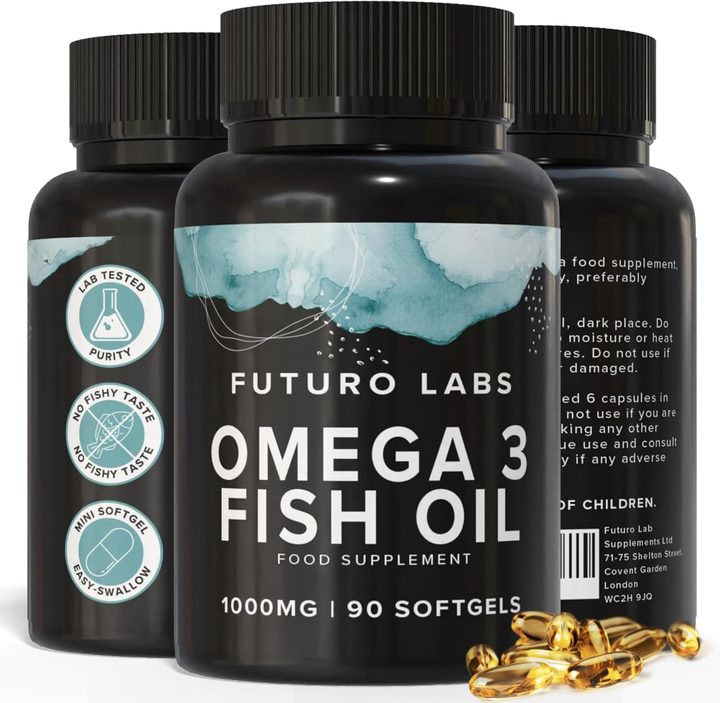
Our brand: the worked example on this page
Futuro Labs Omega 3 Fish Oil
- 17p a day
- 90 softgels, 1 softgel daily
- Lab tested
- Made in the UK
Omega-3 by the oily-fish audit, with the curve's small shift as a bonus at the higher rungs: Futuro Labs Omega 3 Fish Oil on Amazon UK, 1 softgel with food, 180mg EPA and 120mg DHA, 90 for £14.99 at 17p. Full label breakdown. The recovery review by measure is on the muscle recovery page; the soreness timeline on the magnesium soreness page.
The soreness curve, and what omega-3 does to it, which is shift it down a little and not to the left
Is fish oil good for sore muscles, and the variants asking about omega-3 for DOMS and for soreness, are answered by drawing the soreness curve and describing what omega-3 does to it, because the review's finding is a shape and a shape is easier to be honest about than a yes. The curve: delayed-onset muscle soreness begins around eight to twenty-four hours after unfamiliar or eccentric work, rises through the first day, peaks at one to three days, and fades by a week, the repair process of adaptation running its course, the soreness timeline's four windows, and a curve that every lifter has felt after a first session back or a new movement. What omega-3 does to the curve, in the review of randomised trials that gave two to three grams of EPA and DHA a day for weeks or months before a deliberately damaging session and measured soreness over the days after: it shifts the curve down a little, perceived soreness a point or so lower on a ten-point scale around the peak at twenty-four to seventy-two hours against placebo, the review's most consistent finding, and it does not shift the curve to the left, soreness beginning when it would have begun and fading when it would have faded, the curve's shape and its length unchanged, so a reader on the trials' dose is a little less sore at the peak and sore for exactly as long. The strength-recovery curve, the return of force over the same days, runs its own course unchanged, the review finding no consistently faster recovery of strength, jump height or range of motion, so the day a reader can train the muscle hard again is the day it would have been.
The conditions that produce the shift, the levers that flatten the curve more, the register, and the curve filed
The conditions that produce even the small shift narrow it further. The dose: two to three grams of EPA and DHA a day in the trials, seven to ten standard softgels or two or three concentrate softgels, not the standard softgel a rung-one reader takes, so the shift belongs to the higher rungs and a reader on 300mg should expect the unshifted curve. The timing: weeks or months of intake before the damaging session, since the mechanism runs through EPA and DHA already built into muscle membranes, the index kinetics literature's clock, so a softgel taken after a session does nothing for that session's curve and a habit of months does a little for the curves to come, the after-workout page's finding. The population: unaccustomed participants doing an unfamiliar session, in whom the curve is tallest, rather than trained lifters doing their usual work, in whom the curve is already low. The levers that flatten the curve more than any softgel, in order: the repeated-bout effect, a second exposure to the same load producing a far lower curve than the first, the single most powerful factor and the reason a lifter who progresses gradually rarely meets a tall curve at all; sleep, in which most of the repair that ends the curve happens; protein at around 1.6 grams per kilogram across the day feeding the repair; carbohydrate restoring glycogen; light movement on sore days; and heat if the reader wants the comfort, the soreness timeline's list. No soreness, recovery or repair claim exists for omega-3 on the register, whose sentences are heart, brain, vision, triglycerides and blood pressure, so a fish oil may not print sore muscles. The curve filed: rising from eight hours, peaking at one to three days and fading by a week, shifted down a point or so and not left by two to three grams for weeks before, strength recovery unshifted, the repeated-bout effect flattening it far more, and no claim, with the worked example being omega-3 by the oily-fish audit and the small shift as a bonus at the higher rungs, one softgel at 17p, £14.99 for 90.
| The item | The finding | The shift |
|---|---|---|
| The curve | Rises from eight to twenty-four hours; peaks at one to three days; fades by a week | The repair process of adaptation |
| Omega-3 at two to three grams for weeks before | A point or so lower around the peak | Down a little; not left |
| Omega-3 at a standard softgel, or after the session | Nothing | The unshifted curve |
| Strength recovery | Not consistently faster | Its own curve, unshifted |
| The repeated-bout effect | A second exposure produces a far lower curve | The largest shift there is |
| Sleep, protein, carbohydrate, movement | The repair that ends the curve | Flatten it more than any softgel |
The verdict, a curve shifted down a little at grams over months, and left alone by a softgel
Is fish oil good for sore muscles: a little, in the specific sense the review supports, the soreness curve that rises from around eight hours after unfamiliar work, peaks at one to three days and fades by a week being shifted down a point or so around its peak by two to three grams of EPA and DHA a day taken for weeks or months before the session, and not shifted to the left, the curve's shape and length and the strength-recovery curve beside it unchanged, with a standard softgel or a softgel taken after the session leaving the curve where it was, the repeated-bout effect and sleep, protein and carbohydrate flattening it far more, and no soreness claim existing for omega-3. Omega-3 by the oily-fish audit: Futuro Labs Omega 3 Fish Oil, one softgel with food, 180mg EPA and 120mg DHA, 90 for £14.99 at 17p a day.
What to check on the label
- Draw the curve: eight hours, a peak at one to three days, a week.
- Know omega-3's shift: down a point, not left, at grams for months.
- Expect the unshifted curve on a standard softgel: or after the session.
- Flatten the curve with the repeated-bout effect: gradual progression.
- End the curve with sleep, protein and carbohydrate: the repair's fuel.
Our brand
The worked example: Futuro Labs Omega 3 Fish Oil
Futuro Labs Omega 3 Fish Oil: 1 softgel daily with food, 1000mg fish oil providing 180mg EPA and 120mg DHA (300mg combined), 90 softgels for £14.99, 17p a day, lab-tested purity, UK GMP made. Gelatin shell, so not vegetarian.
- Fish oil per softgel
- 1000mg
- EPA / DHA per softgel
- 180mg / 120mg (300mg combined)
- Serving
- 1 softgel a day
- Bottle
- 90 softgels, 90 days
- Price
- £14.99 (17p a day)
- Softgel
- mini softgel, no fishy taste
Questions people also ask
Does fish oil help with DOMS?
A little, at grams over months: the review of trials giving two to three grams of EPA and DHA a day for weeks before a damaging session finds perceived soreness a point or so lower around its one-to-three-day peak, the soreness curve shifted down a little and not to the left, with strength recovery unchanged and a standard softgel doing nothing to the curve.
Does omega-3 make soreness go away faster?
No: the curve's length is unchanged, soreness beginning when it would have and fading by a week as it would have, and the review finds no consistently faster recovery of strength, jump height or range of motion, so the day a muscle can be trained hard again is the day it would have been.
How much omega-3 did the soreness studies use?
Two to three grams of EPA and DHA a day, seven to ten standard softgels or two or three concentrate softgels, taken for weeks or months before the damaging session, in unaccustomed participants doing an unfamiliar session rather than trained lifters doing their usual work.
What reduces muscle soreness more than fish oil?
The repeated-bout effect above all, a second exposure to the same load producing a far lower curve than the first, which is why gradual progression rarely meets a tall curve, then sleep, protein at around 1.6 grams per kilogram across the day, carbohydrate to restore glycogen and light movement on sore days.
Can a fish oil claim to help sore muscles?
No: no soreness, recovery or repair claim exists for omega-3 on the register, whose sentences are heart, brain, vision, triglycerides and blood pressure, so a fish oil sold for sore muscles has stepped outside it and the small shift in the curve stays a research finding.
Sources
- Review evidence on omega-3 supplementation and exercise-induced muscle damage and soreness: small positive findings mainly in untrained participants, mixed-to-null results in trained populations. PubMed record
- The delayed-onset muscle soreness time-course literature: soreness after unfamiliar or eccentric exercise begins at eight to twenty-four hours, peaks at twenty-four to seventy-two hours and resolves over five to seven days, with the repeated-bout effect reducing subsequent episodes. PubMed record
- The omega-3 index kinetics literature: red-cell EPA and DHA rise over three to four months of daily intake and fall over a similar period after stopping, the index changing on a clock of months rather than days, with no acute effect of a single dose. PubMed record
- The protein intake and resistance training literature: meta-analyses support intakes around 1.6g per kilogram of body weight daily for maximising resistance-training gains, with diminishing returns above. PubMed record