Ghost Fitness/Omega-3/Does fish oil reduce muscle pain?
Does fish oil reduce muscle pain?
The short answer
Reduce, quantified. The review finds perceived soreness a point or so lower on a ten-point scale around its peak, in people who took two to three grams a day for weeks before. The minimal clinically important difference for pain is around one and a half to two points, so omega-3's reduction sits at or below the threshold a person reliably notices: statistically real, clinically marginal, and for delayed soreness only. No pain claim exists.
- The reductiona point or so on a ten-point scale at the soreness peak; two to three grams for weeks before
- The thresholdthe minimal clinically important difference for pain: around one and a half to two points, or about thirty percent
- The verdict on the numberat or below the threshold: statistically real, clinically marginal
- The scopedelayed soreness only; no file for a strain, a cramp, statin myalgia or other muscle pain; no claim
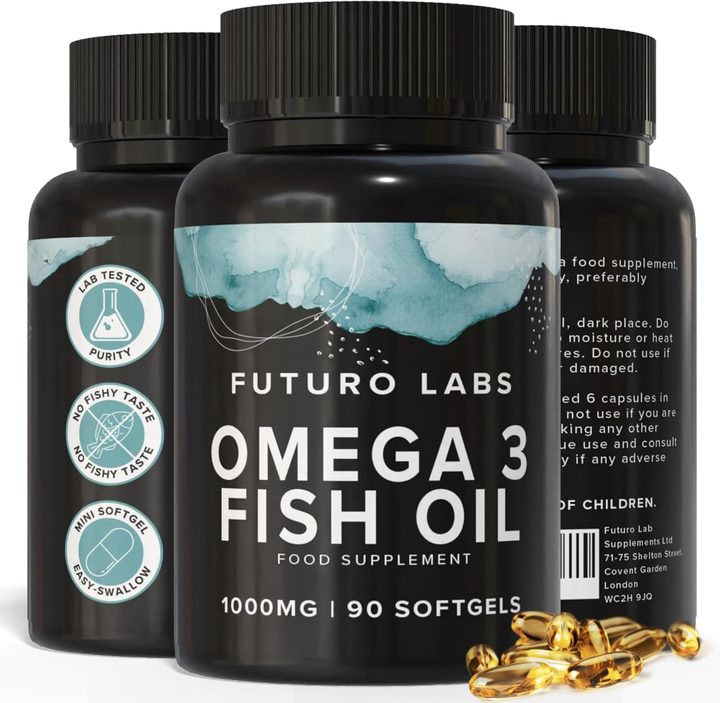
Our brand: the worked example on this page
Futuro Labs Omega 3 Fish Oil
- 17p a day
- 90 softgels, 1 softgel daily
- Lab tested
- Made in the UK
Omega-3 for its own sentences, with no pain word: Futuro Labs Omega 3 Fish Oil on Amazon UK, 1 softgel with food, 180mg EPA and 120mg DHA, 90 for £14.99 at 17p. Full label breakdown. The six-pain differential is on the muscle pain page; the soreness curve on the sore muscles page.
Reduce quantified, the size of the effect in the review and the threshold a person notices
Does fish oil reduce muscle pain is a question the careful-claims flag answers by quantifying the verb, because reduce is true in a statistical sense and the size of the reduction decides whether it is true in any sense a reader would feel. The size: the review of randomised trials of omega-3 and exercise-induced muscle damage, trials that gave two to three grams of EPA and DHA a day for weeks or months before a deliberately damaging session and rated soreness over the days after, finds perceived soreness lower by around a point on a ten-point scale at the one-to-three-day peak against placebo, a reduction that reaches statistical significance when the trials are pooled and that varies from trial to trial, the recovery review's most consistent finding. The threshold: pain researchers have measured the smallest change on a ten-point pain scale that a person reliably notices as a change, the minimal clinically important difference, and it sits at around one and a half to two points, or about thirty percent of the starting score, the pain measurement literature's figure, below which a statistically significant difference between two groups is one the groups' members would not reliably feel. Set the two side by side and the honest verdict on the number appears: omega-3's reduction in delayed soreness is at or below the threshold, statistically real across many trials and clinically marginal for an individual, a reader on the trials' dose being on average a little less sore in a way that sits at the edge of what soreness scales can register and that a soreness of six rather than seven would not reliably convey.
The scope of the reduction, which is delayed soreness and nothing else, the register, the reader's real question, and the number filed
The scope of even that marginal reduction is narrow. It applies to delayed-onset soreness, the ache after unfamiliar or eccentric work that rises from eight hours, peaks at one to three days and fades by a week, and to nothing else on the muscle-pain differential: no trial of omega-3 exists in strains, whose route is the pulled-muscle protocol of protection, relative rest and progressive loading; none in cramps, whose route is a stretch, sodium and fluid and a medicine review; none in statin myalgia, whose route is the prescriber; none in the widespread fibromyalgia-type pain a GP diagnoses and manages; and none in the rare inflammatory muscle disease that presents with weakness and raised enzymes, the muscle pain page's six pains with one small file on the first. It applies at two to three grams a day, seven to ten standard softgels or two or three concentrate softgels, taken for weeks or months before the session, and not to a standard softgel or to a softgel taken after the ache began. And it applies in unaccustomed participants doing an unfamiliar session, in whom soreness is tallest, more than in trained lifters doing their usual work. The register is consistent with the arithmetic: no pain, soreness, recovery or repair claim exists for omega-3, whose sentences are heart, brain, vision, triglycerides and blood pressure, so a fish oil may not print muscle pain and a reduction at the threshold could not have earned a claim in any case. The reader's real question, whether to take something for muscle pain, has a better answer than a marginal reduction in one kind of it: for delayed soreness, the repeated-bout effect, sleep, protein and a week's patience, and for every other muscle pain, its own route and a GP for the red flags, weakness, dark urine, fever, a swollen calf or pain beyond a week. The number filed: a point or so on a ten-point scale at two to three grams over months, against a threshold of one and a half to two points, statistically real and clinically marginal, for delayed soreness only, with no file for any other muscle pain and no claim, and the worked example being omega-3 for its own sentences with no pain word, one softgel at 17p, £14.99 for 90.
| The item | The number or finding | The verdict |
|---|---|---|
| The reduction in the review | About a point on a ten-point scale at the soreness peak | At two to three grams a day for weeks before |
| The minimal clinically important difference | Around one and a half to two points, or about thirty percent | The smallest change a person reliably notices |
| The comparison | The reduction sits at or below the threshold | Statistically real; clinically marginal |
| The scope | Delayed soreness only | No file for a strain, a cramp, statin myalgia, widespread pain or muscle disease |
| The dose and timing | Grams over months before; not a standard softgel; not after the ache | Conditions few readers meet |
| The register | No pain, soreness, recovery or repair claim | A fish oil may not print muscle pain |
The verdict, a reduction that is real on a graph and marginal in a muscle, for one pain only
Does fish oil reduce muscle pain: by about a point on a ten-point scale at the soreness peak in the review of trials at two to three grams a day for weeks or months before a damaging session, a reduction that sits at or below the minimal clinically important difference for pain of around one and a half to two points, the smallest change a person reliably notices, so that it is statistically real across trials and clinically marginal for an individual, applies to delayed-onset soreness only and to no other muscle pain on the differential, needs grams over months rather than a standard softgel or a softgel after the ache, and carries no pain claim on the register. Omega-3 for its own sentences: Futuro Labs Omega 3 Fish Oil, one softgel with food, 180mg EPA and 120mg DHA, 90 for £14.99 at 17p a day.
What to check on the label
- Quantify reduce: about a point on ten, at grams over months.
- Know the threshold: one and a half to two points before a person notices.
- Read the reduction as marginal: real on a graph, faint in a muscle.
- Keep the scope to delayed soreness: nothing for any other muscle pain.
- Route the other pains properly: loading, a stretch, the prescriber, a GP.
Our brand
The worked example: Futuro Labs Omega 3 Fish Oil
Futuro Labs Omega 3 Fish Oil: 1 softgel daily with food, 1000mg fish oil providing 180mg EPA and 120mg DHA (300mg combined), 90 softgels for £14.99, 17p a day, lab-tested purity, UK GMP made. Gelatin shell, so not vegetarian.
- Fish oil per softgel
- 1000mg
- EPA / DHA per softgel
- 180mg / 120mg (300mg combined)
- Serving
- 1 softgel a day
- Bottle
- 90 softgels, 90 days
- Price
- £14.99 (17p a day)
- Softgel
- mini softgel, no fishy taste
Questions people also ask
How much does fish oil reduce muscle soreness?
By about a point on a ten-point scale at the one-to-three-day peak in the review of trials at two to three grams of EPA and DHA a day for weeks before a damaging session, a reduction at or below the one-and-a-half-to-two-point threshold a person reliably notices, statistically real and clinically marginal.
Is a one-point reduction in pain noticeable?
Not reliably: the minimal clinically important difference on a ten-point pain scale is around one and a half to two points, or about thirty percent of the starting score, below which a difference between two groups is statistically real and not one the groups' members would feel, which is where omega-3's soreness reduction sits.
Does fish oil help other kinds of muscle pain?
No: the small file is for delayed-onset soreness only, with no trial of omega-3 in strains, cramps, statin myalgia, widespread fibromyalgia-type pain or inflammatory muscle disease, each of which has its own route from progressive loading and a stretch to the prescriber and a GP.
What dose of fish oil was used in the muscle pain studies?
Two to three grams of EPA and DHA a day, seven to ten standard softgels or two or three concentrate softgels, taken for weeks or months before the damaging session, so a standard softgel or a softgel taken after the ache began has no file at all.
Can a fish oil claim to relieve muscle pain in the UK?
No: no pain, soreness, recovery or repair claim exists for omega-3 on the register, whose sentences are heart, brain, vision, triglycerides and blood pressure, and a reduction at the threshold of noticeability could not have earned one.
Sources
- The pain measurement literature: the minimal clinically important difference on a ten-point pain scale is around one and a half to two points, or about thirty percent of the starting score, below which a statistically significant change is not one a person reliably notices. PubMed record
- Review evidence on omega-3 supplementation and exercise-induced muscle damage and soreness: small positive findings mainly in untrained participants, mixed-to-null results in trained populations. PubMed record
- The muscle strain literature: grade one strains, a few fibres torn, recover over one to three weeks; grade two, a partial tear, over three to six weeks; grade three, a complete tear, over months and sometimes with surgery, with graded loading the key to return and no nutrient shortening the timeline. PubMed record
- The statin-associated muscle symptoms literature: muscle aches, weakness and cramps are the commonest reason for stopping statins, are managed by the prescriber through dose, drug or timing changes, and have no established prevention from supplements, coenzyme Q10 trials being mixed and magnesium untested. PubMed record