Ghost Fitness/Omega-3/Does fish oil reduce DOMS?
Does fish oil reduce DOMS?
The short answer
The repeated-bout effect is the missing half. The trials find soreness a point or so lower at two to three grams a day for weeks before a session, using novel eccentric-heavy protocols in mostly untrained people. A repeat of the same exercise within weeks produces far less soreness, the protection lasting months, so a trained lifter on a familiar programme has little DOMS to reduce. The footnote applies to the novel session, the deload return and the new exercise.
- The trialsa point or so less perceived soreness at two to three grams a day for weeks or months before; no faster strength
- What they usednovel, eccentric-heavy protocols in mostly untrained participants: the marked soreness of a first exposure
- The repeated-bout effecta repeat within weeks produces far less soreness; protection lasting months; a familiar programme has little DOMS
- Where the footnote appliesthe new exercise, the return from a deload, the unaccustomed volume, the novel session
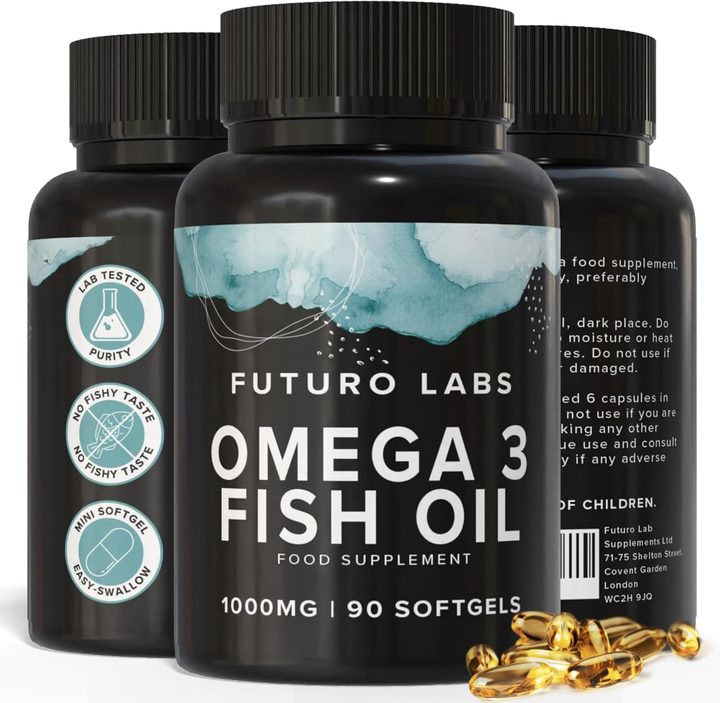
Our brand: the worked example on this page
Futuro Labs Omega 3 Fish Oil
- 17p a day
- 90 softgels, 1 softgel daily
- Lab tested
- Made in the UK
A softgel for the plate, with the DOMS footnote at nine a day for a novel session: Futuro Labs Omega 3 Fish Oil on Amazon UK, 1 softgel with food, 180mg EPA and 120mg DHA, 90 for £14.99 at 17p. Full label breakdown. The recovery timeline is on the muscle recovery page; the soreness curve on the sore-muscles page.
The trials, what they found and what they used, and the soreness they measured
Does fish oil reduce DOMS is a question whose usual answer, a small yes at high doses after weeks, is half the answer, and the honest page supplies the other half, which is what kind of DOMS the trials measured and whether a trained lifter has any. The trials: the review of omega-3 and exercise-induced muscle damage pools randomised trials in which participants took two to three grams of EPA and DHA a day, seven to ten standard softgels or two to three concentrate capsules, for weeks or months, and then performed a damaging exercise bout, with soreness rated on a ten-point scale over the following days, and it finds perceived soreness a point or so lower on that scale across the twenty-four to seventy-two hour peak, with no faster return of strength, jump height or range of motion, the DOMS review's finding, a curve shifted down rather than left, and a point on a ten-point scale being below the one and a half to two points the pain literature treats as the smallest change a person reliably notices. What the trials used is the half usually left out: the damaging bout in those trials is a novel, eccentric-heavy protocol designed to produce marked soreness, downhill running, repeated drop jumps, eccentric-only biceps curls to failure, a hundred eccentric knee extensions, in participants who were mostly untrained or unaccustomed to the movement, because a trial that wants to measure soreness reduction needs a lot of soreness to reduce, and a first exposure to eccentric-heavy work in an unaccustomed muscle is the most reliable way to produce it, the DOMS timeline's peak of forty-eight hours and a week to full recovery. So the soreness the trials reduced by a point is the soreness of a first exposure, which is a specific and large kind of DOMS.
The repeated-bout effect, why a trained lifter has little to reduce, where the footnote does apply, and the halves filed
The repeated-bout effect is the reason that kind of DOMS is not the kind a trained lifter has. A single bout of unaccustomed eccentric-heavy exercise produces marked soreness and strength loss, and a repeat of the same exercise within a few weeks produces far less, sometimes almost none, a protective adaptation in the muscle and its connective tissue that lasts weeks to months and that is one of the most reliable findings in exercise physiology, the repeated-bout literature's effect, so a lifter who squats every week has been squatting through the repeated-bout effect for years and experiences, after a normal session, a mild stiffness that fades in a day or two rather than the three-day peak the trials produced, which leaves a point-lower shift with almost nothing to shift. Where the footnote does apply is the list of sessions that escape the repeated-bout effect: a new exercise, or an old one after months away; the first week back after a deload, a holiday or an injury, when the protection has faded; an unaccustomed volume, a rep-max week or a session with a friend's programme; an eccentric-heavy block deliberately programmed; and the novel event, a first race, a first competition, a first hike, which is where a lifter meets the trial's kind of soreness, and where two to three grams a day taken for the weeks before might take a point off a peak they would otherwise notice. The honest instruction that follows: a lifter on a familiar programme takes fish oil for the plate's heart claim and expects nothing for the DOMS they barely have, and a lifter with a novel event weeks away, who is already at the higher rungs for the index or with a GP's blessing, may notice the footnote at the peak, with strength back on the same day either way, and neither takes it for soreness alone, the register holding no recovery or soreness claim and the muscle sentences belonging to protein. The halves filed: a point lower on a ten-point scale at two to three grams for weeks before a novel eccentric-heavy bout as the first half, and the repeated-bout effect leaving a trained lifter's usual week with little DOMS to reduce as the second, the footnote applying to the new exercise, the deload return and the unaccustomed volume, with the worked example being a softgel for the plate, £14.99 for 90 at 17p.
| The item | The finding | What it means for a lifter |
|---|---|---|
| The trials' result | A point or so less perceived soreness at two to three grams a day for weeks before; no faster strength | A footnote below the smallest change a person notices |
| The trials' protocol | Novel, eccentric-heavy bouts in mostly untrained participants | The marked soreness of a first exposure |
| The repeated-bout effect | A repeat within weeks produces far less soreness; protection lasts months | A familiar programme has little DOMS to reduce |
| Where the footnote applies | A new exercise; the first week back after a deload; unaccustomed volume; an eccentric block; a novel event | The sessions that escape the protection |
| Where it does not | The usual week | Mild stiffness that fades in a day or two either way |
| The register | No recovery or soreness claim | A softgel for the plate |
The verdict, a point off the soreness of a first exposure at high rungs after weeks, and a trained week that has little to take a point off
Does fish oil reduce DOMS: a little, at two to three grams of EPA and DHA a day taken for weeks or months before a damaging session, perceived soreness a point or so lower on a ten-point scale across the peak with no faster return of strength, and the missing half of the answer is that the trials produced that soreness with novel, eccentric-heavy protocols in mostly untrained people, the marked soreness of a first exposure that the repeated-bout effect removes from a familiar programme within weeks and keeps away for months, so that a trained lifter on their usual week has little DOMS to reduce and the footnote applies to the new exercise, the first week back after a deload, an unaccustomed volume, an eccentric block and a novel event, with strength back on the same day either way and no soreness claim on the register. A softgel for the plate: Futuro Labs Omega 3 Fish Oil, one with food, 180mg EPA and 120mg DHA, 90 for £14.99 at 17p a day.
What to check on the label
- Read the trials' point for what it is: below the smallest change a person notices.
- Read the trials' protocol: novel eccentric bouts in the unaccustomed.
- Credit the repeated-bout effect: your usual week has little DOMS.
- Expect the footnote only for a novel session: a new exercise, a deload return, a big week.
- Take the softgel for the plate: not for soreness you barely have.
Our brand
The worked example: Futuro Labs Omega 3 Fish Oil
Futuro Labs Omega 3 Fish Oil: 1 softgel daily with food, 1000mg fish oil providing 180mg EPA and 120mg DHA (300mg combined), 90 softgels for £14.99, 17p a day, lab-tested purity, UK GMP made. Gelatin shell, so not vegetarian.
- Fish oil per softgel
- 1000mg
- EPA / DHA per softgel
- 180mg / 120mg (300mg combined)
- Serving
- 1 softgel a day
- Bottle
- 90 softgels, 90 days
- Price
- £14.99 (17p a day)
- Softgel
- mini softgel, no fishy taste
Questions people also ask
Does omega-3 reduce muscle soreness after a workout?
A little, at two to three grams a day taken for weeks or months beforehand, perceived soreness a point or so lower on a ten-point scale across the peak with no faster return of strength, in trials that produced marked soreness with novel eccentric-heavy protocols in mostly untrained people, the kind of soreness a familiar programme rarely produces.
Why do I not get DOMS from my usual training any more?
The repeated-bout effect: a single bout of unaccustomed eccentric-heavy exercise produces marked soreness, and a repeat within weeks produces far less, a protective adaptation lasting months, so a lifter on a familiar programme has trained through the effect for years and feels only a mild stiffness that fades in a day or two.
When would fish oil actually help with soreness?
For the sessions that escape the repeated-bout effect, a new exercise, the first week back after a deload or a holiday, an unaccustomed volume, a programmed eccentric block or a novel event, where a lifter meets the trials' kind of soreness and two to three grams a day taken for the weeks before might take a point off the peak.
How much fish oil for DOMS?
The trials used two to three grams of EPA and DHA a day, seven to ten standard softgels or two to three concentrate capsules, for weeks or months before the damaging bout, with nothing from a standard softgel and nothing from a dose started that week, and the effect being a point on a ten-point scale for how sore and nothing for how soon.
What reduces DOMS the most?
The repeated-bout effect itself, which is why a gradual introduction of a new exercise, a lighter first week back and a sensible volume ramp reduce soreness more than any supplement, with sleep, protein and light movement helping the recovery that follows, and fish oil a footnote at the higher rungs for the novel session.
Sources
- Review evidence on omega-3 supplementation and exercise-induced muscle damage and soreness: small positive findings mainly in untrained participants, mixed-to-null results in trained populations. PubMed record
- The repeated-bout effect literature: a single bout of unaccustomed, eccentric-heavy exercise produces marked delayed-onset soreness and strength loss, and a repeat of the same exercise within weeks produces far less, the protective adaptation lasting weeks to months, so trained lifters on a familiar programme experience little soreness and the omega-3 soreness trials, which use novel damaging protocols in mostly untrained participants, measure a soreness that a habitual programme rarely produces. PubMed record
- The pain measurement literature: the minimal clinically important difference on a ten-point pain scale is around one and a half to two points, or about thirty percent of the starting score, below which a statistically significant change is not one a person reliably notices. PubMed record
- The delayed-onset muscle soreness time-course literature: soreness after unfamiliar or eccentric exercise begins at eight to twenty-four hours, peaks at twenty-four to seventy-two hours and resolves over five to seven days, with the repeated-bout effect reducing subsequent episodes. PubMed record