Ghost Fitness/Lion's mane/What should you check on a lion's mane label?
What should you check on a lion's mane label?
The short answer
Split the label in two: what the law requires, the words food supplement, the daily portion, the do-not-exceed and varied-diet warnings, best-before and a UK address, and what honest brands add, tissue, ratio, glucans and testing.
- The required particularsfood supplement, portion, warnings, quantities, allergens, batch, date, address
- The voluntary factstissue, ratio with maths, real milligrams, glucans, testing
- The gapa compliant label can still say nothing about the mushroom
- The tellany claim on either side: instant fail
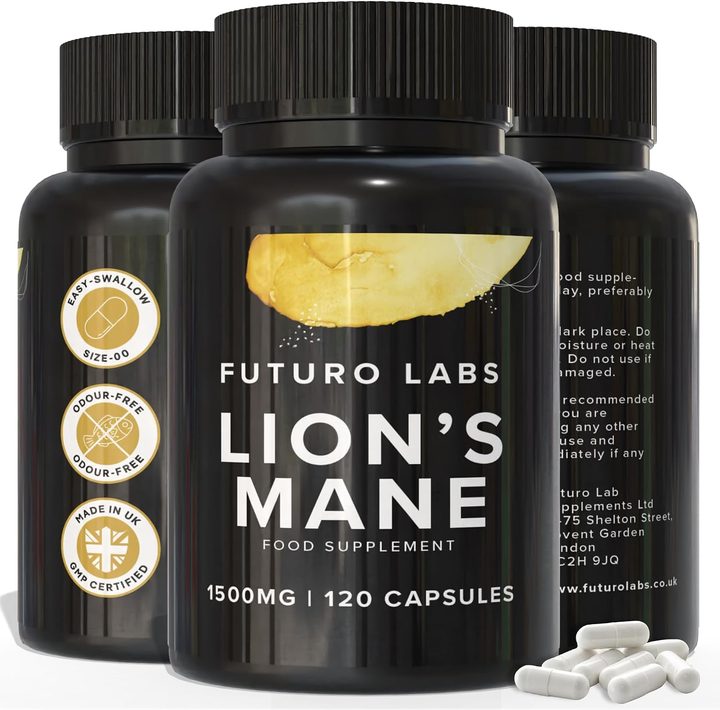
Our brand: the worked example on this page
Futuro Labs Lion's Mane
- 13p a day
- 120 capsules, 1 capsule daily
- Lab tested
- Made in the UK
A label compliant and complete: Futuro Labs Lion's Mane on Amazon UK, required particulars plus fruiting body, 5:1 and testing stated, £15.49 for 120 days at 13p. Full label breakdown. The ten-point inspection is on the buying page; the required-address rule on the brand page.
The particulars UK law requires on every food supplement, read as the floor a label must reach
Every lion's mane capsule sold in the UK is a food supplement under the Food Supplements Regulations, and those regulations prescribe a set of particulars every label must carry, so read them first as the floor, the things a compliant label shows whether or not the brand cares about the mushroom. The words food supplement, printed as the product's legal name. The names of the categories of substances characterising the product, which for a mushroom extract means the mushroom named, ideally with its Latin binomial. The recommended daily portion, one capsule daily on the worked example. A warning not to exceed the stated dose. A statement that food supplements should not be used as a substitute for a varied diet. A warning to keep out of reach of young children. The quantity of the characterising substances per portion, the milligram figure the four tests read. Then the general food-labelling particulars: a list of ingredients including the capsule shell and any bulking agent, allergen emphasis where relevant, the net quantity, a best-before date, a batch or lot mark, and the name and address of the responsible food business in the UK, the address the brand page treats as its company test. A label missing any of those is non-compliant before its mushroom is discussed, the ghost-brand pattern failing on the address and informal imports failing on most of the list, which is why the required particulars are a quick honesty screen in themselves.
The facts honest brands add above the floor, the gap where marketing lives, and the label read in one pass
The floor says nothing about whether the mushroom is any good, and that is the gap: a label can carry every required particular and still be silent on tissue, ratio and testing, legally compliant and commercially empty, because the law requires the quantity of the characterising substance but not its concentration, requires the mushroom's name but not its stage, and requires nothing about testing at all. Above the floor sit the facts honest brands add voluntarily, and they are the section's four tests: the tissue stated as fruiting body, the extract ratio with its mushroom-equivalent maths, the real extract milligrams per serving read behind any equivalent figure, glucan content where measured, and testing and manufacture stated, GMP and BRC where held, with the certificate askable. The gap between the floor and the voluntary facts is exactly where marketing lives: a compliant label with forest photography, a bold equivalent figure and no ratio has met the law and told you nothing, while a label carrying the voluntary facts has told you everything a buyer can lawfully know, and the one thing neither side of the label may carry is a claim, no mushroom holding any authorised health claim, so a cognition, focus, memory or nerve promise anywhere on the pack is an instant fail whether the particulars are perfect or not. Read in one pass, then: check the required particulars are all present as the compliance screen, the address especially; check the voluntary facts are stated as the quality screen, tissue and ratio first; scan for claims as the ejection rule; and treat the worked example as the model of both halves, food supplement named, one capsule daily, warnings printed, ingredients listed with its HPMC shell and rice flour, batch and date marked, UK address shown, and, above the floor, fruiting body, 5:1 with its maths, testing and manufacture stated, no claim anywhere, at 13p, a label that reaches the floor and then keeps going.
| The half | The items | What it tells you |
|---|---|---|
| Required: identity | Food supplement; the mushroom named; portion; quantity per portion | Compliance, not quality |
| Required: warnings | Do not exceed; not a diet substitute; keep from children | Compliance, not quality |
| Required: traceability | Ingredients, allergens, net quantity, best-before, batch, UK address | The honesty screen: ghost brands fail here |
| Voluntary: the mushroom | Fruiting body; ratio with maths; real milligrams | Whether the mushroom is any good |
| Voluntary: the proof | Glucans; testing; GMP and BRC; certificate askable | Whether the statements are evidence |
| Forbidden on both halves | Any health claim | Instant fail |
The verdict, a floor and a ceiling on one pack
What to check on a lion's mane label: two halves, the particulars UK food supplement law requires, the words food supplement, the mushroom named, the daily portion and quantity, the do-not-exceed, varied-diet and children warnings, ingredients, allergens, net quantity, best-before, batch and a UK address, read as the compliance screen, and the facts honest brands add above that floor, fruiting body, ratio with its maths, real milligrams, glucans and testing, read as the quality screen, with the gap between them being where marketing lives and any claim on either half being the ejection. The model of both halves: Futuro Labs Lion's Mane, compliant on every particular and complete on every voluntary fact, UK made, lab tested, £15.49 for 120 days at 13p a day, a label that reaches the floor and keeps going.
What to check on the label
- Screen for the required particulars: compliance first, the address especially.
- Then read the voluntary facts: tissue, ratio, milligrams, glucans, testing.
- Mind the gap: compliant and empty is the marketing zone.
- Eject on any claim: neither half may carry one.
- Expect both halves: the floor and the mushroom, on one pack.
Our brand
The worked example: Futuro Labs Lion's Mane
Futuro Labs Lion's Mane: 1 capsule daily of 5:1 fruiting body extract, labelled 1500mg mushroom equivalent (about 300mg extract), 120 capsules for £15.49, 120 days at 13p a day. Vegan HPMC shell, UK made under GMP and BRC, independently lab tested, caffeine free. Lion's mane holds no authorised UK health claims; this site describes its small studies as studies.
- Extract
- fruiting body, 5:1
- Per capsule
- 1500mg mushroom equivalent
- Serving
- 1 capsule a day
- Bottle
- 120 capsules, 120 days
- Price
- £15.49 (13p a day)
- Capsule
- HPMC vegan shell, size 00
Questions people also ask
What does UK law require on a lion's mane label?
The words food supplement, the mushroom named, the daily portion and quantity per portion, warnings not to exceed the dose, not to substitute a varied diet and to keep from children, plus ingredients, allergens, net quantity, best-before, batch and a UK business address.
Can a legally compliant label still be a poor product?
Yes: the law requires quantity but not concentration, the mushroom's name but not its stage, and nothing about testing, so a compliant label can be silent on tissue, ratio and proof, which is where marketing lives.
What do honest brands add above the legal minimum?
The four tests: fruiting body stated, the extract ratio with its mushroom-equivalent maths, real per-serving milligrams, glucan content where measured, and testing and manufacture stated with the certificate askable.
What should never appear on a lion's mane label?
Any health claim: no mushroom holds an authorised claim, so a cognition, focus, memory or nerve promise anywhere on the pack is an instant fail regardless of how complete the particulars are.
What is the quickest honesty check on a label?
The required particulars, especially the UK address, batch and best-before: ghost brands and informal imports fail those before the mushroom is even discussed.
Sources
- The Food Supplements (England) Regulations 2003. https://www.legislation.gov.uk/uksi/2003/1387/contents/made
- The medicinal mushroom labelling discussion: fruiting body versus mycelium-on-grain, extract ratios and beta-glucan content as the label facts that separate concentrated extracts from diluted powders. PubMed record
- Retained Regulation (EC) No 1924/2006 on nutrition and health claims made on foods, and the Great Britain nutrition and health claims register. https://www.gov.uk/government/publications/great-britain-nutrition-and-health-claims-nhc-register
- The mushroom polysaccharide analysis literature: beta-glucan content marks fungal material while high alpha-glucan readings indicate grain starch, the analytical distinction between fruiting body extracts and mycelium-on-grain powders. PubMed record