Ghost Fitness/Collagen/Can I take turmeric and collagen together?
Can I take turmeric and collagen together?
The short answer
Yes, as a joint stack with no claims and one ingredient worth reading. Turmeric and curcumin hold no claim and a small, biased osteoarthritis trial record. Collagen holds no claim and an empty loaded-joint file. They do not interact and both are well tolerated at ordinary doses. The one thing to read is the piperine curcumin products add for absorption, which raises the blood levels of several medicines: check prescriptions with a pharmacist.
- Turmeric and curcuminno authorised claim; plain curcumin poorly absorbed; short, small, high-bias osteoarthritis trials with modest pain reductions for extracts
- Collagenno authorised claim; an empty loaded-joint file; the tendon adjunct for a physiotherapist
- Togetherno interaction; gut upset the commonest effect of either at ordinary doses
- The one ingredient to readpiperine: inhibits drug-metabolising enzymes; raises the blood levels of several medicines; a pharmacist checks the prescriptions
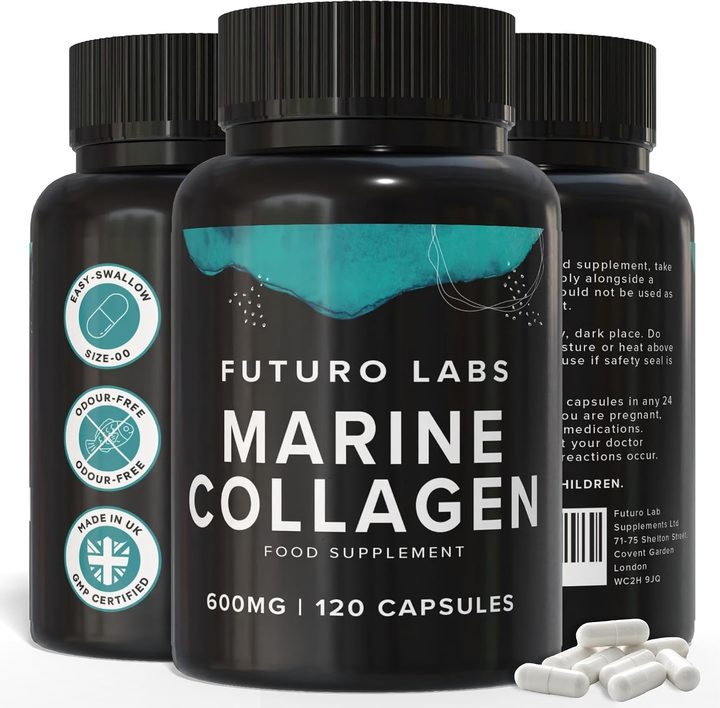
Our brand: the worked example on this page
Futuro Labs Marine Collagen
- 28p a day
- 120 capsules, 2 capsules daily
- Lab tested
- Made in the UK
The collagen half with the one collagen-related sentence, vitamin C's, built in: Futuro Labs Marine Collagen on Amazon UK, 2 capsules, 1200mg hydrolysed type 1 marine collagen with 12mg vitamin C at 15% NRV plus zinc, no piperine, 120 for £16.99, 28p a day. Full label breakdown. Collagen against turmeric for joints is on the turmeric comparison; the joint shelf walked against the register on the joint shelf page.
The two halves of the stack, turmeric's record and collagen's, and why neither holds a claim
Can I take turmeric and collagen together, and is it okay to, is a question about a joint stack, since the two are almost always bought for the same knee, and the honest page reads the stack's two halves against the register and then finds the one ingredient in it that deserves a second look. Turmeric's half: turmeric and its extract curcumin hold no authorised health claim in the UK, the joint and inflammation claims that were applied for having been rejected, the claims register's position, and the science behind the shelf is two things at once, a bioavailability problem, since plain curcumin is poorly absorbed and the research runs on formulated extracts and on piperine co-administration to get it into the blood, the curcumin bioavailability literature's account, and a trial record for knee osteoarthritis in which meta-analyses of short, small randomised trials with heterogeneous formulations and a high risk of bias report modest reductions in pain with curcumin extracts against placebo, the curcumin and osteoarthritis literature's finding, real enough to be interesting and weak enough that no guideline recommends it and osteoarthritis guidance puts exercise, weight management and education first with supplements absent. Collagen's half: collagen holds no authorised claim in any type or format, the collagen pages' first fact, and its loaded-joint file is empty, the osteoarthritis trials small and the tendon evidence a physiotherapist's research adjunct at around fifteen grams with vitamin C before loading rather than anything for a knee that hurts under a bar, the joint pages' verdict, so the stack is two products bought for a joint of which neither may say anything about a joint, and the joint itself, if it is a lifter's loaded one, is fixed by progressive loading, technique and volume with a physiotherapist, the tendinopathy literature's programme.
Whether they interact, the one ingredient worth reading, what okay means for the reader on medicines, and the stack filed
Whether they interact: no. Curcumin is a small polyphenol and collagen is a protein, they take different routes, neither changes the other's absorption or effect, and both are generally well tolerated at ordinary doses, gut upset being the commonest effect of either, the curcumin safety literature's record and collagen's short leaflet of fullness, a taste and a fish note for marine, so taking them together adds nothing to the sum of two mild leaflets and a reader who feels something new reads one of the two. The one ingredient worth reading is not the turmeric or the collagen but the piperine: most curcumin products add piperine, the black pepper extract, at a few milligrams to raise curcumin's absorption many-fold, and piperine does that by inhibiting the drug-metabolising enzymes and transporters in the gut and the liver that also clear many medicines, so a curcumin-with-piperine product can raise the blood levels of several prescription drugs, the piperine interaction literature's finding, which makes the stack's real question not turmeric and collagen but turmeric-with-piperine and the reader's medicine cabinet. What okay means for a reader on medicines, then, is a pharmacist's check: a reader on blood thinners, some blood pressure or heart medicines, some antidepressants, epilepsy medicines, immunosuppressants or any drug with a narrow margin takes the curcumin product's label to a pharmacist before adding it, and a reader on nothing takes it without the check, with the collagen half needing no check at all since it interacts with nothing. The honest note under the whole stack is the joint pages' standing one: a lifter's sore knee or shoulder has a loading programme before either tub, the two vitamins with a sentence naming a joint tissue, vitamin C and vitamin D, cost pennies, and a reader who still wants the stack takes it knowing it holds no claim, one small biased trial record and one empty file, and reads the piperine line. The stack filed: turmeric with no claim, poor absorption and a modest high-bias osteoarthritis record, collagen with no claim and an empty loaded-joint file, no interaction between them, piperine as the one ingredient that interacts with medicines and needs a pharmacist, and the joint fixed by load, with the worked example being the collagen half with vitamin C's sentence built in and no piperine, £16.99 for 120 at 28p a day.
| The item | The register and the record | The note |
|---|---|---|
| Turmeric and curcumin | No authorised claim; plain curcumin poorly absorbed | Short, small, high-bias osteoarthritis trials: modest pain reductions for extracts; no guideline recommends it |
| Collagen | No authorised claim | An empty loaded-joint file; the tendon adjunct is a physiotherapist's at fifteen grams with vitamin C |
| Turmeric with collagen | No interaction | Two mild leaflets; gut upset the commonest effect of either |
| Piperine in the curcumin product | Inhibits drug-metabolising enzymes and transporters | Can raise the blood levels of several medicines: a pharmacist checks the prescriptions |
| The joint | Exercise, weight management and education first; supplements absent from guidance | Progressive loading with a physiotherapist for a lifter's loaded joint |
| The collagen half on its true termsOurs | 1200mg type 1 with 12mg vitamin C; no piperine | Vitamin C's collagen formation sentence; nothing for a joint |
The verdict, okay to take together, with neither holding a claim, one ingredient needing a pharmacist, and the joint needing a loading programme
Can I take turmeric and collagen together, and is it okay: yes, as a joint stack with no claims and one ingredient worth reading, turmeric and curcumin holding no authorised claim, absorbing poorly and carrying a short, small, high-bias osteoarthritis trial record with modest pain reductions for extracts that no guideline recommends, collagen holding no claim and an empty loaded-joint file with its tendon evidence a physiotherapist's adjunct, the two not interacting and both well tolerated at ordinary doses, and the piperine that curcumin products add for absorption being the one thing in the stack to read, since it inhibits drug-metabolising enzymes and can raise the blood levels of several medicines, so a reader on prescriptions checks the curcumin product with a pharmacist, while the joint that bought both tubs is fixed by progressive loading. The collagen half with vitamin C's sentence built in and no piperine: Futuro Labs Marine Collagen, 1200mg type 1 with 12mg vitamin C, 120 for £16.99 at 28p a day.
What to check on the label
- Read both halves against the register: no claim for either.
- Read turmeric's record honestly: modest, small, biased, no guideline.
- Read collagen's joint file as empty: a tendon adjunct at most.
- Read the piperine line: a pharmacist if you take any medicine.
- Load the joint: the one thing that fixes it.
Our brand
The worked example: Futuro Labs Marine Collagen
Futuro Labs Marine Collagen: 2 capsules daily, 1200mg hydrolysed type 1 marine collagen with 12mg vitamin C and 1.5mg zinc (15% NRV each), 120 capsules for £16.99, 60 days at 28p a day, lab-tested, UK GMP made. Slim veggie-shell capsules, odour free. Fish derived: pescatarian, not vegetarian or vegan.
- Collagen per serving
- 1200mg hydrolysed type 1 marine (fish)
- Co-factors
- vitamin C 12mg (15% NRV), zinc 1.5mg (15% NRV)
- Serving
- 2 capsules a day
- Bottle
- 120 capsules, 60 days
- Price
- £16.99 (28p a day)
- Capsule
- slim size 00, veggie shell, odour free
Questions people also ask
Do turmeric and collagen interact?
No: curcumin is a small polyphenol and collagen a protein, they take different routes and change nothing about each other's absorption or effect, and both are generally well tolerated at ordinary doses with gut upset the commonest effect of either, so taking them together is the sum of two mild leaflets.
Is turmeric safe with medications?
The turmeric usually is and the piperine often is not: most curcumin products add black pepper extract to raise absorption, and piperine inhibits the drug-metabolising enzymes and transporters that clear many medicines, raising the blood levels of several, so a reader on blood thinners, heart, blood pressure, epilepsy, antidepressant or immunosuppressant medicines or any drug with a narrow margin checks the product with a pharmacist first.
Does turmeric help joint pain?
Modestly in weak trials and with no claim: meta-analyses of short, small, high-bias randomised trials in knee osteoarthritis report modest pain reductions with formulated curcumin extracts against placebo, no authorised health claim exists for turmeric or curcumin in the UK, and osteoarthritis guidance puts exercise, weight management and education first with supplements absent.
Is collagen or turmeric better for joints?
Neither holds a joint claim and neither has a file for a lifter's loaded joint: turmeric has a modest, biased osteoarthritis record and collagen an empty one with a tendon adjunct for a physiotherapist's programme, so the joint is fixed by progressive loading and the two vitamins with a sentence naming a joint tissue, vitamin C and vitamin D, cost pennies.
Can I take turmeric and collagen every day?
Yes at ordinary doses, both being well tolerated, with the turmeric product's piperine checked against any medicines by a pharmacist and the collagen needing no check, and with the honest expectation that the stack holds no claim, one small biased trial record and one empty file, and that a sore joint has a loading programme before either tub.
Sources
- The curcumin and osteoarthritis literature: meta-analyses of short randomised trials report modest reductions in knee osteoarthritis pain with curcumin extracts against placebo, with heterogeneous formulations, small samples and a high risk of bias, and no UK authorised health claim for turmeric or curcumin. PubMed record
- The curcumin bioavailability literature: plain curcumin is poorly absorbed, which is why formulations and piperine co-administration dominate the research, and why label milligrams overstate what arrives. PubMed record
- The piperine interaction literature: piperine, the black pepper extract added to curcumin products to raise absorption, inhibits drug-metabolising enzymes and transporters and can raise blood levels of several medicines, so a curcumin-with-piperine product is checked against a reader's prescriptions with a pharmacist. PubMed record
- The curcumin supplement safety literature: curcumin is poorly absorbed and generally well tolerated at ordinary doses, with gastrointestinal upset the commonest effect, in-vitro antiplatelet activity that prompts caution with anticoagulants and before surgery, and a series of liver-injury case reports linked to high-bioavailability formulations, particularly with piperine. PubMed record