Ghost Fitness/Collagen/Revive Collagen review: is it worth it for lifters?
Revive Collagen review: is it worth it for lifters?
The short answer
Review the sachet, not the brand: grams of hydrolysed collagen per day against the 2.5 to 15 gram research band, the source and type, pence per gram rather than per box, the vitamin C line that carries the only collagen sentence, and the lifter's reason. A premium liquid sachet at around ten grams is in the band and expensive per gram; a plain powder is in the band and cheap; a capsule dose sits below it. The reason decides.
- Read one: grams per daythe research band is 2.5 to 15 grams; a liquid sachet's usual pattern is around ten
- Reads two and three: type and pence per grammarine type 1 in this format; price divided by grams per box, not price per box
- Read four: the vitamin C linevitamin C holds the register's only collagen sentence, normal collagen formation; collagen itself holds none
- Read five: the lifter's reasona tendon programme's adjunct is around 15 grams with vitamin C before loading; skin trials are small and industry funded
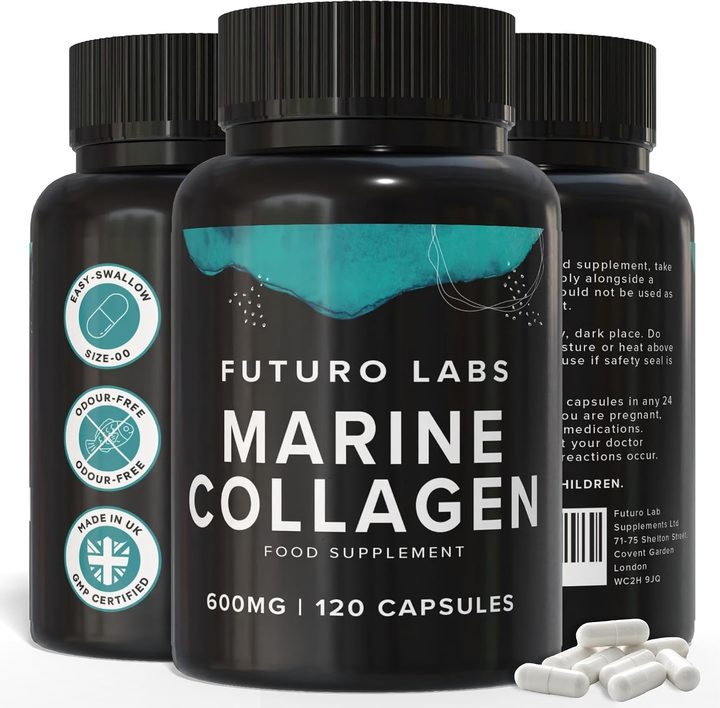
Our brand: the worked example on this page
Futuro Labs Marine Collagen
- 28p a day
- 120 capsules, 2 capsules daily
- Lab tested
- Made in the UK
The capsule benchmark stated on its true terms, a dose below the band with the vitamin C line met: Futuro Labs Marine Collagen on Amazon UK, 2 capsules, 1200mg hydrolysed type 1 marine collagen with 12mg vitamin C at 15% NRV plus zinc, 120 for £16.99, 28p a day. Full label breakdown. The formats compared are on the formats page; collagen for lifters on the lifters page.
Why this review is a template, and the first three reads applied to a premium liquid sachet
A premium liquid marine collagen sold in daily sachets, endorsed and priced accordingly, is a product this site can teach a lifter to review but will not review for them, because premium ranges reformulate, change sachet sizes and reprice without notice and a verdict written today describes a box that may differ next month, so this page is the template, the five reads that review any collagen, applied by the reader to the sachet in their hand, with a premium liquid's typical pattern described so the reads land. Read one, the grams per day: the collagen research runs at 2.5 to 15 grams of hydrolysed collagen a day, the lower end in the skin trials and the upper end in the tendon and joint work, the collagen trial literature's range, and a liquid sachet's usual pattern is around ten grams a day, which sits inside the band, against a capsule dose of one or two grams that sits below it, so the first read places a liquid sachet where the research was done and most capsules where it was not, which is a point in the sachet's favour that the price then has to justify. Read two, the source and type: a liquid marine collagen is hydrolysed type 1 from fish skin and scales, pescatarian and not vegetarian, the type the skin and tendon research mostly used and the type a bovine powder's 1 and 3 overlap with, so the type read is unremarkable in this format and the source read is a dietary one. Read three, the arithmetic that decides a premium: the honest comparison is pence per gram of hydrolysed collagen, the price of the box divided by the sachets times the grams per sachet, rather than the price per box or per day, and a premium liquid at around ten grams a sachet and the prices these ranges carry runs to tens of pence per gram, while a plain unflavoured peptide powder runs to a few pence per gram at the same dose, the powder pages' arithmetic, so the sachet buys convenience, flavour and a brand at a multiple of the powder's price for the same grams.
Reads four and five, the vitamin C line and the lifter's reason, the verdict the reader writes, and the benchmark stated on its true terms
Read four, the vitamin C line: collagen itself holds no authorised health claim in the UK, in any type or format, no joint, skin, tendon or bone sentence, and the only sentence that mentions collagen belongs to vitamin C, which contributes to normal collagen formation for the normal function of cartilage, bones, skin, blood vessels, gums and teeth, the claims register's allocation, so a sachet that carries vitamin C at a meaningful amount may carry that sentence and a sachet that does not may carry nothing, and a reader checks the ingredients for vitamin C and its amount, adding a cheap tablet or a glass of orange juice if the sachet has none. Read five, the lifter's reason, which decides everything: a lifter with a tendon or joint programme run by a physiotherapist may raise the research adjunct, around 15 grams of gelatin or hydrolysed collagen with vitamin C about an hour before loading, studied for collagen synthesis markers in small rehabilitation-context studies, the gelatin and vitamin C literature's protocol, for which a ten-gram sachet is under the dose and a powder scoop reaches it cheaply; a lifter interested in skin is reading a literature of small, short, industry-funded trials of oral collagen peptides on elasticity and hydration with no claim resulting, the skin trial literature's shape, in which a sachet at ten grams is in the range and a reader's expectation should be modest; and a lifter with no specific reason is buying a premium for a general belief that the register does not support. The verdict the reader writes: a premium liquid sachet is in the research band, convenient and expensive per gram, worth it to a reader who values the format and will use it daily for a reason the research addresses, and not worth it to a reader who could reach the same or a higher dose from a plain peptide powder with a vitamin C tablet at a fraction of the pence per gram. The benchmark this site states on its true terms is a capsule product, Futuro Labs Marine Collagen, 1200mg of hydrolysed type 1 marine collagen per two capsules with 12mg of vitamin C at 15% NRV, the vitamin C line met and the collagen dose stated plainly as sitting below the research band, lab tested, UK made, 28p a day, a product for the reader who wants the vitamin C sentence with a collagen dose in a capsule and not for the reader chasing the 15-gram protocol, who is sent to a powder.
| The read | What to look for | The premium liquid's usual pattern |
|---|---|---|
| Grams of hydrolysed collagen per day | Against the 2.5 to 15 gram research band | Around ten grams: in the band |
| Source and type | Marine type 1 or bovine 1 and 3; pescatarian or not | Marine type 1: unremarkable |
| Pence per gram | Price divided by sachets times grams; not price per box | Tens of pence per gram against a powder's few |
| The vitamin C line | Vitamin C present at a meaningful amount: the only collagen sentence | Check the ingredients; add a tablet if absent |
| The lifter's reason | A physiotherapist's tendon programme at around 15 grams; skin at modest expectation; or no reason | Under the tendon protocol dose; in the skin range |
| The capsule benchmark on its true termsOurs | 1200mg type 1 marine with 12mg vitamin C, below the band, 28p a day | The vitamin C line in a capsule, not the protocol |
The verdict, a template with the reason and the pence per gram as the deciding reads
Is a premium liquid marine collagen in daily sachets worth it for lifters: reviewed by five reads the reader applies to the sachet in their hand, the grams of hydrolysed collagen per day against the 2.5 to 15 gram research band, where a liquid sachet's usual ten grams sits inside it, the marine type 1 source that is unremarkable in the format, the pence per gram that runs to tens against a plain powder's few, the vitamin C line that carries the register's only collagen sentence while collagen itself carries none, and the lifter's reason, a physiotherapist's tendon programme whose research adjunct is around 15 grams with vitamin C before loading or a skin interest whose trials are small and industry funded, worth it to a reader who values the format for a reason the research addresses and not to a reader who could reach the dose from a powder at a fraction of the price. The capsule benchmark on its true terms: Futuro Labs Marine Collagen, 1200mg type 1 with 12mg vitamin C, a dose below the band with the vitamin C line met, 120 for £16.99 at 28p a day.
What to check on the label
- Read the grams per day: against 2.5 to 15 grams.
- Divide the price by the grams: not by the box.
- Find the vitamin C: the only collagen sentence belongs to it.
- Name your reason: a tendon programme, skin, or none.
- Compare the powder: the same grams at a fraction of the price.
Our brand
The worked example: Futuro Labs Marine Collagen
Futuro Labs Marine Collagen: 2 capsules daily, 1200mg hydrolysed type 1 marine collagen with 12mg vitamin C and 1.5mg zinc (15% NRV each), 120 capsules for £16.99, 60 days at 28p a day, lab-tested, UK GMP made. Slim veggie-shell capsules, odour free. Fish derived: pescatarian, not vegetarian or vegan.
- Collagen per serving
- 1200mg hydrolysed type 1 marine (fish)
- Co-factors
- vitamin C 12mg (15% NRV), zinc 1.5mg (15% NRV)
- Serving
- 2 capsules a day
- Bottle
- 120 capsules, 60 days
- Price
- £16.99 (28p a day)
- Capsule
- slim size 00, veggie shell, odour free
Questions people also ask
Is liquid collagen better than powder or capsules for lifters?
Better only in convenience: a liquid sachet's usual ten grams sits in the research band as a powder scoop does, at tens of pence per gram against a powder's few, while a capsule dose of one or two grams sits below the band at the lowest daily price, so the format is a preference and the grams per day and the pence per gram are the facts.
How much collagen per day for tendons or joints?
The research adjunct for a tendon programme is around 15 grams of gelatin or hydrolysed collagen with vitamin C about an hour before loading, studied for collagen synthesis markers in small rehabilitation-context studies, a physiotherapist's conversation rather than a claim, and a ten-gram sachet sits under it while a powder scoop reaches it cheaply.
Does collagen have a health claim in the UK?
No: collagen itself holds no authorised health claim in any type or format, and the only register sentence that mentions collagen belongs to vitamin C, which contributes to normal collagen formation for the normal function of cartilage, bones, skin, blood vessels, gums and teeth, so a collagen product's vitamin C line is the one claim it can carry.
Does collagen help skin?
The trials of oral collagen peptides on skin elasticity and hydration are small, short and mostly industry funded, with no authorised claim resulting, so a reader taking a sachet at ten grams for skin is in the range those trials used and should hold a modest expectation, with the vitamin C line as the only sentence the label may print.
Why will this site not give a verdict on the named brand?
Because premium ranges reformulate, change sachet sizes and reprice without notice, so a verdict describes a box that may have changed; the five reads and the pence-per-gram arithmetic let the reader review the actual sachet against a stated benchmark and their own reason.
Sources
- The collagen peptide trial literature: randomised controlled studies of hydrolysed collagen supplementation across skin, joint and connective-tissue outcomes, typically at 2.5g to 15g daily, with small effects and frequent industry funding. PubMed record
- The gelatin and vitamin C pre-exercise research (Shaw, Baar and colleagues): 15g gelatin with vitamin C taken about an hour before loading, studied for markers of collagen synthesis, the protocol behind the tendon-training conversation. PubMed record
- The collagen and skin trial literature: randomised studies of oral collagen peptides on skin elasticity and hydration, mostly small, short and industry funded, with no authorised claim resulting. PubMed record
- Retained Regulation (EC) No 1924/2006 on nutrition and health claims made on foods, and the Great Britain nutrition and health claims register. https://www.gov.uk/government/publications/great-britain-nutrition-and-health-claims-nhc-register