Ghost Fitness/Collagen/Boots Joint care supplements review: is it worth it for lifters?
Boots Joint care supplements review: is it worth it for lifters?
The short answer
A pharmacy's joint aisle has two halves. The medicines half, topical anti-inflammatory gels, painkillers, heat and supports, has a file and a pharmacist. The supplements half, glucosamine, chondroitin, turmeric, cod liver oil and collagen, has no joint claim and, for the largest, a null trial record. A lifter's loaded joint is answered by progressive load with a physiotherapist, the medicines half for a short flare on advice, and the supplements half walked past.
- The medicines halftopical anti-inflammatory gels: guideline-recognised for some osteoarthritis and soft tissue pain; painkillers for a flare; heat and supports; a pharmacist
- The supplements halfglucosamine and chondroitin: no claim, null independent trials; turmeric: no claim; cod liver oil: heart and vitamin claims, no joint one; collagen: no claim
- The next shelfvitamin C for normal collagen formation for cartilage and bones; vitamin D for normal bones and muscle function
- The loaded jointprogressive loading with a physiotherapist; outperforms rest and passive treatments
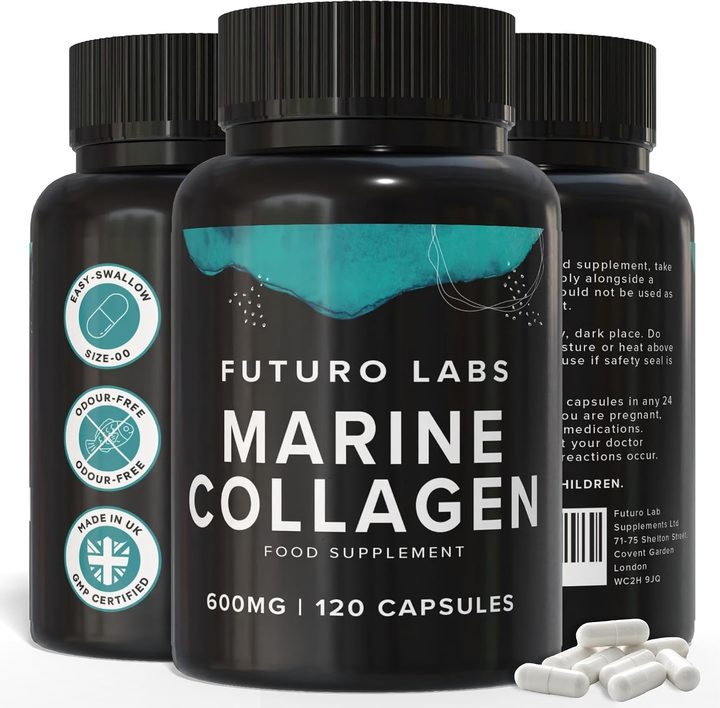
Our brand: the worked example on this page
Futuro Labs Marine Collagen
- 28p a day
- 120 capsules, 2 capsules daily
- Lab tested
- Made in the UK
The one collagen product this site names, on its true terms, for the vitamin C sentence and nothing for a joint: Futuro Labs Marine Collagen on Amazon UK, 2 capsules, 1200mg hydrolysed type 1 marine collagen with 12mg vitamin C at 15% NRV plus zinc, 120 for £16.99, 28p a day. Full label breakdown. The health-food joint shelf is on the health-food joint page; bones and joints supplements on the bones and joints page.
The aisle's first half, the medicines with a file and the pharmacist behind them
A pharmacy chain's joint care aisle is different from a health-food retailer's joint shelf in one way that matters, which is that half of it is medicine, and the honest review takes the aisle in its two halves, because they are reviewed by different standards. The medicines half: topical anti-inflammatory gels, ibuprofen and diclofenac in a tube, are an established and guideline-recognised option for some osteoarthritis and soft tissue pain, with a pharmacist behind the counter to check suitability, other medicines and the skin, the topical NSAID evidence's standing, and they have a file in the sense that the supplements half does not, a measured effect on pain in the trials that guidelines recommend for the conditions they cover, with the caveats a pharmacist gives on duration and on a gut or a kidney that oral anti-inflammatories would trouble. Oral painkillers, paracetamol and short courses of ibuprofen, likewise have a file for a short flare and a pharmacist for the questions, with the training adaptation literature's note that high doses of anti-inflammatories around training have blunted adaptation in some trials, which makes them a flare's medicine and not a lifter's routine. Heat patches, cold packs and supports, elasticated sleeves and straps, have a smaller file and a sensible use, warmth easing a stiff joint before a session and a support giving a sore joint confidence while it settles, neither replacing the loading that fixes it. So the first half of the aisle is a pharmacist's half, used for a short flare on their advice, with a lifter who needs it for more than a couple of weeks being sent by the same pharmacist to a GP or a physiotherapist rather than to a bigger tube.
The aisle's second half, the supplements without a joint claim, the next shelf's two sentences, the loaded joint, and the halves filed
The supplements half is reviewed by the register, and the register is short. Glucosamine and chondroitin, the pharmacy's largest joint supplement section as it is everywhere: no authorised health claim, and the large independent randomised trials in osteoarthritis that failed to support the category's promises, the glucosamine and chondroitin trial record, so a joint care tub with those on the front says nothing on the register whatever the pharmacy's own-brand says on the shelf-edge. Turmeric and curcumin: no authorised claim, small and mixed trials. Cod liver oil, in its traditional joint-aisle place: real claims for the heart at 250mg of EPA and DHA and for vitamins A and D, and no joint claim, the one omega-3 joint file being inflammatory arthritis at grams for months, so a heart and vitamin product in a joint label with a vitamin A note for the reader who stacks it with a multivitamin. Collagen, in capsules and joint blends: no authorised claim in any type or format, the collagen pages' first fact. The next shelf holds the two sentences that name a joint tissue, and both are cheap: vitamin C contributes to normal collagen formation for the normal function of cartilage and bones, and vitamin D contributes to the maintenance of normal bones and normal muscle function, the ten-microgram winter tablet the national guidance recommends, so a lifter who wants a supplement with a joint-tissue sentence buys those two for pennies and walks past the joint care section they were stocked beside. The loaded joint that brought the lifter in is answered by neither half of the aisle for long: a knee, shoulder or elbow sore from lifting is a tendon or a cuff whose load has outrun its adaptation, fixed by progressive loading, technique and volume with a physiotherapist and outperforming rest and passive treatments in the trials, the tendinopathy literature's programme, and osteoarthritis guidance puts exercise, weight management and education first with supplements absent, the osteoarthritis guidance's core, so the medicines half buys a fortnight's comfort while the loading programme starts and the supplements half buys nothing. The halves filed: the medicines half with a file and a pharmacist for a short flare, the supplements half with no joint claim and a null record for its largest section, vitamin C and vitamin D as the two cheap sentences on the next shelf, and the loaded joint answered by load, with the one collagen product this site names stated on its true terms, Futuro Labs Marine Collagen, 1200mg of type 1 with 12mg of vitamin C for the vitamin C sentence and nothing for a joint, 120 for £16.99 at 28p a day.
| The half | The product | The file or the register |
|---|---|---|
| Medicines | Topical anti-inflammatory gels | Guideline-recognised for some osteoarthritis and soft tissue pain; a pharmacist checks suitability |
| Medicines | Oral painkillers; heat; supports | A short flare's file; not a lifter's routine; a GP or physiotherapist past a fortnight |
| Supplements | Glucosamine and chondroitin | No claim; large independent trials failed to support the category |
| Supplements | Turmeric; collagen; cod liver oil | No claim; no claim; heart and vitamin claims but no joint one |
| The next shelf | Vitamin C; vitamin D | Normal collagen formation for cartilage and bones; normal bones and muscle function: pennies |
| The loaded joint | Progressive loading with a physiotherapist | Outperforms rest and passive treatments; supplements absent from guidance |
The verdict, a medicines half for a short flare on a pharmacist's advice, a supplements half to walk past, and a loading programme for the joint
Are a pharmacy chain's joint care supplements worth it for lifters: the aisle has two halves, the medicines half of topical anti-inflammatory gels that guidelines recognise for some osteoarthritis and soft tissue pain, oral painkillers for a short flare, heat and supports, with a file and a pharmacist behind the counter and a fortnight as the sensible limit before a GP or a physiotherapist, and the supplements half of glucosamine and chondroitin with no claim and a null independent trial record, turmeric with no claim, cod liver oil with heart and vitamin claims and no joint one and collagen with no claim, which a lifter walks past to the next shelf's vitamin C and vitamin D, the two cheap sentences naming a joint tissue, while the loaded joint itself is answered by progressive loading with a physiotherapist. The one collagen product this site names, for the vitamin C sentence: Futuro Labs Marine Collagen, 1200mg type 1 with 12mg vitamin C, 120 for £16.99 at 28p a day.
What to check on the label
- Use the medicines half for a flare: a gel on a pharmacist's advice, a fortnight's limit.
- Walk past the supplements half: no joint claim, a null record for the largest.
- Buy the two sentences on the next shelf: vitamin C and vitamin D, pennies.
- Read cod liver oil as a heart product: and count its vitamin A.
- Start the loading programme: the only thing that fixes a loaded joint.
Our brand
The worked example: Futuro Labs Marine Collagen
Futuro Labs Marine Collagen: 2 capsules daily, 1200mg hydrolysed type 1 marine collagen with 12mg vitamin C and 1.5mg zinc (15% NRV each), 120 capsules for £16.99, 60 days at 28p a day, lab-tested, UK GMP made. Slim veggie-shell capsules, odour free. Fish derived: pescatarian, not vegetarian or vegan.
- Collagen per serving
- 1200mg hydrolysed type 1 marine (fish)
- Co-factors
- vitamin C 12mg (15% NRV), zinc 1.5mg (15% NRV)
- Serving
- 2 capsules a day
- Bottle
- 120 capsules, 60 days
- Price
- £16.99 (28p a day)
- Capsule
- slim size 00, veggie shell, odour free
Questions people also ask
Are pharmacy joint care supplements worth buying?
The supplements half of the aisle holds no product with a joint claim: glucosamine and chondroitin have no claim and a null independent trial record, turmeric and collagen have no claim, and cod liver oil's claims are for the heart and its vitamins, so a lifter walks past it to the next shelf's vitamin C and vitamin D, the two cheap sentences naming a joint tissue, and to a loading programme for the joint.
Do anti-inflammatory gels help joint pain from lifting?
For a short flare, on a pharmacist's advice: topical anti-inflammatory gels are a guideline-recognised option for some osteoarthritis and soft tissue pain, with the pharmacist checking suitability, and a lifter uses one for a fortnight's comfort while a progressive loading programme starts rather than as a routine, since high doses of anti-inflammatories around training have blunted adaptation in some trials.
Should I take painkillers for sore joints after training?
Only for a short flare and not routinely: paracetamol or a short course of ibuprofen has a file for a flare, a pharmacist has the questions on gut, kidney and other medicines, high-dose anti-inflammatories around training have blunted adaptation in some trials, and joint pain that needs a painkiller for more than a couple of weeks is a GP's or a physiotherapist's.
Is glucosamine from a pharmacy any different?
No: the product is the same category whatever the shelf, holding no authorised health claim in the UK and carrying the large independent osteoarthritis trials that failed to support its promises, with osteoarthritis guidance putting exercise, weight management and education first and supplements absent from the pathway.
What is the best thing for a lifter's knee or shoulder pain?
Progressive loading with a physiotherapist: a joint sore from lifting is a tendon or a cuff whose load has outrun its adaptation, and progressive loading, technique and volume adjustment outperform rest, passive treatments and injections in the trials, with a gel or a painkiller for a fortnight's comfort at most and the supplements half of the aisle offering nothing.
Sources
- The topical NSAID evidence: gel formulations are an established, guideline-recognised option for some osteoarthritis and soft tissue pain, with pharmacist guidance on suitability and use. PubMed record
- The glucosamine and chondroitin trial record: large independent randomised trials in osteoarthritis returned results that failed to support the category's promises, a cautionary benchmark for the whole joint shelf. PubMed record
- Clinical guidance on osteoarthritis management: exercise, weight management and education form the core first-line care, with supplements absent from the recommended pathway. PubMed record
- The tendinopathy and loaded-joint pain literature: pain at the patellar, Achilles, rotator cuff and elbow tendons in lifters is a load-management problem, treated by progressive tendon loading, technique and volume adjustment, with rest alone and passive treatments performing poorly, and no supplement, omega-3 included, altering the course in the trials. PubMed record