Ghost Fitness/Collagen/Does marine collagen taste fishy?
Does marine collagen taste fishy?
The short answer
Well-made marine collagen barely tastes of anything: fishiness is oxidised lipids and amines that degreasing and deodorising remove, so a fishy glass is a processing report card. Strong carriers mask the faint; capsules exit the question entirely.
- The chemistry of fishyoxidised residual lipids and volatile amines, not the protein itself
- Where it is removedthe degreasing and deodorising stations of the factory tour
- The honest baselinewell-made powder: near-neutral, faintly savoury in plain water
- The zero-taste exitsealed capsules: the question never asked
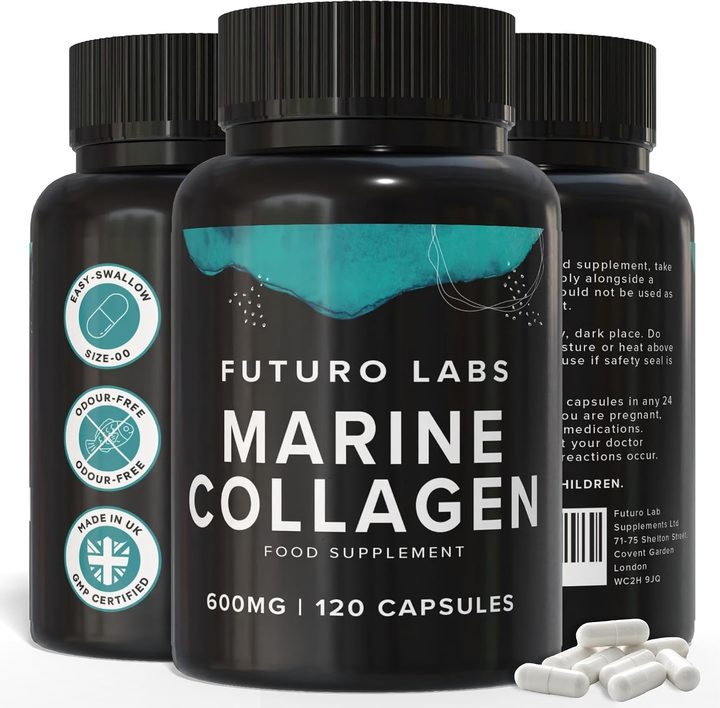
Our brand: the worked example on this page
Futuro Labs Marine Collagen
- 28p a day
- 120 capsules, 2 capsules daily
- Lab tested
- Made in the UK
The exit at the top of the fix ladder: Futuro Labs Marine Collagen on Amazon UK, 1200mg hydrolysed type 1 marine in odour-free capsules, vitamin C and zinc at 15% NRV, £16.99 for 60 days at 28p. Full label breakdown. The kitchen-bench review is on the powder page; the factory stations on the made-of page.
The autopsy: what fishy actually is, chemically, and why the protein was never the culprit
Put the flavour on the bench and identify it properly, because fishy is not a property of collagen at all: pure hydrolysed peptides are close to tasteless, faintly savoury at most, and the smell every worried shopper means comes from passengers, not the protein. Passenger one, residual lipids: fish skin is a fatty tissue, and any fat the degreasing station leaves behind travels into the powder where it does what marine fats do, oxidise, the rancid-sea note of aged fish being oxidation chemistry, which is why fishiness worsens with raw-material age and sloppy storage, the freshness of the skin entering the process being half the final flavour. Passenger two, volatile amines: the nitrogen compounds fish tissue generates as it sits, trimethylamine being the textbook name for the smell of fish past its best, water-soluble, volatile, and removable by the purification and deodorising stations, activated carbon and fine filtration stripping them alongside colour. Which converts the whole question into the bench page's standing verdict, stated here with its mechanism attached: a fishy glass is a processing report card, telling you the manufacturer economised on degreasing, deodorising or raw-material freshness, and a clean glass is those stations doing their jobs, the species, the ocean and the collagen itself having been innocent throughout.
The honest baseline, the taste-test protocol, and the fix ladder climbed rung by rung
Calibrate expectations against the honest baseline: a well-made marine powder in plain water, the harshest possible test, reads near-neutral with a faint savoury edge some palates catch and most do not, disappears completely in coffee, porridge, smoothies or anything with its own character, and never announces the sea, so a shopper's own protocol is simple, judge a new tub first in plain cool water to hear its true report card, then in the real daily carrier, and believe the second result for daily life while remembering the first for repurchase decisions. The fix ladder, for the reader holding a tub with a note they dislike, climbs from cheap to definitive. Rung one, the carrier: strong-flavoured vehicles, coffee above all, cocoa, fruit smoothies, mask a faint edge entirely, and cooler liquids help by keeping volatiles quiet, warmth amplifying aroma. Rung two, the citrus trick: a squeeze of lemon or lime in water reads against amine notes the way it does on a fish counter, a genuinely useful kitchen chemistry. Rung three, the repurchase decision: a powder that needs masking every day has failed its report card, and the fix is a better-processed product next time, brands confident of their deodorisation tending to say so. Rung four, the exit: capsules, the sealed shell carrying the powder past the palate entirely, the zero-taste format the worked example builds in, odour-free by construction, which retires the question rather than answering it, and remains the standing recommendation for any reader whose relationship with marine collagen would otherwise be a daily negotiation with a glass.
| The item | The finding | The action |
|---|---|---|
| The culprit | Oxidised lipids and volatile amines, not the protein | Read fishiness as a processing report card |
| The removal stations | Degreasing, purification, deodorising | Corners cut there end up in the glass |
| The honest baseline | Near-neutral; vanishes in real carriers | Test in plain water, live in coffee |
| Rung one and two | Strong cold carriers; a citrus squeeze | Mask a faint edge for pennies |
| Rung three | Daily masking means a failed card | Repurchase from a better-processed brand |
| Rung four | Sealed capsules | The zero-taste exit: the question retired |
The verdict, tasted and filed
Does marine collagen taste fishy: well-made, barely at all, the peptides themselves being near-tasteless and fishiness being the chemistry of passengers, oxidised residual lipids and volatile amines that fresh raw material and diligent degreasing and deodorising remove, so a fishy glass grades the manufacturer rather than the ocean, faint edges mask under coffee, cold and citrus, persistent ones justify a better tub, and capsules exit the question entirely. The worked example takes the exit by design: Futuro Labs Marine Collagen, 1200mg hydrolysed type 1 marine sealed in odour-free capsules with 12mg vitamin C and 1.5mg zinc at 15% NRV, lab tested per batch, UK made, £16.99 for 60 days at 28p a day, a marine collagen whose taste was engineered out of the conversation, which is the highest mark the report card gives.
What to check on the label
- Fishy is passengers, not protein: oxidised lipids and amines.
- It grades the processing: degreasing, deodorising, raw freshness.
- Test in water, live in coffee: the two-glass protocol.
- Cold, strong carriers and citrus mask: the cheap rungs of the ladder.
- Capsules retire the question: sealed, odour-free, done.
Our brand
The worked example: Futuro Labs Marine Collagen
Futuro Labs Marine Collagen: 2 capsules daily, 1200mg hydrolysed type 1 marine collagen with 12mg vitamin C and 1.5mg zinc (15% NRV each), 120 capsules for £16.99, 60 days at 28p a day, lab-tested, UK GMP made. Slim veggie-shell capsules, odour free. Fish derived: pescatarian, not vegetarian or vegan.
- Collagen per serving
- 1200mg hydrolysed type 1 marine (fish)
- Co-factors
- vitamin C 12mg (15% NRV), zinc 1.5mg (15% NRV)
- Serving
- 2 capsules a day
- Bottle
- 120 capsules, 60 days
- Price
- £16.99 (28p a day)
- Capsule
- slim size 00, veggie shell, odour free
Questions people also ask
Why does some marine collagen smell fishy?
Passengers, not protein: residual skin lipids that oxidise and volatile amines like trimethylamine, both removable by degreasing and deodorising, so fishiness reports the processing, not the species.
What does good marine collagen taste like?
Near-nothing: faintly savoury at most in plain water, the harshest test, and completely invisible in coffee, porridge or a smoothie.
How can I reduce a fishy taste in my current tub?
Climb the ladder: cold, strongly flavoured carriers, coffee above all, a citrus squeeze in water, and if daily masking is still needed, treat the tub as a failed report card at repurchase.
Do capsules solve the taste problem?
Entirely: a sealed odour-free shell carries the powder past the palate, retiring the question rather than answering it, which is the standing exit for taste-sensitive readers.
Is a fishy batch unsafe?
Not by flavour alone: the note signals processing economy, not contamination, and safety lives in the per-batch heavy-metals and microbiology certificates either way.
Sources
- The collagen manufacturing literature: raw hides and fish skins are cleaned, extracted to gelatine and enzymatically hydrolysed into low molecular weight peptides before filtration and spray-drying. PubMed record
- The marine byproduct literature: fish skins and scales from filleting are studied as collagen raw materials, valorising processing side-streams from species including cod, pollock and tilapia. PubMed record
- Futuro Labs Marine Collagen listing and label: 1200mg hydrolysed type 1 marine collagen per 2-capsule serving with 12mg vitamin C and 1.5mg zinc at 15% NRV each, 120 capsules, independently lab tested, UK made. https://www.amazon.co.uk/dp/B0C2J7N364
- EFSA Panel on Dietetic Products, Nutrition and Allergies. Scientific Opinion on the substantiation of health claims related to magnesium. EFSA Journal 2010;8(10):1807. https://efsa.onlinelibrary.wiley.com/doi/10.2903/j.efsa.2010.1807