Ghost Fitness/Collagen/What is collagen supplement made of?
What is collagen supplement made of?
The short answer
Fish skins or bovine hide, cleaned, extracted to gelatine with heat, cut into small peptides by enzymes, filtered, spray-dried to powder and batch-tested: that is the whole tub, plus a capsule shell or added vitamin C where stated.
- The raw materialbyproduct streams: fish skins and scales, bovine hide
- The pivotal stepenzymatic hydrolysis: gelatine cut into small peptides
- The finishfiltration, spray-drying, per-batch testing
- The rest of the tuba shell, a cofactor, or nothing: the ingredients line says
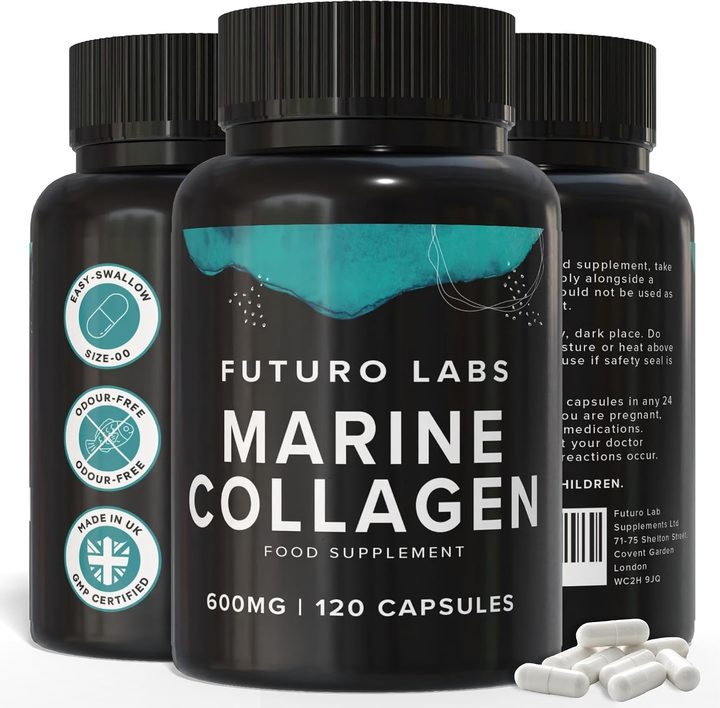
Our brand: the worked example on this page
Futuro Labs Marine Collagen
- 28p a day
- 120 capsules, 2 capsules daily
- Lab tested
- Made in the UK
The tour's end product, panels shown: Futuro Labs Marine Collagen on Amazon UK, 1200mg hydrolysed type 1 from fish, heavy-metal and microbiology tested, vitamin C and zinc at 15% NRV, veggie shells, £16.99 for 60 days at 28p. Full label breakdown. Why the process solves absorption is on the absorption page; the quality lines on the quality page.
The tour, stations one to four: from side-stream to gelatine to peptides
A collagen supplement has an unusually honest answer to what it is made of, because the process is industrial, documented and the same everywhere, so walk the factory. Station one, the raw material: fish skins and scales from the filleting industry, or bovine hide from the beef industry, occasionally porcine skin or chicken sternum, all byproduct streams, side-streams an existing food industry would otherwise discard, which is why no animal is farmed for collagen and why the sustainability pages call both sources upcycling. Station two, preparation: the material is washed, degreased and, for scales and bone-adjacent inputs, demineralised, then treated with controlled acid or alkali to loosen the collagen's cross-links, days of unglamorous soaking that determine much of the final purity. Station three, extraction: heat and water pull the loosened collagen out of the tissue as gelatine, literally the same substance as the dessert aisle's, long tangled protein strands that gel when cool, and a product stopped here is sold as gelatine or the beef gelatine powder the tendon protocol's budget lane uses. Station four, the pivotal one: enzymatic hydrolysis, food-grade proteases added to cut the long gelatine strands into short peptides, the low molecular weight fragments every label boasts about, this single step being what the word hydrolysed means, why the powder dissolves in cold liquid where gelatine will not, and why the absorption pages keep saying the factory solved digestion in advance, the enzymes having done the stomach's opening work already.
Stations five to seven, the rest of the tub, and what the tour teaches a buyer
Station five, clean-up: the peptide liquor is filtered and purified, activated carbon and fine filtration stripping colour, odour and residues, the station where marine deodorisation lives and where corners cut become the fishy glass the bench page describes. Station six, drying: the purified liquid is spray-dried, atomised into hot air and falling as the fine cream powder that fills every tub, sometimes agglomerated slightly for better wetting. Station seven, verification: batch testing, the identity, heavy-metals and microbiology panels whose certificates the quality page teaches you to demand, marine batches earning the metals panel especially. That is the collagen itself, and the rest of the tub is a short census the ingredients line settles: a plain powder is stations one to seven and nothing else, the single-ingredient product; a formulated product adds its cofactors, the worked example's vitamin C and zinc being the claim-holders deliberately aboard; capsules add a shell, bovine gelatine classically or a vegetal cellulose like the example's veggie shells, the shell census mattering to vegetarians and certification-conscious readers per the animals page; and flavoured or ready-to-drink versions add sweeteners, acids and flavours the pence division prices as water and marketing. The tour's buying lessons compress to three: hydrolysed is a process, universal, never a premium; purity work shows up in the glass and the certificate, so demand the certificate; and everything in the tub is legible from the panel, which was the honest point of asking what it is made of at all.
| The station | What happens | The buyer's takeaway |
|---|---|---|
| Raw material | Fish skins and scales, or bovine hide: byproduct streams | No animal is farmed for collagen: upcycled side-streams |
| Preparation and extraction | Washing, acid or alkali loosening, heat pulls out gelatine | Stopped here, the product is gelatine: the protocol's budget lane |
| Enzymatic hydrolysis | Proteases cut gelatine into short peptides | What hydrolysed means: universal, never a premium |
| Filtration and purification | Colour, odour and residues stripped | Where deodorisation lives: corners cut end up in the glass |
| Spray-drying and testing | Fine powder, then identity, metals and micro panels | Demand the certificates, marine's metals panel especially |
| The rest of the tub | A shell, a cofactor, flavours, or nothing | The ingredients line is the complete census |
The verdict, and the tub understood from skin to scoop
What is a collagen supplement made of: animal side-streams walked through seven honest stations, fish skin or bovine hide cleaned and loosened, extracted to gelatine, enzymatically cut into the small peptides the word hydrolysed describes, filtered, spray-dried and batch-tested, plus whatever short census the ingredients line adds, a shell, a cofactor, a flavour, or nothing at all. The worked example is the tour's end product with its paperwork attached: Futuro Labs Marine Collagen, 1200mg hydrolysed type 1 from fish, purified to odour-free, heavy-metal and microbiology panels passed, carried in vegetal cellulose shells with 12mg vitamin C and 1.5mg zinc at 15% NRV, UK made, £16.99 for 60 days at 28p a day, a tub whose entire biography fits on its own back panel, which is what an honest one looks like.
What to check on the label
- The raw material is a side-stream: fish skins or hide the food industry discards.
- Hydrolysis is the defining step: enzymes cut gelatine into peptides.
- Purity work is a station, not a slogan: it shows in the glass and the certificate.
- The panels close the tour: identity, heavy metals, microbiology, per batch.
- The ingredients line is the census: shell, cofactor, flavour, or nothing.
Our brand
The worked example: Futuro Labs Marine Collagen
Futuro Labs Marine Collagen: 2 capsules daily, 1200mg hydrolysed type 1 marine collagen with 12mg vitamin C and 1.5mg zinc (15% NRV each), 120 capsules for £16.99, 60 days at 28p a day, lab-tested, UK GMP made. Slim veggie-shell capsules, odour free. Fish derived: pescatarian, not vegetarian or vegan.
- Collagen per serving
- 1200mg hydrolysed type 1 marine (fish)
- Co-factors
- vitamin C 12mg (15% NRV), zinc 1.5mg (15% NRV)
- Serving
- 2 capsules a day
- Bottle
- 120 capsules, 60 days
- Price
- £16.99 (28p a day)
- Capsule
- slim size 00, veggie shell, odour free
Questions people also ask
What exactly is in a collagen supplement?
Hydrolysed animal collagen: fish skins or bovine hide extracted to gelatine, enzymatically cut into small peptides, filtered, spray-dried and tested, plus whatever the ingredients line adds, a shell or a cofactor.
Is collagen the same as gelatine?
Gelatine is the tour's halfway product: the same protein before enzymatic hydrolysis cuts it into peptides, which is why gelatine gels and hydrolysate dissolves cold, and why the budget protocol lane uses gelatine.
Are animals farmed to make collagen?
No: the raw materials are byproduct streams, skins, scales and hides an existing food industry would otherwise discard, upcycled rather than purpose-farmed.
Why do some marine powders smell fishy?
The purification station: deodorisation and fine filtration cost money, and corners cut there end up in the glass. It is a processing quality signal, not a species destiny.
What should I check before buying, given the process?
The paperwork the tour generates: per-batch identity, heavy-metals and microbiology certificates, a named source, and an ingredients line short enough to census in a glance.
Sources
- The collagen manufacturing literature: raw hides and fish skins are cleaned, extracted to gelatine and enzymatically hydrolysed into low molecular weight peptides before filtration and spray-drying. PubMed record
- The collagen peptide trial literature: randomised controlled studies of hydrolysed collagen supplementation across skin, joint and connective-tissue outcomes, typically at 2.5g to 15g daily, with small effects and frequent industry funding. PubMed record
- Futuro Labs Marine Collagen listing and label: 1200mg hydrolysed type 1 marine collagen per 2-capsule serving with 12mg vitamin C and 1.5mg zinc at 15% NRV each, 120 capsules, independently lab tested, UK made. https://www.amazon.co.uk/dp/B0C2J7N364
- EFSA Panel on Dietetic Products, Nutrition and Allergies. Scientific Opinion on the substantiation of health claims related to magnesium. EFSA Journal 2010;8(10):1807. https://efsa.onlinelibrary.wiley.com/doi/10.2903/j.efsa.2010.1807