Ghost Fitness/Collagen/How much is too much collagen per day?
How much is too much collagen per day?
The short answer
Relative to the reason: over 10g for skin, over 15g for joints or the tendon protocol, any gram for muscle. The tub's 20g scoop is over on all of them. No upper level exists; 15g is where the data ends.
- For skintrials at 2.5 to 10g: over ten is past every skin trial
- For joints and tendonsjoints ~10g, some at 15; the tendon protocol 15g with vitamin C: fifteen is the top of the data
- For muscleevery gram: no tryptophan, a third of whey's leucine
- The absolute ceilingsno upper level; 15g the end of the data; fullness around a scoop; the oxalate footnote for stone formers
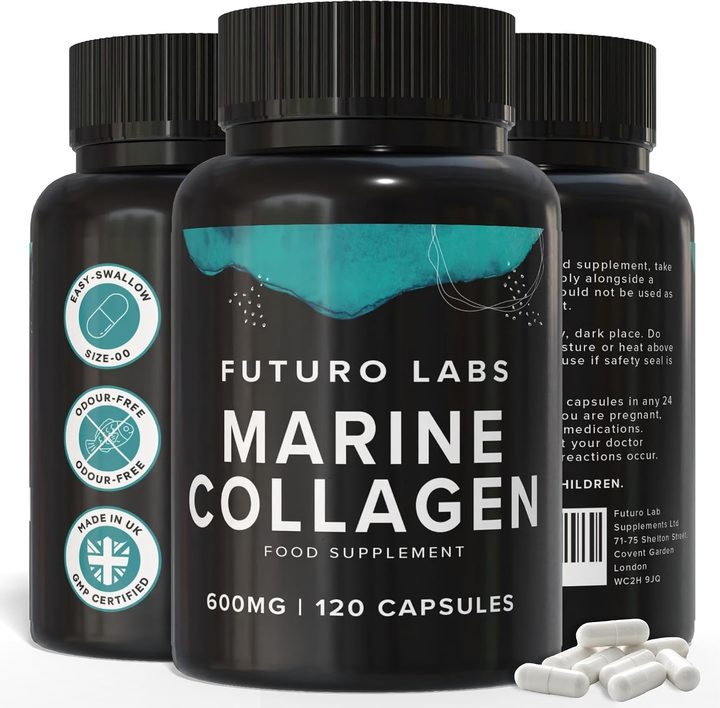
Our brand: the worked example on this page
Futuro Labs Marine Collagen
- 28p a day
- 120 capsules, 2 capsules daily
- Lab tested
- Made in the UK
Under every ceiling on this page: Futuro Labs Marine Collagen on Amazon UK, 2 capsules, 1200mg hydrolysed type 1 marine collagen with 12mg vitamin C at 15% NRV plus zinc, 120 for £16.99, 28p a day, lab tested and UK made, below the research band and taken for vitamin C's collagen formation sentence. Full label breakdown. The four numbers that bracket safe are on the how many mg is safe page; the symptom audit on the symptoms of too much collagen page.
Too much by reason: skin, joints, the tendon protocol, and muscle
How much is too much collagen per day is usually asked as if there were one number, and the honest answer is that there are four, because too much is relative to the reason a reader is taking it before it is absolute, and a dose that is exactly right for one reason is twice too much for another. For skin, the oral collagen trials gave 2.5 to 10 grams a day for eight to twelve weeks and measured elasticity and hydration by instrument, and no skin trial gave more than ten, so a reader taking collagen for skin is past every skin trial at eleven grams and is paying, at four calories a gram and pence per gram, for grams no skin study ever tested; ten is the skin ceiling, and 2.5 grams, the low end that the eight-week wrinkle depth trial used, is a reminder that the skin band starts low. For joints, the comfort trials gave around ten grams a day for twelve to twenty-four weeks, with a few at fifteen and some at five, so ten is the usual joint dose and fifteen the top of the joint data, above which no joint trial speaks. For the tendon pre-loading protocol, the one timed collagen dose, the trial gave around fifteen grams of gelatin with roughly 50mg of vitamin C an hour before loading, and fifteen is therefore both the protocol's dose and the highest dose any collagen protocol has used for any reason, the ceiling of the whole evidence base. For muscle, the answer is different in kind: every gram is too much, because collagen lacks tryptophan entirely, scores near zero on the completeness scale and carries around a third of whey's leucine, so it does not build muscle in the trials that compare it with whey and does not count toward the 1.6 grams per kilo a lifter eats for it, and a reader taking twenty grams for muscle has taken twenty grams too many and should have taken whey. Set those four ceilings against the tub and the tub loses: a standard scoop holds around twenty grams, a serving size chosen by the brand and not a dose chosen by any trial, and a reader following the scoop is over the skin ceiling by double, over the joint ceiling, over the tendon protocol, and over the muscle ceiling by twenty grams, every day, which is why the first answer to how much is too much is whatever the scoop says.
The absolute ceilings behind the relative ones, and the reader-specific one
Behind the four relative ceilings sit the absolute ones, and they are gentler than the question expects. First, there is no upper level: no authority in the UK, Europe or elsewhere has set a tolerable upper intake for collagen or gelatin, because they are food proteins with no toxicity to set a limit against, so no daily dose of collagen is poisonous in the way a vitamin or mineral can be, and the word overdose does not apply to it. Second, fifteen grams is where the data ends: the trials ran up to fifteen grams a day for months without an adverse event above placebo, and above fifteen no trial speaks, so a reader at twenty or thirty grams is not in danger but is off the map, taking protein no study measured for any outcome, which is the difference between unsafe and unstudied and should be stated as one. Third, the gut sets its own ceiling: twenty grams of any protein in a glass produces fullness and bloating in many readers, especially fasted or late, fading over a fortnight as the gut adapts and absent at a dessertspoon, so the point at which a dose becomes uncomfortable is around a scoop and is the body's own too much. Fourth, the ledger: collagen is four calories a gram and an incomplete protein, so grams above the reason are calories added and, if counted as protein, complete protein displaced from the day, the practical cost of too much for a lifter tracking either. Then the reader-specific ceiling, which is the only one that could matter clinically: hydroxyproline, around a tenth of collagen, is metabolised partly to oxalate, and urinary oxalate rises after large gelatin loads, so a reader who has formed calcium oxalate kidney stones has a lower too much than anyone else, keeps collagen and gelatin modest and asks whoever manages the stones, while a reader with no stones has no such ceiling. The ceilings totalled: too much is any gram past the reason, ten for skin, fifteen for joints and the protocol, none for muscle; the scoop is over all of them; nothing is toxic, fifteen is the end of the data, fullness is the gut's limit, and stone formers have a lower line. The worked example sits under every ceiling on the page: two capsules, 1200mg hydrolysed type 1 marine collagen with 12mg vitamin C plus zinc, 120 for £16.99 at 28p a day, lab tested and UK made, below the research band, a dose no reason on this page calls too much and taken for vitamin C's collagen formation sentence rather than for any of the trials' grams. How much is too much collagen per day: more than the reason needs, which the tub's scoop is for every reason there is.
| The reason or ceiling | The line | Why |
|---|---|---|
| Skin | Over 10g | Trials at 2.5 to 10g for 8 to 12 weeks; nothing above ten |
| Joints | Over 10 to 15g | Trials mostly at ~10g, a few at 15 |
| The tendon protocol | Over 15g | The trial's dose with vitamin C an hour before loading; the top of all collagen data |
| Muscle | Every gram | No tryptophan, a third of whey's leucine; the wrong protein |
| The tub's scoop | ~20g | Over every reason above, daily |
| No upper level | None set anywhere | A food protein with no toxicity to limit |
| The data ceiling | 15g | Above it unstudied, not unsafe |
| The gut's ceiling | Around a scoop | Fullness and bloating, fading over a fortnight; absent at a dessertspoon |
| The stone former's ceiling | Lower, and asked | Hydroxyproline to oxalate after large loads |
| The worked exampleOurs | Two capsules, 1200mg marine collagen with 12mg vitamin C, 28p a day | Under every ceiling; the vitamin C line |
What to check on the label
- Name the reason before the grams: skin, joints, tendon or habit.
- Stop at the trial's top: 10g skin, 15g joints and tendon.
- Take none for muscle: buy whey.
- Ignore the scoop: it is over every reason.
- Stone formers set a lower line: and ask.
Our brand
The worked example: Futuro Labs Marine Collagen
Futuro Labs Marine Collagen: 2 capsules daily, 1200mg hydrolysed type 1 marine collagen with 12mg vitamin C and 1.5mg zinc (15% NRV each), 120 capsules for £16.99, 60 days at 28p a day, lab-tested, UK GMP made. Slim veggie-shell capsules, odour free. Fish derived: pescatarian, not vegetarian or vegan.
- Collagen per serving
- 1200mg hydrolysed type 1 marine (fish)
- Co-factors
- vitamin C 12mg (15% NRV), zinc 1.5mg (15% NRV)
- Serving
- 2 capsules a day
- Bottle
- 120 capsules, 60 days
- Price
- £16.99 (28p a day)
- Capsule
- slim size 00, veggie shell, odour free
Questions people also ask
Is 20g of collagen a day too much?
For every reason there is: the skin trials stopped at ten grams, the joint trials mostly at ten with a few at fifteen, the tendon protocol at fifteen, and muscle needs none of it, so a twenty-gram scoop is over each ceiling, not dangerous, since no upper level exists, but unstudied above fifteen and full of calories the reason does not need.
Can you overdose on collagen?
Not in any toxic sense: no authority has set an upper level for collagen or gelatin because they are food proteins with no toxicity to limit, trials at up to fifteen grams a day for months recorded nothing above placebo, and the ceilings that exist are the reason's, the gut's fullness around a scoop and the stone former's oxalate footnote.
How much collagen is too much for skin?
More than ten grams: the oral collagen skin trials gave 2.5 to 10 grams a day for eight to twelve weeks and measured a few percent by instrument, no skin trial gave more, so the eleventh gram is past every skin study and buys calories rather than skin.
What happens if you take more than 15g of collagen a day?
You leave the evidence: fifteen grams is the highest dose any collagen trial used, the tendon protocol's, and above it no trial speaks, so the extra grams are unstudied rather than unsafe, adding four calories each, displacing complete protein if counted as such, and bringing fullness around a scoop.
Is there a maximum dose of collagen for kidney stone formers?
A lower and personal one: hydroxyproline, a tenth of collagen, is metabolised partly to oxalate and urinary oxalate rises after large gelatin loads, so a reader who has formed calcium oxalate stones keeps collagen and gelatin modest and sets the line with whoever manages the stones, while readers without stones have no such ceiling.
Sources
- The collagen peptide trial literature: randomised controlled studies of hydrolysed collagen supplementation across skin, joint and connective-tissue outcomes, typically at 2.5g to 15g daily, with small effects and frequent industry funding. PubMed record
- The gelatin and vitamin C pre-exercise research (Shaw, Baar and colleagues): 15g gelatin with vitamin C taken about an hour before loading, studied for markers of collagen synthesis, the protocol behind the tendon-training conversation. PubMed record
- Comparative protein research: the leucine content of a protein drives its muscle protein synthesis response, with whey outperforming collagen in direct comparisons. PubMed record
- The hydroxyproline and urinary oxalate literature: gelatin and collagen are rich in hydroxyproline, which the liver metabolises partly to oxalate, and feeding studies show a rise in urinary oxalate after large gelatin loads, a note for people who form calcium oxalate kidney stones and no concern at ordinary intakes in others. PubMed record